


Woven Gabion Box: Structure, Specifications and Engineering Applications
Woven gabion boxes are flexible steel wire containers used in civil engineering, erosion control, riverbank protection and landscape construction. Filled with suitable stone, they form permeable structures that can help stabilize exposed soil, manage erosion and accommodate a degree of ground movement when properly designed.
Unlike welded gabion boxes, which use rigid mesh panels, woven gabion boxes are commonly manufactured from double-twist hexagonal wire mesh. This structure allows a degree of local deformation while helping maintain the integrity of the mesh enclosure.
Bendin (Hebei Bendin Industrial Technology Co., Ltd.) supplies customizable woven gabion products for infrastructure, water management, slope protection and landscape projects. Configurations can be discussed according to mesh opening, wire diameter, coating system, basket dimensions, diaphragms and connection accessories.
This guide explains woven gabion box construction, typical specifications, material options, engineering applications and practical selection considerations.
1. What Is a Woven Gabion Box?
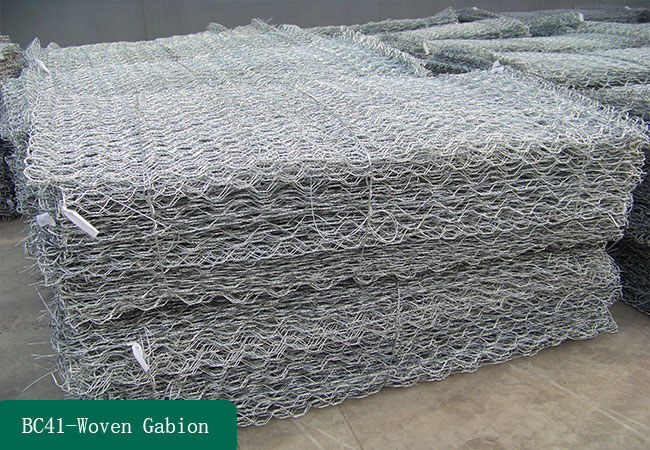
A woven gabion box is a three-dimensional container manufactured from steel wire woven into a double-twist hexagonal mesh pattern.
The mesh panels are assembled into a basket with a bottom, sides, ends and a lid. Internal diaphragms may be added to divide longer baskets into compartments.
After assembly, the box is filled with suitable stone or other approved material to form a protective structure.
A typical system may include:
- Double-twist hexagonal wire mesh
- Bottom, side and end panels
- Internal diaphragms
- Edge or selvedge wires
- Binding wire
- Connection spirals or approved fasteners
- Stone filling
- Foundation and drainage components where specified
The completed structure’s performance depends on the mesh specification, connections, stone grading, foundation, drainage and engineering design.
2. How Double-Twist Woven Mesh Works
Double-twist mesh is formed by twisting adjacent wire pairs together to create a continuous hexagonal pattern.
This construction allows a degree of local movement within the mesh. When the basket is correctly assembled and filled, the woven structure can accommodate some deformation without immediately losing its overall integrity.
This characteristic may be useful in projects where minor settlement or irregular terrain needs to be considered.
However, flexibility does not mean that the structure can withstand unlimited deformation. The basket geometry, wire specification, stone filling, foundation and hydraulic conditions must all be suitable for the project.
3. Typical Woven Gabion Box Specifications
Bendin can discuss customized configurations according to project drawings and manufacturing capabilities.
| Parameter | Typical Options |
|---|---|
| Product Type | Woven Gabion Box / Woven Gabion Basket |
| Mesh Structure | Double-Twist Hexagonal |
| Material | Low-Carbon Steel Wire |
| Mesh Opening | Common options include 60 × 80 mm, 80 × 100 mm and 100 × 120 mm, subject to specification |
| Wire Diameter | Project-specific |
| Box Length | Selected modular lengths, such as 2 m or 3 m, subject to availability |
| Box Width | Customized |
| Box Height | Customized |
| Internal Diaphragms | Optional according to basket dimensions and design |
| Surface Treatment | Galvanized / Galfan / PVC-Coated Options |
| Connections | Binding Wire / Spirals / Approved Fasteners |
| Filling Material | Suitable Natural Stone or Approved Aggregate |
| Packaging | Folded Mesh / Bundled Components / Project-Specific Packaging |
These are indicative options rather than a fixed specification for every product. Actual mesh openings, wire diameters, coating characteristics, box dimensions and connection details should be confirmed before ordering.
4. Main Advantages of Woven Gabion Boxes
Flexible Mesh Structure
The double-twist woven construction allows a degree of local movement within the mesh.
This can be useful where limited settlement or irregular ground conditions need to be considered.
Permeable Stone-Filled Construction
Water can move through the spaces between the stones, depending on the filling arrangement and site conditions.
This characteristic makes woven gabions suitable for selected erosion-control and water-management applications.
Modular Assembly
Woven mesh components can be folded for transportation and assembled into baskets on site.
The modular format can help simplify logistics and installation planning.
Adaptability to Terrain
Woven gabion structures can accommodate some local variation in ground level when properly designed.
The allowable deformation depends on the basket design, foundation conditions, connections and surrounding loads.
Natural Landscape Integration
Stone-filled gabions can blend into many outdoor environments, particularly when locally suitable stone is used.
Vegetation may establish around suitable structures under favorable environmental conditions, depending on the site and ecological management plan.
5. Material and Surface Treatment Options
Woven gabion boxes may be exposed to rain, soil moisture, freshwater, coastal conditions and other environmental factors. The appropriate wire and coating system should be selected according to the expected exposure and required maintenance conditions.
Galvanized Steel Wire
Galvanized wire uses a zinc coating to help protect the steel substrate against corrosion.
It is commonly considered for general outdoor gabion applications.
Galfan-Coated Steel Wire
Galfan is a zinc-aluminum alloy coating that may provide enhanced corrosion performance compared with conventional zinc coatings in suitable environments.
It can be considered for projects requiring additional corrosion protection.
PVC-Coated Wire
PVC coating adds a polymer layer over the underlying metallic coating.
It may be suitable for selected projects where additional surface protection or a particular appearance is required.
The compatibility of the coating with the underlying metal and intended environment should be confirmed.
Selecting the Right Coating
Coating selection should consider:
- Freshwater or coastal exposure
- Soil chemistry
- Expected service period
- Wire specification
- Applicable product standard
- Maintenance requirements
A specific service-life claim should only be published when supported by the relevant product specification and clearly defined environmental conditions.
6. Woven Gabion Box vs. Welded Gabion Box
Woven and welded gabion systems are both used for stone-filled engineering structures, but their construction and behavior differ.
| Feature | Woven Gabion Box | Welded Gabion Box |
|---|---|---|
| Manufacturing | Double-twist wire weaving | Resistance-welded panels |
| Mesh Pattern | Hexagonal | Usually square or rectangular |
| Structural Behavior | Flexible woven structure | More rigid panel structure |
| Local Deformation | Can accommodate some local movement | More limited at welded intersections |
| Assembly | Woven mesh folded and connected | Rigid panels connected into boxes |
| Appearance | Traditional woven texture | Regular geometric grid |
| Typical Applications | Riverbanks, erosion control and irregular terrain | Selected retaining structures, landscaping and erosion control |
| Main Selection Factor | Flexibility and deformation requirements | Defined geometry and panel rigidity |
Neither system is automatically better for every project. Selection should reflect the foundation conditions, expected movement, filling material, hydraulic loading and engineering requirements.
7. Woven Gabion Boxes for Riverbank Protection
Riverbanks may be exposed to changing water levels, current forces, surface erosion and localized scour.
Woven gabion structures can be considered where a flexible, stone-filled and permeable system is appropriate for protecting exposed soil and stabilizing the riverbank surface.
Potential benefits include:
- Protecting exposed soil from direct water action
- Providing a permeable stone-filled structure
- Accommodating a degree of local movement
- Supporting modular construction along the bank
- Integrating with selected landscape restoration measures
The project team should evaluate water velocity, flood levels, scour depth, foundation conditions, stone grading, toe protection and any filter or geotextile requirements.
Gabion boxes alone do not guarantee riverbank stability. The complete structure must be designed for the hydraulic and geotechnical conditions of the site.
8. Woven Gabion Boxes for Slope Stabilization
Slope-protection projects often need to manage surface runoff, soil erosion and localized ground movement.
Woven gabion boxes may be incorporated into suitable retaining or erosion-control systems.
Potential applications include:
- Roadside slopes
- Highway embankments
- Drainage channels
- Hillside developments
- Selected retaining structures
- Erosion-prone areas
Depending on the project, gabions may be combined with geotextiles, drainage layers, vegetation and engineered foundations.
The final design should account for soil properties, slope geometry, groundwater conditions, foundation stability and drainage.
9. Woven Gabion Boxes for Ecological Restoration
Gabions can be incorporated into ecological engineering projects when the structure and placement are compatible with the surrounding environment.
Potential considerations include:
- Local plant species
- Aquatic and terrestrial habitat requirements
- Seasonal water levels
- Sediment movement
- Stone type and grading
- Water quality
- Maintenance practices
The spaces between stones may provide habitat features for selected organisms, while the permeable construction allows water movement.
However, vegetation growth and improvements in biodiversity are not guaranteed by the gabion structure alone. These outcomes depend on the site, the design and the wider ecological management plan.
10. Stone Filling and Drainage Considerations
Stone filling is an essential part of a woven gabion box.
Suitable stone should have appropriate strength, durability and grading for the intended application.
Before selecting the filling material, consider:
- Particle-size distribution
- Material strength and durability
- Compatibility with the mesh opening
- Resistance to the expected environment
- Availability and transport costs
- Project-specific environmental requirements
For hydraulic structures, stone grading and basket design must be compatible with the expected water flow and potential scour conditions.
Drainage and filter requirements should be determined by the project design. A permeable gabion does not eliminate the need to evaluate soil migration, foundation drainage or potential scour.
11. Assembly and Installation Process
A typical woven gabion box installation includes the following steps.
Step 1: Prepare the Foundation
Prepare the foundation according to the engineering design. Install any specified filter layer or geotextile before placing the gabion.
Step 2: Unfold the Mesh
Lay out the bottom, side, end and diaphragm components on a suitable working surface.
Step 3: Assemble the Box
Connect the panels using the specified binding wire, spirals or approved fasteners.
Step 4: Install the Diaphragms
Fit internal diaphragms where required by the basket design.