



Workshop Isolation Fence for the USA and Germany: Specifications and Compliance Guide
Industrial workshops require effective separation between production lines, machinery, material-handling routes and pedestrian areas. A well-designed workshop isolation fence helps organize the workplace, restrict access to designated areas and support a safer, more efficient factory layout.
For international projects, selecting the right system involves more than choosing a mesh panel. Frame dimensions, mesh openings, mounting arrangements, surface treatment, access gates and applicable safety requirements must all be considered.
Bendin (Hebei Bendin Industrial Technology Co., Ltd.) supplies customizable metal fencing solutions for industrial and commercial applications. Depending on the selected design, workshop isolation systems may include welded wire mesh panels, steel tube frames, modular posts, access gates and galvanized or powder-coated finishes.
This guide explains how to select workshop isolation fencing for projects in the United States and Germany, which technical specifications to confirm, and what documentation buyers should review before ordering.
1. What Is a Workshop Isolation Fence?
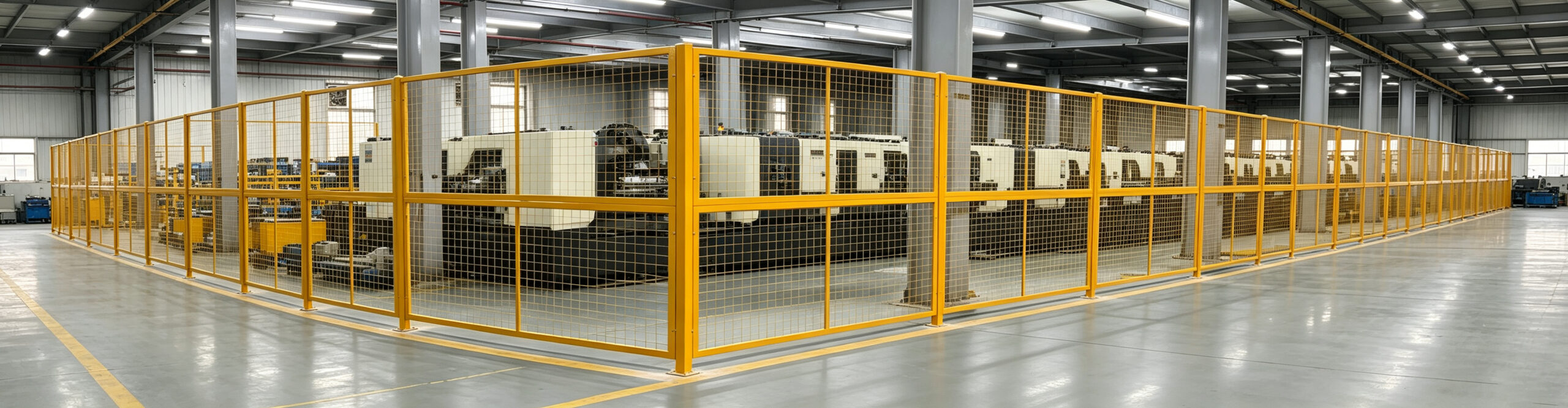
A workshop isolation fence is a modular metal partition used to separate functional areas inside a factory or industrial facility.
Typical applications include:
- Separating production lines and workstations
- Defining pedestrian and equipment operating zones
- Enclosing selected machinery and robotic work cells
- Dividing storage and material-handling areas
- Restricting access to designated work areas
- Supporting organized workshop layouts
A typical system may include welded mesh panels, steel tube frames, supporting posts, mounting brackets, fasteners and compatible access gates.
The required design depends on the intended function. A general workshop partition is not automatically equivalent to a machine guard designed to protect workers from specific machinery hazards.
2. Workshop Isolation Fence Specifications
Bendin can discuss customized configurations according to product design, manufacturing capabilities and project requirements.
| Parameter | Typical Options |
|---|---|
| Product Type | Workshop Isolation Fence |
| Panel Structure | Welded Steel Wire Mesh |
| Frame Material | Specified Steel Tube |
| Frame Profile | Square / Rectangular, where available |
| Panel Height | Project-specific; 1–3 m may be considered for selected designs |
| Panel Width | Customized according to the layout |
| Mesh Opening | Selected options may include 50 × 50 mm to 100 × 100 mm |
| Wire Diameter | Confirmed according to the selected product |
| Frame Tube Dimensions | Product-specific |
| Surface Treatment | Galvanized / Powder Coated / Other Specified Finish |
| Color | Selected RAL reference, where available |
| Mounting | Compatible Floor-Fixed or Other Approved Arrangement |
| Access Gates | Compatible Gate Designs, where available |
| Customization | Panel / Mesh / Frame / Color / Accessories |
These are indicative configuration options, not guaranteed specifications for every model. Actual mesh opening, wire diameter, tube dimensions, wall thickness, panel size and mounting details should be confirmed in the approved technical drawing.
Mesh Opening and Wire Diameter
Mesh opening affects visibility and the size of openings within the partition. Wire diameter influences material usage and panel rigidity.
The appropriate combination depends on the intended separation function and any applicable safety requirements.
Frame and Post Dimensions
Frame tube dimensions and wall thickness should be specified for the selected panel design.
A thicker tube does not automatically guarantee a stronger complete system. Panel geometry, weld quality, connectors, posts and the floor mounting arrangement also affect performance.
Modular Panel Design
Modular panels may be suitable where a workshop layout needs to change over time.
Confirm whether panels can be removed individually, whether connectors are reusable and whether replacement sections will remain compatible with the original system.
3. Materials and Corrosion Protection
Workshop environments vary considerably. Some production areas are dry and clean, while others experience humidity, dust, oil deposits, cleaning agents or chemical exposure.
The appropriate material and surface treatment depend on the base material, manufacturing process and operating environment.
Galvanized Steel
Galvanized steel has a zinc coating that helps protect the underlying steel against corrosion.
The coating specification should be confirmed for the selected product and intended environment.
Powder-Coated Finish
Powder coating provides a decorative finish and an additional protective layer when applied over an appropriately prepared substrate.
It can also help distinguish workshop zones through coordinated colors, subject to the available finish options.
Galvanizing Plus Powder Coating
A compatible galvanized substrate combined with powder coating may be suitable where both corrosion protection and appearance are important.
The manufacturing sequence should be confirmed because cutting, welding and other processing operations can affect protective coatings.
Choosing a Finish for the Workshop
| Environment | Main Considerations |
|---|---|
| Dry Assembly Workshop | Panel construction, finish and ease of cleaning |
| Humid Production Area | Corrosion protection and moisture exposure |
| Dusty Workshop | Cleaning access and coating durability |
| Oil-Exposed Area | Compatibility with the actual oil or cleaning agents |
| Chemical Processing Area | Specific chemical compatibility and maintenance requirements |
Do not assume that every powder coating is oil-resistant or suitable for chemical exposure. Where these properties matter, confirm the coating specification and supporting compatibility data.
4. Workshop Isolation Fence Applications
Production Line Separation
Workshop isolation fencing can separate production areas, assembly stations and material-handling zones.
The panel layout should maintain suitable access for operators and maintenance personnel.
Robotic Work Cells
Fences may be used around selected robotic work cells as part of a machine safeguarding system.
Where the fence is intended to prevent access to hazardous machinery, the design must follow the applicable machinery risk assessment and safety requirements. Gate interlocks or other safety devices may be required depending on the machine and its risk assessment.
Warehouse and Storage Areas
Industrial partitions can help separate storage areas from production routes and designated pedestrian zones.
Panel height, mesh opening, gate locations and mounting arrangements should match the operational layout.
Equipment and Maintenance Areas
Fencing can define areas containing selected equipment, maintenance workstations or restricted-access machinery.
Access openings should be planned around the equipment that needs to be inspected, serviced or replaced.
5. Compliance Considerations for the United States
For US projects, the relevant requirements depend on whether the fence is a general workshop partition, part of a machine guard, or a component of a more specialized safety system.
OSHA Machine Guarding Requirements
For workplace machinery, OSHA 29 CFR 1910.212 addresses general requirements for machine guarding, including protection against hazards such as points of operation, ingoing nip points, rotating parts, flying chips and sparks. It also requires guards not to create an accident hazard themselves. See the official OSHA machine guarding requirements. <Cite refs={[“turn329401search0”]}/>
A workshop fence intended to serve as a machine guard should therefore be assessed in relation to the actual machinery hazards, access points and required protective functions.
Product Specification and Documentation
Before ordering, US buyers should confirm:
- Intended use of the fence
- Required panel height and mesh opening
- Frame and post dimensions
- Mounting and anchoring requirements
- Gate and access-control requirements
- Applicable machinery or workplace safety requirements
- Product drawings and relevant inspection records
Not every workshop partition needs the same documentation. Requirements should be established according to the product’s function and the project specification.
ASTM Standards
ASTM standards apply to specific technical scopes. For example, ASTM F2611-23 is a guide for the design and construction of chain-link security fencing; it should not automatically be cited as the governing standard for a welded-mesh workshop isolation fence. See the ASTM F2611-23 scope. <Cite refs={[“turn329401search7”]}/>
The applicable standard should be identified for the actual product and intended use rather than listed as a general marketing claim.
6. Compliance Considerations for Germany
For Germany, the applicable requirements depend on the product’s intended function and whether it forms part of machinery, a building-related construction product or a general industrial partition.
Machinery Guard Design
Where a workshop fence functions as a machine guard, EN ISO 14120 may be relevant to the design and construction of fixed and movable guards. It addresses general guard requirements, while interlocking devices are covered separately by EN ISO 14119. See the official ISO 14120 standard overview. <Cite refs={[“turn329401search6”]}/>
The exact standard and edition should be confirmed for the project and applicable legal framework.
CE Marking and Product Scope
CE marking is not a generic quality certificate for every metal fence. The European Commission explains that manufacturers must identify the applicable EU legislation, assess the product’s conformity, prepare the required technical documentation and issue the relevant declaration when CE marking is required. See the European Commission guidance for manufacturers. <Cite refs={[“turn329401search12”]}/>
Therefore, a workshop isolation fence should not be advertised as “CE-certified” unless the specific product and applicable legal requirements support that claim.
Other Standards and Regulations
EN 1090-2, the Construction Products Regulation and RoHS have specific scopes and should not automatically be applied to every workshop isolation fence.
Before specifying them, confirm whether they are relevant to the product’s intended use, construction and materials. Where a customer requires a particular standard, the manufacturer and buyer should agree on the applicable scope and supporting documentation before production.
7. USA and Germany: Practical Procurement Checklist
Buyers in both markets can use the following checklist to establish a clear product specification.
| Item | What to Confirm |
|---|---|
| Intended Use | General partition / Machine guard / Restricted-access enclosure |
| Panel Dimensions | Height, width and relevant tolerances |
| Mesh Opening | Required opening size for the intended function |
| Wire Diameter | Confirmed product specification |
| Frame and Posts | Profile, section dimensions and wall thickness |
| Surface Treatment | Galvanized / Powder Coated / Other Specified Finish |
| Mounting | Floor fixing, base plates or another approved arrangement |
| Access Gates | Dimensions, opening direction and required safety devices |
| Risk Assessment | Required where the fence protects against machinery hazards |
| Applicable Standards | Identified for the actual product and intended use |
| Documentation | Drawings, material data, inspection records and applicable conformity documents |
| Packaging | Export packing and product identification |
| Delivery | Agreed production schedule, shipping terms and destination |
This checklist helps prevent a general-purpose fence from being ordered for an application requiring a more specialized safety design.
8. Installation and Layout Planning
Correct installation helps maintain panel alignment and the intended separation function.
Step 1: Review the Workshop Layout
Identify machinery, pedestrian routes, storage areas, access points and maintenance requirements.
Step 2: Confirm the Panel Specification
Verify panel dimensions, mesh opening, wire diameter, frame dimensions and surface treatment against the approved drawings.
Step 3: Determine the Mounting Method
Floor fixing, base plates or other mounting arrangements should be selected according to the product design, floor structure and expected loads.
Check the floor and identify embedded utilities before drilling.
Step 4: Install Posts and Panels
Position the posts and assemble the panels using compatible brackets and fasteners.
Check alignment and ensure that connections are installed according to the manufacturer’s instructions.
Step 5: Install Access Gates
Confirm gate opening dimensions, swing direction, latches and any required safety equipment.
For machinery safeguarding applications, verify that the completed gate and interlock arrangement meets the approved safety design.
Step 6: Inspect the Completed System
Check panel stability, fasteners, exposed edges, surface condition, gate operation and access clearances before the area is returned to use.
9. Quality Control and Product Inspection
A suitable inspection plan should cover the panel, frame, posts, connectors and surface treatment.
Dimensional Inspection
Check panel height and width, mesh opening, frame dimensions and relevant tolerances.
Weld Inspection
Inspect welded joints according to the agreed method and acceptance criteria.
Visual appearance alone does not establish a particular load capacity or safety rating.
Surface Inspection
Check coating consistency and visible defects. Where specified, verify coating measurements or other relevant test results.
Assembly Compatibility
Confirm that panels, posts, connectors and gates match the approved drawings.
Documentation
Depending on the project, buyers may request product drawings, material specifications, inspection records and applicable test reports.
Any certification or compliance claim should identify the applicable product, scope and supporting documentation.
10. Illustrative Project Example: Automated Assembly Workshop
A manufacturing facility plans to separate an automated assembly line from adjacent pedestrian and material-handling areas.
The project team considers modular welded mesh panels, steel tube frames and compatible access gates.
Preliminary Configuration
| Item | Example Requirement |
|---|---|
| Application | Automated Assembly Workshop |
| Fence Type | Modular Workshop Isolation Fence |
| Panel Height | Confirmed according to layout and safety requirements |
| Panel Width | Selected according to equipment positions |
| Mesh Opening | Confirmed according to the intended separation function |
| Frame | Specified Steel Tube |
| Surface Treatment | Suitable for the workshop environment |
| Mounting | Approved Floor-Fixed Arrangement |
| Access Gates | Positioned for operation and maintenance |
| Compliance Review | According to intended use and applicable requirements |
| Inspection | Dimensions, Connections, Stability, Coating and Gate Operation |
The final configuration should be confirmed against the workshop layout, equipment requirements, mounting conditions and applicable safety specifications.
This is an illustrative project scenario, not a completed Bendin customer installation.
11. Bendin Workshop Isolation Fence Solutions
Bendin supplies customizable metal fencing products for industrial and commercial applications.
Depending on product design and manufacturing capabilities, workshop isolation configurations may include:
- Welded mesh panels
- Square or rectangular steel tube frames
- Compatible posts and mounting brackets
- Galvanized or powder-coated finishes
- Selected RAL color options
- Access gates and compatible accessories
- Customized panel dimensions
- Packaging and OEM requirements
Customers can provide workshop layout drawings, equipment dimensions, access requirements, environmental conditions and technical specifications for review before ordering.
For projects in the United States or Germany, specify the intended function and any customer-required standards at the quotation stage. This allows the proposed configuration and supporting documentation to be reviewed before production begins.
12. Frequently Asked Questions
Can one workshop isolation fence design be used in both the USA and Germany?
A common physical design may be considered for both markets, but the applicable requirements and documentation must be checked separately for each intended use and project.
Does OSHA 1910 apply to every workshop partition?
OSHA 1910 contains US general-industry workplace requirements. The specific provisions relevant to a fence depend on its function, especially whether it serves as a machine guard.
Does every workshop isolation fence need CE marking in Germany?
Not automatically. CE marking depends on the applicable EU product legislation and the product’s intended function. The requirements should be determined for the specific product.
Is ASTM F2611 the correct standard for workshop isolation fences?
Not necessarily. ASTM F2611-23 concerns chain-link security fencing. It should not automatically be used as the governing standard for a welded-mesh machine guard or general workshop partition. <Cite refs={[“turn329401search7”]}/>
Can panel dimensions and mesh openings be customized?
Customization can be discussed according to product design and manufacturing capabilities. Confirm the dimensions, wire specification, frame design and intended application before ordering.
What documents should be requested before production?
Request the approved product drawings, material and coating specifications, relevant inspection records, and any applicable conformity or test documents required by the project.
13. Request a Workshop Isolation Fence Quotation
Workshop isolation fencing helps organize industrial spaces and define designated areas. The appropriate system depends on panel dimensions, mesh opening, frame structure, mounting method, environmental conditions and intended safety function.
Bendin (Hebei Bendin Industrial Technology Co., Ltd.) supplies customizable metal fencing products for international distributors, contractors and industrial project owners.
For a quotation, provide:
- Project country and intended application
- Workshop layout or reference drawings
- Required panel height and width
- Mesh opening and wire diameter
- Frame and post specifications
- Surface treatment and color
- Mounting method
- Gate and access requirements
- Applicable project specifications
- Quantity and delivery destination
Bendin can review your requirements and discuss a suitable workshop isolation fence configuration for your project.