



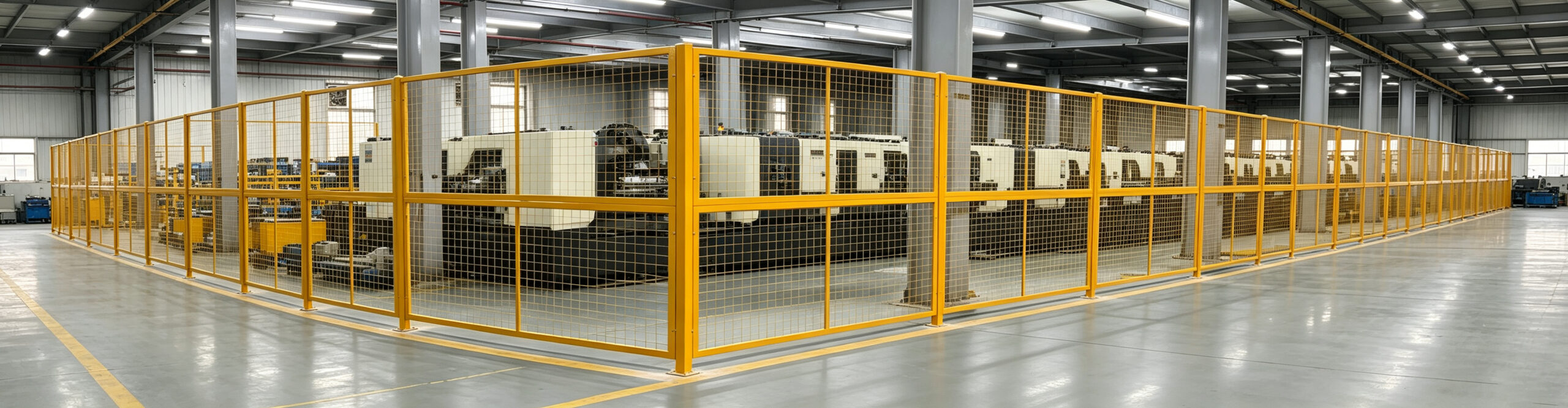
Workshop Isolation Fence for Safe and Flexible Factory Zoning
Modern factories need more than production equipment to operate efficiently. Clearly separating production lines, machinery, warehouses, pedestrian areas and restricted zones is also an important part of workshop organization and safety management.
A workshop isolation fence provides a practical physical barrier for dividing different functional areas inside factories and industrial facilities. Compared with permanent walls, modular steel fencing maintains visibility while allowing production layouts to be adjusted when equipment or workflows change.
Bendin provides customizable workshop isolation fencing for factories, warehouses, automated production lines and machinery areas. Available configurations can be adapted according to required fence height, mesh spacing, panel structure, access points and workshop layout.
What Is a Workshop Isolation Fence?
A workshop isolation fence is a modular industrial partition system designed to separate people, machinery, materials and different operating areas within a factory or warehouse.
A typical system consists of:
- Welded wire mesh panels
- Reinforced steel frames
- Steel posts
- Floor fixing components
- Panel connectors
- Bolts and brackets
- Swing or sliding access doors
- Customized corner sections
- Optional solid or perforated panels
Unlike masonry walls or permanently welded partitions, modular workshop fencing can be installed, removed or reconfigured according to changes in the production layout.
This makes it particularly useful for modern factories where production lines and equipment arrangements may change over time.
Why Use Isolation Fencing in a Workshop?
Factories often contain multiple activities within the same building.
Workers, forklifts, machines, materials and automated equipment may all operate close to one another. Without clearly defined boundaries, workshop management can become more difficult and unnecessary access to equipment areas may occur.
Workshop isolation fencing can help create clearly separated zones for:
- Production equipment
- Automated machinery
- Material storage
- Restricted areas
- Warehouse sections
- Maintenance areas
- Production lines
- Pedestrian routes
The purpose is not simply to install a physical fence. A well-planned partition system can also make the factory layout easier to understand and manage.
Key Features of Bendin Workshop Isolation Fence
1. Heavy-Duty Steel Construction
Industrial environments require fencing that can withstand everyday use.
Bendin workshop isolation fencing uses steel mesh, reinforced frames and posts to provide a stable partition structure for industrial applications.
The panel configuration can be selected according to the intended application and required level of separation.
2. Reinforced Welded Mesh
Welded wire mesh provides a combination of structural stability and open visibility.
Wire intersections are welded to create a rigid mesh panel, while the surrounding steel frame provides additional reinforcement.
This construction makes the fencing suitable for long-term use in busy factory environments.
3. Clear Visibility Across the Workshop
One important advantage of mesh workshop partitions is visibility.
Unlike solid walls, open mesh allows supervisors and workers to observe equipment and activity on the opposite side of the barrier.
This is particularly useful for:
- Production monitoring
- Equipment inspection
- Workshop supervision
- Material management
- Automated production areas
Where greater physical separation is required, mesh panels can also be combined with solid or perforated sections.
4. Reinforced Steel Frame
The outer steel frame provides additional structural support for each panel.
For workshops where carts, tools, materials or equipment may accidentally contact the partition, a reinforced frame helps improve the overall stability of the fencing system.
The appropriate frame and post specification should be selected according to the actual factory environment.
5. Corrosion-Resistant Surface Treatment
Factory environments can contain humidity, dust, oil mist and other contaminants.
Surface protection therefore plays an important role in maintaining the appearance and condition of steel partitions.
Depending on project requirements, Bendin can provide galvanized and powder-coated surface options to improve corrosion resistance and create a clean industrial finish.
6. Smooth and Finished Edges
Industrial partitions are often installed close to working areas and pedestrian routes.
Panels, frames and connection components should therefore be properly finished to minimize exposed sharp edges or burrs.
Attention to edge treatment also helps provide a cleaner overall appearance for the installed fencing system.
Modular Design for Flexible Factory Layouts
One of the biggest advantages of workshop isolation fencing is its modular structure.
Modern factories frequently change production layouts because of:
- New machinery
- Production line expansion
- Automation upgrades
- Warehouse reorganization
- New products
- Capacity expansion
- Process optimization
Permanent walls are difficult and expensive to relocate.
A modular workshop fence system can be easier to modify because individual panels, posts and doors can be removed, added or repositioned according to the new layout.
This makes modular fencing particularly suitable for factories that expect future production changes.
Main Applications of Workshop Isolation Fence
Production Line Separation
Different production lines can be divided into clearly defined operating areas.
This helps organize the workshop and can reduce unnecessary movement between production zones.
Machine Area Isolation
Workshop fencing can be installed around machinery to create a physical boundary between equipment areas and general working spaces.
For machinery with specific hazards, the final guarding design should be determined according to the machine risk assessment and applicable safety requirements.
Automated Equipment Areas
Automated production systems and robotic equipment often require controlled operating zones.
Mesh partitions can provide physical separation while maintaining visibility for production monitoring.
Warehouse Partitioning
Large warehouses often need to divide space according to products, materials or access permissions.
Workshop isolation fencing can create:
- Material storage zones
- Finished goods areas
- Restricted storage
- Tool storage areas
- Spare parts sections
- High-value goods zones
Unlike permanent walls, mesh partitions allow warehouse staff to see inventory through the barrier.
Factory Zoning
Large manufacturing facilities can use isolation fencing to divide the workshop into functional zones.
For example:
Raw Materials → Processing → Assembly → Inspection → Finished Goods → Storage
Clearly defined physical zones can make internal workflow and space management more organized.
Maintenance and Restricted Areas
Maintenance rooms, electrical equipment zones and other restricted areas can also use fencing to limit casual access while maintaining visibility.
Different Workshop Isolation Fence Configurations
Different industrial processes require different partition structures.
Bendin can provide several configurations according to project requirements.
Full-Mesh Isolation Fence
Full welded mesh panels provide maximum visibility and ventilation.
They are suitable for general workshop zoning, warehouse partitions, production-line separation and equipment areas where visual monitoring is important.
Mesh + Solid Panel Fence
This configuration combines an open mesh upper section with a solid lower section.
The lower panel provides additional separation close to floor level, while the upper mesh maintains visibility.
It can be considered for areas involving debris, materials or equipment movement.
Perforated Panel Isolation Fence
Perforated steel panels provide more coverage than open mesh while retaining some ventilation and visibility.
They can be used where a project requires greater separation between work areas.
Full Solid Panel Partition
For areas requiring greater visual separation, solid steel panels can also be incorporated into the partition system according to project requirements.
Custom Workshop Isolation Fence Solutions
Factory layouts vary considerably, so a standard fence specification cannot meet every project.
Bendin supports customized workshop isolation fencing according to drawings, site dimensions and project requirements.
| Component | Custom Options |
|---|---|
| Fence Height | According to project layout |
| Panel Width | Standard or customized |
| Mesh Spacing | Multiple options |
| Wire Diameter | According to specification |
| Frame Size | Multiple configurations |
| Panel Type | Mesh / solid / perforated / combined |
| Post Type | According to layout |
| Door Type | Swing / sliding / customized |
| Surface Finish | Galvanized / powder coated |
| Color | Custom RAL colors |
For larger projects, customers can provide factory layout drawings so that panel quantities, corner positions and access doors can be planned according to the actual installation area.
How to Choose a Workshop Isolation Fence
Before requesting a quotation, buyers should consider several important factors.
Determine the Purpose of the Fence
First identify what needs to be separated.
Is the fence intended for:
- General workshop zoning?
- Machinery isolation?
- Warehouse partitioning?
- Automated equipment?
- Restricted storage?
- Production-line separation?
Different purposes may require different panel structures.
Measure the Installation Area
Provide the total fence length and required height.
A factory layout drawing is particularly useful for projects containing multiple corners, doors or separate fenced areas.
Select the Appropriate Panel Type
Full mesh provides excellent visibility, while solid and perforated panels provide greater physical separation.
Different panel types can also be combined within the same project.
Plan Access Doors
Consider how workers, materials and equipment will enter and exit each isolated area.
Depending on the application, the layout may require:
- Single pedestrian doors
- Double swing doors
- Sliding doors
- Wider equipment access openings
Door positions should be planned before production whenever possible.
Consider Future Layout Changes
If machinery or production lines are likely to change, a modular design can make future reconfiguration easier.
This should be considered when planning panel dimensions and connection methods.
Workshop Isolation Fence vs Permanent Wall
For many factory zoning applications, buyers compare steel partition fencing with traditional walls.
| Factor | Workshop Isolation Fence | Permanent Wall |
|---|---|---|
| Visibility | High with mesh panels | Low |
| Ventilation | Good | Limited |
| Installation | Modular | Construction required |
| Reconfiguration | Easier | Difficult |
| Expansion | Panels can be added | Structural work required |
| Equipment Monitoring | Convenient | Limited |
| Factory Layout Changes | Flexible | Less flexible |
Permanent walls remain appropriate for applications requiring complete enclosure, acoustic separation or other building-specific functions.
However, where the main goal is industrial zoning and physical separation, modular fencing provides greater flexibility.
Low-Maintenance Industrial Partition Solution
Workshop isolation fencing is designed for long-term industrial use with relatively straightforward maintenance.
Routine inspection can include:
- Checking panel connections
- Tightening loose fasteners
- Inspecting floor anchors
- Checking door operation
- Inspecting coating damage
- Removing accumulated dust or contaminants
If an individual panel becomes damaged, modular construction may allow the affected section to be replaced without removing the entire partition system.
Why Choose Bendin Workshop Isolation Fence?
Bendin provides industrial fencing solutions for factory and warehouse projects.
Our workshop isolation fence systems can be configured according to different production layouts and project requirements.
We support:
- Full-mesh panels
- Mesh and solid combinations
- Perforated panels
- Customized dimensions
- Different mesh openings
- Reinforced steel frames
- Custom RAL colors
- Matching posts and accessories
- Swing and sliding doors
- OEM and ODM production
- Project drawing review
- Export packaging
Our goal is to provide a coordinated partition system rather than simply supplying individual mesh panels.
Information Needed for a Workshop Fence Quote
To prepare an accurate quotation, provide the following information where possible:
- Total fence length
- Required fence height
- Preferred panel type
- Mesh size
- Required color
- Number of corners
- Door quantity
- Door dimensions
- Installation environment
- Factory layout drawing
- Required quantity
- Destination country or port
If detailed specifications are not yet available, a preliminary factory layout can be used as the starting point for discussion.
FAQ About Workshop Isolation Fence
What is a workshop isolation fence used for?
It is used to divide different areas inside factories and warehouses, including production lines, machinery areas, storage zones and restricted spaces.
Can workshop isolation fencing be customized?
Yes. Bendin can customize fence height, panel dimensions, mesh opening, frame structure, surface color, doors and other components according to project requirements.
Can the fence be relocated when the production line changes?
Modular fencing is generally easier to reconfigure than permanent walls. Panels, posts and doors can potentially be relocated or expanded when factory layouts change.
Can Bendin provide doors with the partition fence?
Yes. Matching access doors can be included according to the required layout and dimensions.
Which type is better: full mesh or mesh with solid panels?
It depends on the application. Full mesh provides better visibility and ventilation, while combined panels provide greater separation in the lower section. The correct configuration should be selected according to the production environment.
Can workshop fencing be used around machinery?
Yes, workshop fencing can be used to create physical separation around machinery. However, when it forms part of a machine-guarding safety system, the layout, openings, distances and access controls should be determined according to the equipment risk assessment and applicable safety requirements.
Create a Safer and More Organized Factory Layout
A well-planned workshop isolation fence can help factories divide production areas, control access, improve visibility and adapt more easily to changing production layouts.
For manufacturers, warehouses and industrial facilities, modular fencing provides a practical alternative to permanent partitions when flexibility and visibility are important.
Send Bendin your factory layout, required dimensions, panel type and access requirements. We can provide a customized workshop isolation fencing configuration and quotation based on your project needs.