


Welded Gabion Mesh: Structure, Specifications, Applications and Project Guide
Welded gabion mesh is a modular wire mesh system designed to form rigid gabion baskets that can be filled with natural stone, crushed rock, recycled concrete, or other suitable materials. Unlike traditional woven gabion mesh, welded gabion panels are manufactured by welding straight steel wires at predetermined intersections, creating a more uniform and dimensionally stable structure.
For riverbank protection, slope stabilization, drainage structures, retaining applications, landscaping, and erosion-control projects, the choice between welded and woven gabion systems depends on terrain, hydraulic conditions, structural requirements, installation methods, and project design.
Bendin, a professional wire mesh and fencing manufacturer based in Anping, Hebei, China, supplies welded gabion mesh systems with customized mesh dimensions, wire diameters, panel sizes, coatings, and basket configurations for international engineering projects.
This guide explains the structure, available specifications, surface treatments, installation considerations, and typical applications of welded gabion mesh to help contractors, distributors, engineers, and project owners select a suitable system.
What Is Welded Gabion Mesh?
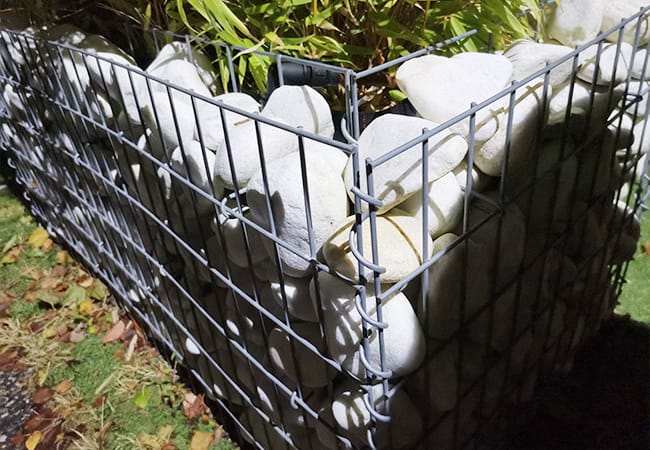
Welded gabion mesh is manufactured from longitudinal and transverse steel wires that are resistance-welded together to create rigid rectangular or square mesh panels.
Several panels can then be assembled into three-dimensional gabion baskets or mattresses using spiral wires, binding wire, C-rings, clips, or other approved connection systems.
Once assembled, the baskets are filled with appropriately graded stones. The resulting structure combines the mechanical characteristics of a steel mesh cage with the mass and drainage properties of the stone filling.
The open mesh structure allows water to pass through the gabion body rather than creating a completely impermeable barrier. This characteristic makes gabion structures particularly useful for erosion control, drainage and landscape applications where controlled water movement is required.
Welded Gabion Mesh vs. Woven Gabion Mesh
The two systems serve similar purposes but have different structural characteristics.
| Feature | Welded Gabion Mesh | Woven Gabion Mesh |
|---|---|---|
| Manufacturing | Resistance welded | Mechanically woven |
| Mesh appearance | Uniform and rigid | Flexible and interlocked |
| Panel shape retention | Excellent | More flexible |
| Installation | Modular panel assembly | Roll/fold assembly |
| Dimensional accuracy | High | Relatively flexible |
| Terrain adaptability | Good with proper foundation | Excellent on irregular terrain |
| Typical use | Retaining, riverbank, landscaping, engineered structures | Erosion control, slope protection, flexible structures |
| Visual appearance | Clean and geometric | Traditional gabion appearance |
For projects where consistent dimensions, clean geometry and fast panel assembly are important, welded gabion mesh can provide significant installation advantages.
Bendin Welded Gabion Mesh Manufacturing
Bendin manufactures welded gabion mesh using automated welding and wire-processing equipment designed to maintain consistent mesh openings and panel dimensions.
The manufacturing process generally includes:
- Steel wire preparation
- Wire straightening and cutting
- Automated resistance welding
- Panel dimensional inspection
- Surface treatment
- Cutting and forming
- Basket or panel assembly
- Final quality inspection
- Packaging for export
The welding process creates fixed intersections between the longitudinal and transverse wires. This provides the panel with a rigid geometric structure and helps maintain its shape during handling and assembly.
For large engineering projects, production consistency is particularly important because differences in mesh dimensions or panel size can make on-site assembly more difficult.
Bendin is located in Anping, Hebei, widely known as China’s “Hometown of Wire Mesh.” The company’s manufacturing operations cover welded fencing, gabion products, industrial fencing and other metal mesh systems.
Welded Gabion Mesh Specifications
The exact specification should be selected according to the structural design, filling material, environmental conditions and project requirements.
Typical options include:
| Parameter | Typical Options |
|---|---|
| Mesh opening | 50 × 50 mm, 75 × 75 mm, 100 × 100 mm |
| Wire diameter | Approx. 3.0–6.0 mm |
| Panel length | Customized according to basket design |
| Panel width | Customized |
| Basket height | Customized |
| Material | Low-carbon steel wire |
| Surface treatment | Galvanized, Galfan, PVC coated |
| Connection | Spiral wire, binding wire, clips or C-rings |
| Filling material | Natural stone, crushed rock or suitable recycled aggregate |
| Color | Metallic galvanized, PVC-coated colors where required |
The values above represent commonly available configurations rather than a fixed product specification. Final dimensions should be confirmed against the project drawings and structural requirements.
Mesh Size Selection
Mesh size affects both the visual appearance of the gabion and the retention of the filling material.
Smaller openings are generally preferable when the project requires better control of smaller stone sizes. Larger openings can reduce mesh weight and may be suitable when larger, well-graded stones are available.
A practical selection should consider:
- Stone diameter
- Hydraulic flow conditions
- Expected erosion forces
- Basket dimensions
- Required structural weight
- Installation equipment
- Local engineering requirements
The mesh opening should not be selected solely according to price. If the opening is too large for the selected filling material, stones may move through or become difficult to retain.
Wire and Surface Treatment Options
The steel wire used for welded gabion mesh must provide sufficient mechanical performance while also resisting the environmental conditions of the installation site.
Bendin can supply different surface-treatment configurations according to project requirements.
Galvanized Welded Gabion Mesh
Galvanized wire provides a zinc protective layer around the steel substrate. It is commonly used for outdoor applications where resistance to atmospheric moisture is required.
It can be suitable for:
- Landscaping
- General retaining structures
- Drainage projects
- Riverbank applications
- Roadside erosion control
Galfan-Coated Welded Gabion Mesh
Galfan is a zinc-aluminum coating system designed to provide enhanced corrosion protection compared with conventional zinc coatings in many outdoor environments.
It can be considered for projects exposed to:
- High humidity
- Frequent rainfall
- Coastal conditions
- Industrial atmospheric exposure
- Long-term outdoor service
The appropriate coating should be determined according to the actual environmental exposure and project specification.
PVC-Coated Welded Gabion Mesh
PVC coating adds an additional polymer protective layer over the metallic coating.
This configuration can be useful when both corrosion protection and visual appearance are important.
PVC-coated systems are commonly considered for:
- Landscape projects
- Urban riverbanks
- Parks
- Residential developments
- Decorative retaining structures
Color selection can also be coordinated with the surrounding landscape.
Why Choose Welded Gabion Mesh?
1. Rigid and Uniform Structure
The welded intersections create a fixed panel geometry. This helps the baskets maintain their shape during transportation, assembly and filling.
For projects using repeated basket dimensions, consistent panel geometry can simplify installation and improve the visual uniformity of completed structures.
2. Efficient Assembly
Welded gabion panels are supplied as relatively rigid components rather than flexible rolls.
A typical installation sequence includes:
- Prepare and level the foundation.
- Position the bottom panel.
- Connect side, end and partition panels.
- Secure the basket connections.
- Install internal reinforcement where required.
- Place stone filling progressively.
- Close and secure the top panel.
This modular process can reduce the amount of mesh forming required on site.
3. Excellent Drainage
The spaces between the stone filling allow water to move through the structure.
This makes gabion systems different from solid concrete retaining elements. Proper drainage can reduce water pressure behind certain retaining structures, although project-specific hydraulic and geotechnical design remains essential.
4. Natural Appearance
After installation, the visible surface is primarily formed by natural stone rather than exposed steel.
This allows gabion structures to integrate naturally into:
- River landscapes
- Parks
- Roadsides
- Hillside developments
- Residential landscaping
- Ecological restoration projects
Vegetation can also establish around or between suitable gabion structures where environmental conditions allow.
Typical Applications of Welded Gabion Mesh
Riverbank and Channel Protection
Gabion baskets can be used along riverbanks and drainage channels to help control soil erosion and stabilize vulnerable areas.
The permeable structure allows water movement while the stone-filled cages provide mass and surface protection.
For high-flow waterways, engineers should determine basket dimensions, stone grading, foundation requirements and anchoring according to hydraulic calculations.
Slope Stabilization
Welded gabion structures can be incorporated into retaining and slope-protection systems.
They can help:
- Retain soil
- Reduce surface erosion
- Stabilize localized slopes
- Control runoff
- Create terraced landscape structures
The gabion itself should not be treated as a substitute for geotechnical design. Foundation conditions, drainage, soil pressure and slope stability must be evaluated for each project.
Road and Highway Protection
Gabion systems can be used around road construction projects for:
- Embankment protection
- Drainage channels
- Culvert outlets
- Slope protection
- Roadside retaining structures
The modular construction also makes them suitable for projects where construction access is limited.
Landscape and Architectural Projects
Because the final structure has a natural stone appearance, welded gabion mesh is increasingly used in landscape architecture.
Typical applications include:
- Garden retaining walls
- Decorative walls
- Park boundaries
- Seating structures
- Planters
- Feature walls
- Landscape terraces
In these applications, stone color and size can be selected as part of the overall design concept.
Project Example 1: Riverbank Erosion-Control Application
A riverbank protection project required a permeable protective structure capable of following an existing river edge while maintaining a natural appearance.
The project team selected welded gabion baskets because the modular panels could be assembled into repeated units and filled with locally available stone.
The installation process included foundation preparation, basket assembly, staged stone filling and top closure.
The key project considerations were:
- Consistent basket dimensions
- Appropriate stone grading
- Corrosion-resistant mesh
- Stable foundation preparation
- Controlled drainage
- Easy transportation to the riverbank
The final structure provided a combination of erosion protection, drainage and landscape integration.
Important: project performance depends on site conditions and engineering design; the above example illustrates a typical application configuration rather than a universal performance guarantee.
Project Example 2: Highway Slope Protection
For a roadside slope project, the main requirement was to create a stable retaining and erosion-control structure without introducing a visually heavy concrete wall.
A welded gabion system was selected because the stone-filled structure could provide both functional support and a natural appearance.
The project design focused on:
- Slope geometry
- Foundation bearing conditions
- Drainage
- Basket dimensions
- Stone filling
- Corrosion protection
The modular construction also allowed individual sections to be assembled progressively as the road construction advanced.
How to Select the Right Welded Gabion Mesh
Before ordering a welded gabion system, project owners and contractors should confirm several key parameters.
1. What will the gabion be used for?
River protection, retaining structures, slope stabilization and landscaping can require different configurations.
2. What type of stone is available?
The stone size directly influences the appropriate mesh opening.
3. What is the environmental exposure?
Coastal, humid, industrial and freshwater environments can require different corrosion-protection strategies.
4. What are the foundation conditions?
A strong mesh basket cannot compensate for an unstable foundation.
5. How will the baskets be transported?
Panel dimensions should be considered in relation to container loading, site access and handling equipment.
6. Does the project require engineering drawings?
For retaining walls, river structures and other load-bearing applications, Bendin can work from project drawings and technical requirements to develop a suitable manufacturing configuration.
Bendin Customization Services
Bendin supports customized welded gabion mesh production for distributors, contractors and engineering projects.
Customization can include:
- Mesh opening
- Wire diameter
- Panel dimensions
- Basket dimensions
- Partition configuration
- Connection method
- Surface treatment
- PVC coating color
- Packaging method
- Private-label/OEM requirements
For large projects, customers can provide drawings, bill-of-materials documents or project specifications so the manufacturing team can evaluate the required configuration.
This approach is particularly useful when standard catalog dimensions do not match the project’s engineering design.
Packaging and International Delivery
Welded gabion panels are designed for efficient transportation.
Depending on the product configuration, panels and accessories can be bundled, palletized or packaged according to container-loading requirements.
For international orders, packaging should protect:
- Panel edges
- Coated surfaces
- Connection accessories
- Small installation components
Bendin can coordinate packaging and export arrangements according to customer requirements.
For container projects, the loading plan can also be optimized around panel dimensions and accessory quantities to improve transportation efficiency.
Frequently Asked Questions
What is welded gabion mesh used for?
Welded gabion mesh is commonly used for riverbank protection, erosion control, slope stabilization, retaining structures, drainage projects and landscape construction.
Is welded gabion mesh stronger than woven gabion mesh?
Welded gabion mesh provides a more rigid and dimensionally stable panel structure. Woven gabion mesh is more flexible and can adapt well to irregular ground. The better option depends on the project design rather than strength alone.
What stone should be used inside a gabion?
The stone should be durable, appropriately graded and compatible with the selected mesh opening and project design. Engineers or contractors should confirm the required stone size before ordering the baskets.
Can welded gabion mesh be customized?
Yes. Mesh opening, wire diameter, basket dimensions, coating and connection accessories can be customized according to project requirements.
Is welded gabion mesh suitable for coastal areas?
It can be used in coastal environments when the corrosion-protection system is appropriately selected. Galvanized, Galfan and PVC-coated configurations can be considered depending on exposure conditions and the project’s durability requirements.
Can welded gabion mesh be used for retaining walls?
Yes, gabion structures are commonly used for retaining applications. However, retaining walls must be designed according to site-specific soil, drainage, foundation and loading conditions.
Bendin Welded Gabion Mesh: Built for Project-Specific Requirements
Welded gabion mesh combines rigid welded panels, natural stone filling and modular installation to create a practical solution for erosion control, retaining structures, river engineering and landscape construction.
The most important consideration is not simply choosing a thicker wire or larger panel. A successful gabion project requires the mesh, coating, basket dimensions, stone size, foundation and drainage system to work together.
Bendin provides customized welded gabion mesh manufacturing for international distributors, contractors and project owners. From mesh specifications and surface treatment to packaging and project-based customization, our team can help develop a configuration suited to the actual application.
For welded gabion mesh specifications, project drawings, customized dimensions or quotation requests, contact Bendin for a project-specific solution.