



Temporary Fence for US Construction Sites: Safety Requirements, Bases and Gates
Temporary fencing is widely used on construction sites, roadwork projects, renovation areas and temporary public facilities across the United States. A suitable system helps define work zones, restrict unauthorized access and organize pedestrian and equipment movement.
For North American projects, temporary fencing must be selected according to its intended function. A portable perimeter fence used to define a construction boundary is different from a guardrail system designed to prevent workers from falling from an elevated surface.
Bendin (Hebei Bendin Industrial Technology Co., Ltd.) supplies customizable temporary fencing products for construction, municipal and commercial applications. Available configurations can include welded mesh panels, steel frames, weighted bases, modular connectors, access gates and corrosion-resistant finishes.
This guide explains temporary fence options for US projects, including base selection, gate configurations, installation considerations and relevant OSHA requirements.
1. What Is a Temporary Fence System?
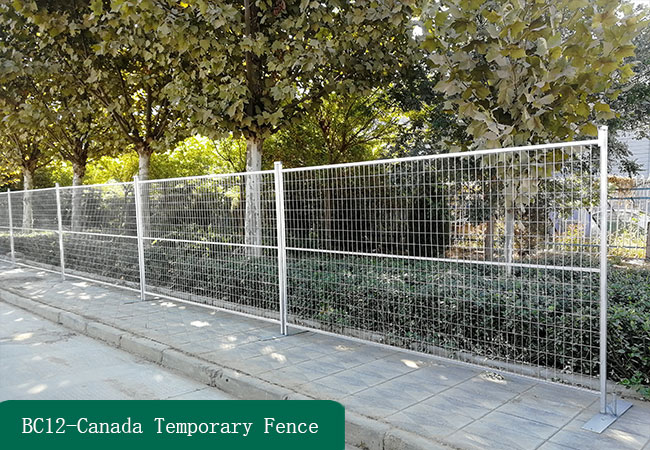
A temporary fence system is a portable barrier used to establish a boundary for a limited period.
Depending on the application, the system may consist of:
- Welded mesh fence panels
- Tubular steel frames
- Interconnecting clamps or connectors
- Freestanding support bases
- Weighted bases where appropriate
- Pedestrian access gates
- Vehicle access gates
- Warning signs and reflective accessories
The modular arrangement allows sections to be connected, relocated and reused as project requirements change.
Temporary fences are commonly used around construction sites, maintenance areas, temporary storage zones and selected event locations.
The required design depends on the site’s security objectives, ground conditions, exposure to wind, expected pedestrian activity and applicable safety requirements.
2. OSHA Requirements: What US Buyers Need to Know
The Occupational Safety and Health Administration (OSHA) establishes workplace safety requirements in the United States.
For construction projects, OSHA’s fall-protection requirements in 29 CFR 1926.502 address systems such as guardrails, safety nets and personal fall-arrest systems.
However, a general temporary perimeter fence is not automatically an OSHA-certified fall-protection system.
The correct specification depends on the fence’s intended purpose.
Temporary Perimeter Fencing
A perimeter fence is generally used to define work areas, restrict access and separate construction activities from surrounding areas.
The project team should determine the required height, panel configuration, base arrangement and access provisions according to the site plan and applicable requirements.
Guardrails for Fall Protection
Where a barrier is intended to protect workers from falling to a lower level, it must be designed and installed to meet the applicable fall-protection requirements.
OSHA construction guardrail provisions generally specify a top-rail height of 42 inches, plus or minus 3 inches, above the walking or working surface, subject to the applicable rule and permitted exceptions.
This height requirement should not be interpreted as a universal specification for every temporary fence.
Project-Specific Compliance
Before procurement, US buyers should confirm:
- Whether the product is for perimeter separation or fall protection
- The applicable OSHA provision, if relevant
- Any state-plan or local requirements
- Required structural performance
- Site-specific mounting and stability requirements
- Inspection and documentation requirements
Bendin can review customer specifications and discuss a suitable product configuration. Any compliance claim should be supported by the actual design and relevant documentation.
3. Typical Temporary Fence Specifications
Bendin can discuss customized configurations according to product design and project requirements.
| Parameter | Typical Options |
|---|---|
| Product Type | Portable Temporary Fence |
| Main Material | Steel Wire Mesh and Steel Frame |
| Fence Style | Welded Mesh Panel / Tubular Frame |
| Panel Height | Commonly around 6 ft for selected perimeter fence systems; other heights available |
| Panel Width | Commonly around 6–10 ft, depending on product design |
| Surface Treatment | Hot-Dip Galvanized / Powder Coated |
| Connection | Clamps / Couplers / Compatible Fixings |
| Base Type | Freestanding / Weighted / Other Specified Base |
| Gate Options | Pedestrian / Vehicle Access, subject to design |
| Color | Galvanized Finish / Safety Colors / Project-Specific |
| Accessories | Warning Signs / Reflective Elements / Privacy Screen, where suitable |
| Customization | Dimensions / Base / Connector / Gate / Finish |
These are indicative configuration options, not a certified product specification. Actual dimensions, frame thickness, mesh opening, base weight and connection details should be confirmed before ordering.
4. Choosing the Right Temporary Fence Base
The base is an important component of a freestanding temporary fence.
The appropriate design depends on the fence dimensions, ground conditions, wind exposure, site activity and the manufacturer’s intended use.
Standard Freestanding Base
A standard base supports the fence panel on a suitable surface.
It may be considered for applications where the ground and site conditions are appropriate for the selected system.
Weighted Base
A weighted base adds mass to the fence assembly.
Depending on the product design, this may help improve stability under the intended operating conditions.
The required weight should be determined from the system specification and relevant site conditions rather than selected by appearance alone.
Sandbag-Compatible Base
Some temporary barrier systems allow the use of sandbags or other specified ballast.
This arrangement should only be used when the base and barrier design permit it.
Mechanically Fixed Base
Where permitted by the product design and site conditions, a base may be secured using specified mechanical fixings.
Before selecting this option, confirm the substrate, fixing method and any restrictions on drilling or anchoring.
Outdoor Stability Considerations
For outdoor installations, assess:
- Wind exposure
- Ground slope
- Surface condition
- Panel height and width
- Connection strength
- Base configuration
- Nearby pedestrian or vehicle movement
A weighted base does not automatically make a fence suitable for high winds, vehicle impact or fall protection. Those functions require appropriate design and evidence.
5. Modular Fence Panels and Connections
Modular temporary fencing allows individual panels to be joined into a longer boundary.
A typical system uses compatible clamps, couplers or other specified connectors.
Benefits of Modular Construction
- Flexible boundary layouts
- Convenient transportation
- Reusable components
- Individual panel replacement
- Adjustable access arrangements
The actual assembly method depends on the product design. Some systems may require tools, and not every panel is compatible with every base or connector.
Before ordering, confirm that the panels, connectors, bases and gates are designed to work together.
6. Temporary Fence Gates for US Projects
Access gates allow authorized personnel and equipment to enter and leave a fenced area.
Gate selection should account for the required opening, traffic type, available space and site-security plan.
Pedestrian Gate
A pedestrian gate can provide controlled access for workers and visitors.
The configuration may include suitable hinges, latches and locking hardware.
Vehicle Access Gate
A vehicle gate provides a wider opening for delivery vehicles, machinery and other authorized traffic.
Its dimensions and supporting arrangement should reflect the vehicle types and expected frequency of use.
Removable Panel Access
For some temporary fence systems, an access opening can be created by removing or rearranging compatible sections.
This approach depends on the connector design and the site-management procedure.
Gate Safety Considerations
Before selecting a gate, confirm:
- Required clear opening
- Swing direction or sliding arrangement
- Ground clearance
- Hinge and latch compatibility
- Vehicle turning space
- Emergency access requirements
- Locking and access-control requirements
A movable gate must remain compatible with the stability and intended function of the surrounding fence.
7. Corrosion Protection for Outdoor Temporary Fencing
Temporary fence panels are frequently transported, handled and reused. Their surface treatment should therefore be appropriate for the intended environment and expected service conditions.
Hot-Dip Galvanizing
Hot-dip galvanizing provides a zinc coating that helps protect steel components against corrosion.
It is commonly considered for outdoor temporary fencing.
Powder Coating
Powder coating provides a decorative finish and an additional protective layer when applied over an appropriately prepared substrate.
Safety colors may be selected where required by the project.
Galvanizing Plus Powder Coating
A duplex coating combines zinc protection with a powder-coated finish.
It may be suitable where the project requires both corrosion protection and a specified appearance.
The appropriate coating depends on environmental exposure, handling, maintenance and project requirements.
A specific service-life claim should only be used when supported by the product specification and relevant evidence.
8. Temporary Fence Applications in the United States
Construction Sites
Temporary fencing can define construction boundaries and help restrict unauthorized access.
The system should be selected according to the site layout, project duration and applicable requirements.
Roadwork and Municipal Maintenance
Temporary barriers can help separate selected work areas from pedestrian routes.
Where the installation is near moving vehicles, the product must be suitable for the specific traffic environment. A lightweight temporary fence should not be treated as a vehicle-crash barrier.
Renovation and Demolition Areas
Portable fence panels can be used to separate work zones from surrounding activity.
The required configuration depends on the hazards present and the site-safety plan.
Events and Temporary Facilities
Temporary fencing may be used to organize access, define restricted areas and separate service routes.
For crowd management, the selected product should be appropriate for the expected crowd conditions and event safety plan.
9. Temporary Fence vs. Crowd Control Barrier
Temporary fencing and crowd-control barriers serve related but different purposes.
| Feature | Temporary Fence | Crowd Control Barrier |
|---|---|---|
| Typical Structure | Mesh panel with frame | Usually tubular metal railing |
| Main Purpose | Perimeter enclosure and access restriction | Pedestrian guidance and crowd separation |
| Base | Often separate support base | Often integrated or detachable feet |
| Privacy Screen | Available for some systems | Less common |
| Common Applications | Construction sites and work zones | Events, queues and pedestrian management |
| Security Function | Depends on panel and connection design | Primarily crowd guidance and separation |
The appropriate choice depends on the required boundary function, site conditions and safety requirements.
10. Illustrative Project Example: US Construction Site
A construction contractor requires temporary fencing around a renovation site to define the work boundary and provide controlled access for personnel and delivery vehicles.
The contractor selects a modular welded mesh system with compatible bases and access gates.
Preliminary Configuration
| Item | Example Requirement |
|---|---|
| Application | Construction Site Perimeter |
| Fence Type | Portable Welded Mesh Fence |
| Panel Height | Selected according to site requirements |
| Panel Width | Selected according to product specification |
| Surface Treatment | Galvanized Steel |
| Base | Compatible Freestanding or Weighted Base |
| Connection | Compatible Panel Clamps |
| Access | Pedestrian and Vehicle Gates |
| Inspection | Before use and after relocation |
The final panel dimensions, base configuration, gate openings and connection method should be confirmed against the site plan and applicable safety requirements.
If the fence is intended to provide fall protection rather than perimeter separation, it must be evaluated against the relevant fall-protection requirements.
This is an illustrative project scenario, not a completed Bendin customer installation.
11. Installation and Inspection
A typical installation process includes the following steps.
Step 1: Review the Site Plan
Identify the boundary, access points, pedestrian routes, vehicle routes and relevant hazards.
Step 2: Check the Ground Conditions
Confirm that the surface is suitable for the selected base and fence configuration.
Step 3: Position the Bases
Place the bases according to the approved layout and product instructions.
Step 4: Install Fence Panels
Position the panels securely in their compatible supports.
Step 5: Connect Adjacent Panels
Fit the specified clamps or connectors and check alignment.
Step 6: Install Gates
Confirm the gate opening, swing or sliding clearance, latching and access arrangements.
Step 7: Inspect the Completed Fence
Check stability, connections, coating condition, sharp edges and gate operation.
The fence should be inspected according to the site procedures and the manufacturer’s instructions, including after relocation, impact or changes to the installation.
12. Quality Control
Quality inspection for temporary fencing may include:
- Panel dimensions
- Frame dimensions
- Wire diameter and mesh opening
- Weld quality
- Base compatibility
- Connector fit
- Surface coating
- Gate operation
- Packaging and labeling
For applications requiring a particular load rating or compliance with a specific standard, the test method and acceptance criteria should be agreed before production.
13. Bendin Custom Temporary Fence Solutions
Bendin supplies customizable temporary fencing products for construction, municipal, commercial and selected industrial applications.
Customization may include:
- Panel height and width
- Mesh opening
- Frame configuration
- Base type
- Connection accessories
- Surface treatment
- Color
- Pedestrian and vehicle gates
- Packaging and OEM requirements
Customers can provide site drawings, required dimensions, intended application and estimated quantities for review before ordering.
For US projects, buyers should identify whether the product is intended for perimeter separation, pedestrian management or fall protection so the correct technical requirements can be established.
14. Frequently Asked Questions
Is there an OSHA-certified temporary fence?
OSHA requirements depend on the intended application. A general temporary perimeter fence is not automatically an OSHA-certified fall-protection system. Any compliance claim should be supported by the applicable design and documentation.
Is 42 inches the required height for every temporary fence?
No. The 42-inch, plus-or-minus-3-inch top-rail requirement applies to relevant construction guardrail provisions. It is not a universal height requirement for every temporary perimeter fence.
Can temporary fences use weighted bases?
Yes, where the base and fence system are designed for that configuration. The required base and ballast depend on the product specification and site conditions.
Can temporary fence panels be reused?
Suitable panels can be reused when they remain in serviceable condition and are inspected, stored and maintained according to the manufacturer’s instructions.
Can Bendin supply matching gates?
Compatible pedestrian and vehicle gate arrangements can be discussed according to the product design and project requirements.
Is a temporary fence suitable for vehicle-impact protection?
Not automatically. A lightweight temporary fence should not be used as a vehicle-crash barrier unless the specific system has been designed and tested for that purpose.
15. Request a Temporary Fence Quotation for the US Market
A temporary fence system should be sele