


Introduction
When a project demands a fencing solution that is both structurally strong and visually clean, tubular steel fence consistently ranks among the most specified choices. Built from square or rectangular hollow steel sections, this fencing type combines high mechanical strength with a neat, modern appearance that suits everything from logistics parks to university campuses.
Unlike chain link, which can look temporary and industrial, or heavy palisade, which feels aggressive, tubular fencing delivers a balanced profile. It offers solid intrusion resistance, long corrosion life and simple modular installation. This article reviews real-world tubular steel fence applications across multiple project types, with practical specifications and performance results that help you evaluate whether it fits your next site.
Why Tubular Steel Fence Is Widely Used
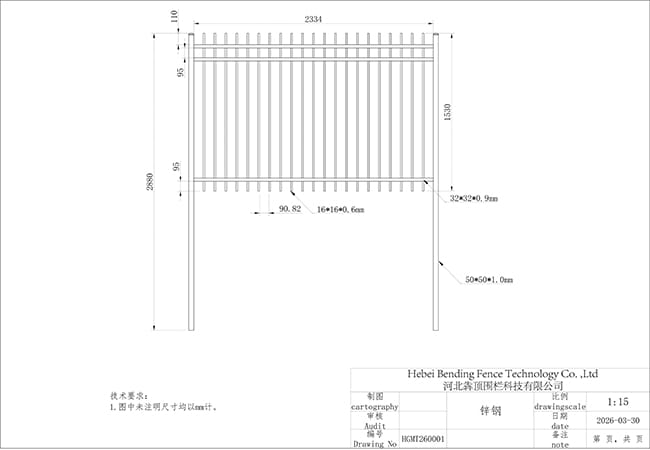
Several engineering characteristics explain the popularity of tubular steel fencing:
- High rigidity-to-weight ratio. Hollow tube sections resist bending far better than flat bar of the same weight, allowing longer spans between posts.
- Smooth, burr-free surface. Rounded or square tubing has no sharp cutting edges, which is critical for schools, parks and residential areas.
- Low maintenance. Hot-dip galvanizing plus powder coating forms a durable double barrier against rust and UV damage.
- Modular assembly. Pre-fabricated panels connect with bolts and clips, cutting on-site welding and reducing installation labour.
- Customisable appearance. Heights, bar spacing, colours and top profiles can be tailored to match architectural or branding requirements.
Engineering Case 1: Commercial Retail Park Boundary
Project background A large outdoor retail park needed a neat perimeter to separate public parking from private service yards, with an aesthetic requirement as high as the security one.
Specifications
- Fence height: 1.8 m, panel width 2.0 m
- Square hollow tube: vertical bars 25×25×1.2 mm, rails 40×40×1.5 mm
- Surface: powder coated RAL7016 anthracite grey
- Installation: concrete in-ground post embedding
Performance result
- Total length: 1,450 m
- Full installation completed in 32 working days
- Uniform appearance across the entire site; scratches easily touched up
- No coating peeling or rust within 3 years of service
Engineering Case 2: Factory Production Zone Partition
Project background A manufacturing plant required internal partition fencing to separate production workshops, raw material storage and office areas, with impact resistance from forklift traffic.
Specifications
- Fence height: 2.0 m
- Galvanized tubular fence with black powder coating
- Square tube rails and vertical bars; bolt-connected panels
- Customizable panel width for flexible zone layouts
Performance result
- Total length: 980 m
- Damaged panels easily replaced individually without rebuilding whole sections
- Structure resists minor forklift collisions without deformation
- Clear sightlines maintained for safety monitoring
Engineering Case 3: University Sports Field Enclosure
Project background A university sports complex needed safe fencing around football and basketball courts, prioritising non-sharp edges for student safety.
Specifications
- Fence height: 1.6 m
- Hot-dip galvanized base plus green powder coating
- Rounded top bar design, no sharp cutting edges
- Vertical bar spacing 100 mm
Performance result
- Total length: 1,120 m
- Heavy daily student use with minimal maintenance required
- Prevents balls rolling out of the playing area
- UV-resistant coating holds colour for 8+ years
Engineering Case 4: Residential Community Garden & Yard
Project background A gated residential community needed decorative yet durable boundary fences for private gardens, balancing visual appeal and anti-rust performance.
Specifications
- Fence height: 1.5 m ornamental tubular steel fence
- Curved decorative top profile
- Double anti-corrosion coating, smooth surface
Performance result
- Total length: 1,760 m
- Expected service life exceeds 10 years
- Safe and smooth for residents and children
- Matches community architectural style
Engineering Case 5: Agricultural Livestock Buffer Fence
Project background A large farm needed a perimeter barrier to keep livestock contained and block wild animals, where weather resistance is critical.
Specifications
- Fence height: 2.2 m heavy-duty tubular fence
- Thick-wall steel tube, hot-dip galvanized
- Reinforced bottom rail
Performance result
- Total length: 2,430 m
- Resists animal pushing and impact
- Stable performance under rain, wind and harsh rural conditions
- Long service life in open-air environments
Engineering Case 6: Port Cargo Storage Yard
Project background A port cargo storage area required a robust perimeter fence to secure stacked containers and goods against unauthorised access, in a corrosive coastal environment.
Specifications
- Fence height: 2.4 m industrial tubular fence
- Heavy-gauge square tubing
- High load-bearing posts, anti-rust coating for salt spray
Performance result
- Total length: 1,390 m
- Withstands coastal salt-air corrosion
- Strong structure resists heavy vehicle impact
- Lower replacement frequency in harsh seaside conditions
FAQ About Tubular Steel Fence Projects
Q1: What is the difference between tubular steel fence and palisade fence? Tubular fence uses hollow square or rectangular tubes with a cleaner, smoother profile, while palisade fence uses flat, pointed vertical blades for a more aggressive anti-climb look. Tubular fencing is often preferred where appearance matters; palisade is chosen for maximum security deterrence.
Q2: How long does a tubular steel fence last? With proper hot-dip galvanizing and powder coating, a tubular steel fence typically lasts 15–25 years in normal conditions. Coastal or heavily polluted environments shorten this, so thicker zinc coating is recommended there.
Q3: Can tubular steel fence follow sloped terrain? Yes. Panels can be angled to follow gentle slopes, or installed in a stepped pattern on steeper ground. Raked panel tops can also match the gradient for a cleaner finish.
Q4: Do you offer custom sizes and colours? Yes. Height, panel width, bar spacing, tube thickness and RAL colours can all be customised. Custom top profiles and matching gates are also available.
Q5: Is professional installation required? For small residential sites, competent DIY installation is possible with careful attention to post depth and concrete curing. For industrial, high-height or large-area projects, professional installation is strongly recommended to guarantee long-term stability.
Conclusion
Tubular steel fence proves its value across an exceptionally wide range of engineering applications — from retail parks and factory zones to university grounds, residential estates, farms and port yards. Its combination of structural strength, clean appearance, corrosion resistance and modular assembly makes it a dependable long-term investment.
When selecting a supplier, verify the raw material standard, zinc coating weight, powder coating quality and warranty terms rather than comparing unit price alone. A well-specified and properly installed tubular steel fence delivers decades of reliable, low-maintenance service.