


Tubular Steel Fence: Materials, Specifications and Durability
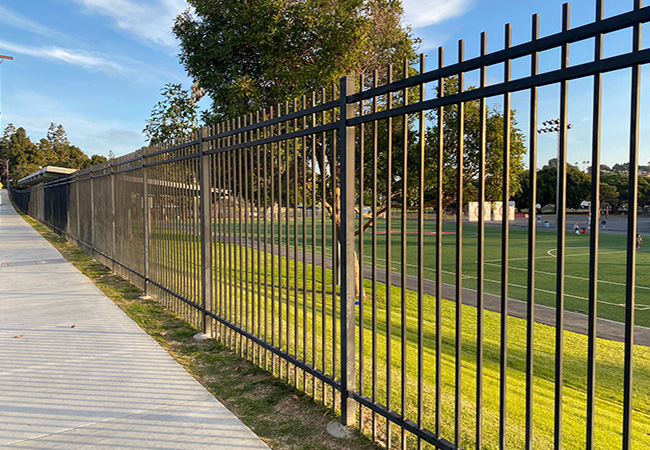
Tubular steel fencing is widely used for residential boundaries, commercial properties, industrial facilities, schools and public spaces. Its combination of steel tube profiles, welded frames and customizable designs provides a practical way to define property boundaries while maintaining a consistent architectural appearance.
The durability of a tubular fence depends on more than the steel tube diameter. Material grade, wall thickness, frame geometry, weld quality, post dimensions, connection details and corrosion protection all influence the performance of the complete system.
Bendin (Hebei Bendin Industrial Technology Co., Ltd.) supplies customizable tubular steel fencing products for international distributors, contractors, developers and project owners. Depending on the selected design, options may include tubular panels, steel posts, horizontal rails, decorative tops, matching gates and galvanized or powder-coated finishes.
This guide explains tubular fence materials, structural components, typical specifications, surface treatments and selection considerations for different outdoor applications.
1. What Materials Are Used in Tubular Steel Fencing?
Tubular fencing generally consists of steel tubes arranged into panels and supported by posts. The exact material specification depends on the product design and intended application.
Steel Tubes for Vertical Bars
Vertical tubes form the main infill structure of a tubular fence.
Their diameter, wall thickness, spacing and length influence the panel’s appearance and structural behavior.
When selecting vertical tubes, confirm:
- Tube outside diameter or profile dimensions
- Wall thickness
- Steel grade
- Vertical-bar spacing
- Tube length and connection method
- Applicable dimensional tolerances
The appropriate tube specification should be determined according to the intended application and the complete fence design.
Horizontal Rails and Frames
Horizontal rails connect and support the vertical tubes, helping maintain panel geometry.
Important factors include rail dimensions, wall thickness, connection details and compatibility with the supporting posts.
A heavier rail does not automatically guarantee a stronger fence. The complete panel, posts, connections and foundations must be considered together.
Steel Support Posts
Posts transfer the loads acting on the fence to the ground or supporting structure.
Depending on the product design, posts may use square, rectangular, round or other compatible steel profiles.
Post dimensions and mounting arrangements should be selected according to the fence height, panel width, ground conditions and expected loads.
Connecting Components
Connecting components may include brackets, bolts, hinges, latches and other specified accessories.
Their dimensions, material and corrosion protection should be compatible with the selected panels and posts.
2. Typical Tubular Fence Specifications
Bendin can discuss customized configurations according to product design, manufacturing capabilities and project requirements.
| Parameter | Typical Options |
|---|---|
| Product Type | Tubular Steel Fence |
| Main Material | Specified Steel Tube |
| Tube Outside Diameter | Product-specific; confirm the selected model |
| Common Tube Diameter Range | Approximately 20–50 mm may be available for selected designs |
| Tube Wall Thickness | Product-specific |
| Panel Height | Common options may include 1.2 m, 1.5 m, 1.8 m, 2.0 m and 2.4 m |
| Panel Width | Customized according to the layout |
| Horizontal Rail | Specified steel tube or compatible profile |
| Post Profile | Square / Rectangular / Round / Other Compatible Profiles |
| Vertical-Bar Spacing | Customized according to design and application |
| Surface Treatment | Galvanized / Powder Coated / Other Specified Finish |
| Top Design | Flat / Spear / Decorative / Other Available Styles |
| Accessories | Brackets / Fasteners / Hinges / Latches |
| Gates | Compatible Pedestrian and Vehicle Gates, where available |
These are indicative options rather than a fixed specification for every product. Actual tube diameters, wall thicknesses, panel dimensions, post sections and bar spacing should be confirmed before ordering.
The required material grade and structural configuration should be stated in the approved product specification.
3. Understanding Tube Diameter and Wall Thickness
Tube diameter and wall thickness are two separate parameters.
Tube Outside Diameter
The outside diameter describes the overall width of a round tube.
Larger diameters may be selected for particular structural or design requirements, but diameter alone does not establish the performance of the complete fence.
Wall Thickness
Wall thickness describes the thickness of the steel tube wall.
It affects material usage, weight and structural behavior. The appropriate value depends on the tube dimensions, panel design, connections and expected loads.
Why Both Parameters Matter
Two tubes with the same outside diameter can have different wall thicknesses and therefore different properties.
For procurement, specify both the outside diameter and wall thickness rather than relying on a general description such as heavy-duty steel tube.
For square and rectangular profiles, specify the section dimensions and wall thickness.
4. Steel Grade and Material Quality
Steel grade should be confirmed against the actual product specification.
Q235 steel may be used for selected tubular fence components, depending on the design and manufacturing requirements. It should not automatically be assumed to apply to every product or component.
Material Verification
Before ordering, confirm:
- Specified steel grade
- Tube dimensions and wall thickness
- Relevant material documentation, where required
- Dimensional tolerances
- Requirements for welded joints and connections
The material should be suitable for the intended application and compatible with the selected fabrication and surface-treatment process.
Material selection alone does not establish the load capacity or safety performance of the complete fence.
5. Corrosion Protection: Galvanizing and Powder Coating
Outdoor tubular fences may be exposed to rain, humidity, sunlight, airborne salt and industrial pollutants.
The appropriate surface treatment depends on the steel substrate, manufacturing process and operating environment.
Hot-Dip Galvanizing
Hot-dip galvanizing provides a zinc coating that helps protect steel against corrosion.
The coating specification should be confirmed for the selected product and manufacturing process.
Powder Coating
Powder coating provides a decorative finish and an additional protective layer when applied over an appropriately prepared substrate.
It also allows the fence color to be coordinated with buildings, landscaping and project design requirements.
Galvanizing Plus Powder Coating
A compatible galvanized substrate combined with powder coating may be suitable where both corrosion protection and appearance are important.
The production sequence should be confirmed because welding, cutting and other fabrication operations can affect protective coatings.
Choosing a Finish for Different Environments
| Environment | Selection Considerations |
|---|---|
| Residential and Urban Areas | Appearance, normal weather exposure and maintenance |
| Industrial Sites | Humidity, pollutants and possible chemical exposure |
| Coastal Locations | Airborne salt and increased corrosion risk |
| High-Humidity Areas | Moisture exposure, drainage and coating integrity |
| Public-Facing Projects | Appearance, coating consistency and repair requirements |
The actual coating specification should be matched to the environment. A particular finish should not be assumed to guarantee a fixed service life under all conditions.
6. Welding, Finishing and Connection Quality
The quality of fabrication affects the appearance, assembly and structural performance of tubular fencing.
Welding Quality
Welded joints should be suitable for their intended structural function and inspected according to the agreed product requirements.
Poorly formed joints or inconsistent fabrication can cause alignment and assembly problems.
Edge Finishing
Exposed edges, tube ends and connection areas should be checked for burrs, sharp projections and other visible defects.
The finished product should be appropriate for its intended use, especially around schools, pedestrian routes and residential areas.
Connection Compatibility
Panel-to-post brackets, bolts and other accessories should match the approved design.
Where matching gates are supplied, hinge positions, latch arrangements and supporting posts should be coordinated with the fence layout.
Dimensional Inspection
Quality checks may include:
- Panel width and height
- Tube diameter or profile dimensions
- Wall thickness, where specified
- Vertical-bar spacing
- Post dimensions
- Connection positions
- Coating appearance
The applicable inspection methods and acceptance criteria should be agreed before production.