



T-Post Fence System: Design, Specifications and Installation
T-post fencing systems use steel posts with a T-shaped cross-section to support wire mesh, woven field fencing and other compatible fence materials. Their profile, fixing arrangements and surface treatment influence installation efficiency, structural performance and long-term maintenance.
T-posts can be considered for agricultural boundaries, pasture fencing, selected perimeter installations and other projects where a compatible post-and-mesh system is required.
Bendin (Hebei Bendin Industrial Technology Co., Ltd.) supplies customizable steel fencing components and wire mesh products for agricultural, industrial and outdoor applications. Depending on product design and manufacturing availability, options can include galvanized T-section posts, compatible mesh, fixing accessories and project-specific dimensions.
This guide explains T-post construction, technical specifications, connection methods, corrosion protection and practical considerations for selecting a suitable fencing system.
1. What Is a T-Post Fence System?
A T-post fence system uses steel posts with a T-shaped cross-section to support compatible fencing materials.
Depending on the design, the post may use dedicated clips, brackets, wire attachments or other fixing accessories.
A typical system may include:
- T-section steel posts
- Woven wire mesh or compatible fencing material
- Post clips and fixing accessories
- Tensioning components where required
- End and corner supports
- Gates and access points
- Galvanized or other specified surface treatments
The posts provide support, while the mesh and fixing components form the boundary.
The performance of the complete system depends on post dimensions, steel grade, embedment depth, post spacing, soil conditions, fencing material and the selected connections.
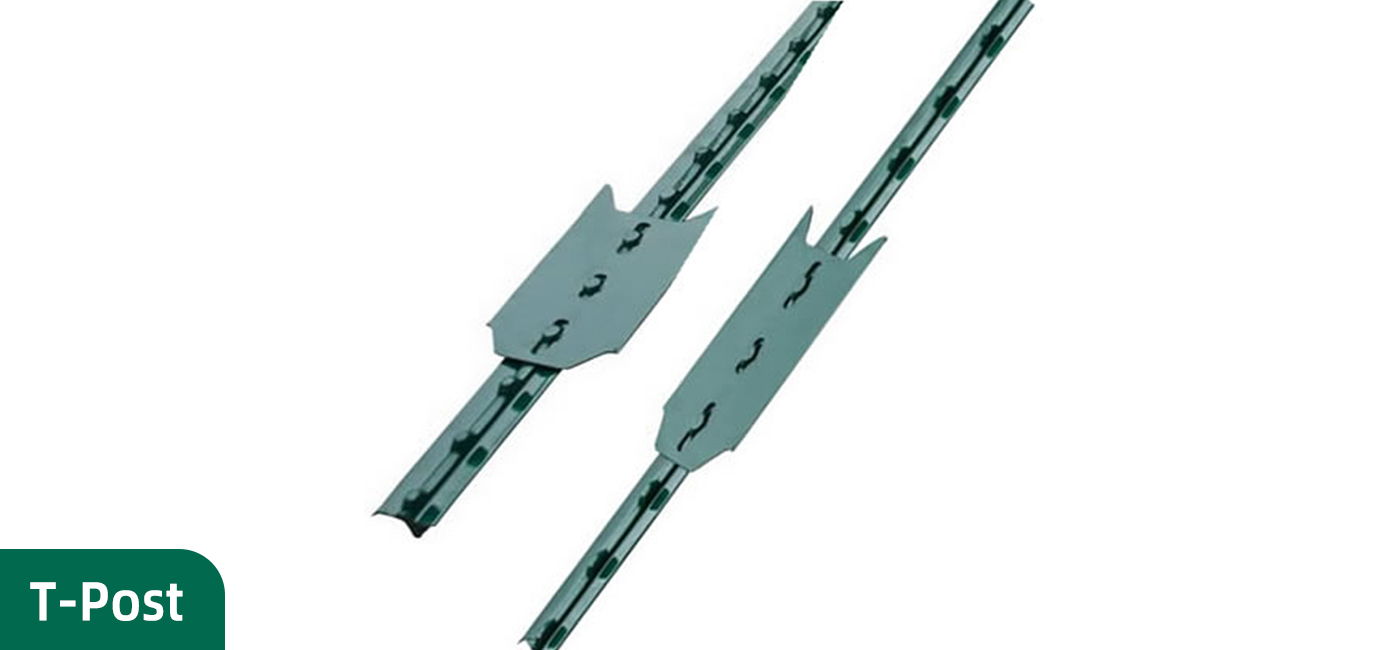
2. Main Characteristics of T-Section Fence Posts
T-Shaped Cross-Section
The T-shaped profile provides a defined section geometry for supporting compatible fencing materials.
Its structural behavior depends on the dimensions, steel thickness, material properties and orientation of the post.
A T-section is not automatically stronger than every round or square post. A valid comparison requires equivalent material conditions, dimensions, loading direction and support arrangements.
Compatible Fixing Accessories
T-posts can be used with suitable clips, wire attachments or brackets.
The fixing method should match the post profile and the type of mesh or wire being installed.
Practical Installation
T-posts may be suitable for fencing layouts where a compatible installation method can be used without constructing a separate heavy post assembly at every location.
Actual installation time depends on ground conditions, post dimensions, spacing, equipment and the required fence configuration.
Replaceable Components
Where the system uses removable clips and compatible mesh, individual components may be replaced when damaged.
The replacement procedure depends on the connection design and the condition of the surrounding fence.
3. Typical T-Post Fence Specifications
Bendin can discuss customized configurations according to product design and project requirements.
| Parameter | Typical Options |
|---|---|
| Product Type | T-Post Fence System |
| Post Material | Steel |
| Post Profile | T-Shaped Cross-Section |
| Post Length | Project-specific |
| Section Dimensions | Customized according to design |
| Steel Thickness | Product-specific |
| Surface Treatment | Hot-Dip Galvanized / Other Specified Finish |
| Fence Material | Compatible Woven Mesh / Wire / Other Suitable Panels |
| Fixing Accessories | Clips / Brackets / Wire Attachments |
| Installation | Embedded or Otherwise Supported, according to design |
| Gates | Compatible Access Gates, where required |
| Customization | Length / Section / Coating / Fixing / Packaging |
These are indicative configuration options rather than a fixed product specification. Final dimensions, steel thickness, coating requirements and installation details should be confirmed before ordering.
4. T-Post Fence Applications
Agricultural and Pasture Fencing
T-posts may be used to support compatible woven field fencing and wire boundaries.
Important considerations include livestock type, mesh opening, boundary length, terrain, post spacing and corner reinforcement.
Garden and Farm Boundaries
A T-post system may be considered for selected garden, crop-protection and farm boundary applications.
The post and mesh must be suitable for the expected loads and environmental conditions.
Selected Industrial Perimeter Fencing
Where the project requires a simple post-and-mesh boundary, T-posts may be considered if the system meets the required structural and security specifications.
For high-security sites, a dedicated post and panel system may be more appropriate.
Roadside Boundary Fencing
T-post systems may be used for selected roadside boundary or access-control fencing when permitted by the project design.
However, a T-post fence should not be treated as a vehicle-impact safety barrier unless the complete system has been specifically designed and tested for that purpose.
5. T-Post Fence vs. Round and Square Posts
Different post profiles have different structural and installation characteristics.
| Feature | T-Post | Round Post | Square Post |
|---|---|---|---|
| Cross-Section | T-Shaped | Circular | Square |
| Main Consideration | Profile orientation and compatible fixing | Diameter and wall thickness | Side dimensions and wall thickness |
| Typical Connection | Clips or compatible wire attachments | Clamps or brackets | Clips or brackets |
| Appearance | Agricultural or functional | Simple tubular profile | Regular geometric profile |
| Typical Applications | Selected wire and field fencing | General fencing systems | Modular mesh and perimeter fencing |
| Structural Performance | Depends on section and installation | Depends on section and installation | Depends on section and installation |
The most suitable post depends on the fence material, site conditions, installation method and structural requirements rather than the profile name alone.
6. Selecting Post Length and Spacing
Post length and spacing influence the stability of the complete fence.
Post Length
The required post length depends on the above-ground fence height, embedment depth, soil conditions and support arrangement.
The visible height alone is not sufficient to determine the required post length.
Post Spacing
Post spacing should be selected according to the mesh type, expected loading, terrain and fixing method.
Wider spacing may reduce the number of posts required, but it can also increase the load on individual posts and affect the behavior of the mesh.
End and Corner Posts
End and corner locations may experience higher wire tension than intermediate positions.
Additional bracing or a different post arrangement may be required depending on the fence design.
The final post layout should follow the approved project specification.
7. Surface Treatment and Corrosion Protection
T-posts are often installed outdoors and may be exposed to rain, humidity, soil moisture and temperature changes.
The appropriate surface treatment depends on the steel specification, manufacturing process and intended environment.
Hot-Dip Galvanizing
Hot-dip galvanizing provides a zinc coating that helps protect steel against corrosion.
The required coating specification should be confirmed for the relevant product and manufacturing process.
Other Specified Finishes
Other coating systems may be considered where the project has particular environmental or appearance requirements.
Compatibility between the coating and the installation method should be confirmed before production.
Maintenance Considerations
Inspection should include:
- Visible coating damage
- Corrosion around the ground line
- Loose or damaged fixing accessories
- Post movement
- Mesh attachment condition
- Deformation after impact
A specific service-life claim should only be published when supported by product data and clearly defined environmental conditions.
8. Fixing Mesh to T-Posts
The connection method should match the post profile and the selected fencing material.
Wire Attachments
Wire attachments may be used with compatible woven or line-wire fencing.
The installation should maintain the required mesh position without damaging the coating or compromising the wire.
Clips and Brackets
Clips and brackets provide a defined attachment point where compatible components are available.
Their dimensions and installation method should be confirmed before ordering.
Tensioning Components
Some woven wire fencing systems require suitable tensioning arrangements.
The method depends on the mesh design, fence length and installation instructions.
Connection Inspection
After installation, check that the mesh is securely attached, the posts remain stable and no sharp or protruding components create a hazard.
9. T-Post Fence for Uneven Terrain
Agricultural and outdoor boundaries often cross slopes, shallow depressions and irregular ground.
A compatible wire fence can accommodate some changes in ground level when the post layout and mesh configuration are correctly selected.
Important considerations include:
- Ground profile
- Post spacing
- Post embedment
- Corner and end support
- Wire tension
- Ground clearance
- Drainage
- Gate locations
On uneven terrain, the fence line should be planned to reduce excessive gaps beneath the mesh while avoiding unnecessary strain on the wire.
For steep slopes or unstable ground, the installation method should be reviewed against site conditions.
10. T-Post Fence for Roadside Applications: Important Distinctions
Roadside fencing can serve different purposes, including boundary definition, pedestrian separation, access restriction and vehicle-impact protection.
These functions require different product specifications.
Boundary and Access Fencing
A T-post and mesh system may be considered for selected boundary applications where the project design permits it.
Vehicle-Impact Protection
A standard T-post fence is not automatically designed to stop or redirect a vehicle.
Where a roadside project requires vehicle-impact protection, the complete barrier system must meet the relevant design, testing and approval requirements.
Project Documentation
Before ordering for a road project, confirm:
- The intended function of the fence
- The applicable project specification
- Required post and mesh dimensions
- Mounting and foundation details
- Any relevant testing or approval documents
The product description should accurately reflect the system’s intended use.
11. Illustrative Project Example: Agricultural Boundary
A farm requires a 1,000-meter boundary fence to separate grazing areas and manage livestock movement.
The project team considers galvanized T-posts with compatible woven wire mesh.
Preliminary Configuration
| Item | Example Requirement |
|---|---|
| Application | Agricultural Boundary |
| Fence Length | 1,000 m |
| Post Type | Galvanized T-Section Steel Post |
| Fence Material | Compatible Woven Wire Mesh |
| Post Spacing | Determined by the fence design and terrain |
| Mesh Opening | Selected for the livestock |
| Fixing | Compatible Clips or Wire Attachments |
| Gates | Livestock and Vehicle Access |
| Inspection | Periodic checks of posts, fixings and mesh |
The final post length, spacing, mesh opening, wire specification and installation method should be selected according to livestock behavior, soil conditions and the product specification.
This is an illustrative project scenario, not a completed Bendin customer installation.
12. Installation and Inspection
A typical T-post fence installation includes the following steps.
Step 1: Survey the Fence Line
Identify the boundary, terrain, corners, access points and gate locations.
Step 2: Confirm the Post Layout
Determine post length, spacing, embedment and end or corner support requirements.
Step 3: Install the Posts
Install the posts using the specified method and check their alignment.
Step 4: Position the Fence Material
Unroll or position the mesh along the planned boundary.
Step 5: Attach the Mesh
Secure the mesh using the compatible clips, wire attachments or brackets.
Step 6: Adjust Tension and Alignment
Where the product design requires tensioning, follow the specified installation method.
Step 7: Inspect the Completed Fence
Check post stability, mesh alignment, fixing security, coating condition and potential sharp edges.
The installation method should follow the manufacturer’s instructions and the applicable project requirements.
13. Quality Control
Quality inspection for T-post fence systems may include:
- Post length
- Section dimensions
- Steel thickness
- Surface coating
- Straightness and deformation
- Fixing compatibility
- Mesh dimensions
- Packaging and labeling
For projects requiring a specific structural performance or third-party testing, the applicable test methods and acceptance criteria should be agreed before production.
14. Bendin Custom T-Post Fence Solutions
Bendin supplies customizable steel fencing components and wire mesh products for agricultural, industrial and outdoor applications.
Depending on product design and manufacturing capabilities, customization may include:
- Post length
- T-section dimensions
- Steel thickness
- Surface treatment
- Compatible mesh
- Fixing accessories
- Gate arrangements
- Packaging and OEM requirements
Customers can provide drawings, site dimensions, reference photographs and details about the intended application for review before ordering.
For roadside or other regulated projects, buyers should also provide the relevant technical specification so the product can be evaluated for its intended function.
15. Frequently Asked Questions
What is a T-post fence used for?
T-posts can support compatible wire fencing for agricultural boundaries, pastures and selected outdoor perimeter applications.
Is a T-post stronger than a round or square post?
Not necessarily. Structural performance depends on the section dimensions, steel properties, loading direction, post spacing and installation conditions.
Can T-posts be galvanized?
Yes. Galvanized T-post configurations can be discussed according to the product design and project requirements.
Can T-posts support woven wire fencing?
They can be used with compatible woven wire fencing when the fixing method, post arrangement and mesh specifications are suitable.
Is a T-post fence suitable for highway crash protection?
Not automatically. A standard T-post fence should not be used as a vehicle-impact barrier unless the complete system has been specifically designed and tested for that purpose.
Can Bendin customize post dimensions?
Customization can be discussed according to product design, manufacturing capabilities and project requirements.
16. Request a T-Post Fence Quotation
A suitable T-post fence system combines compatible posts, mesh, fixing accessories and an installation method appropriate for the site.
The correct configuration depends on the intended application, post dimensions, mesh type, surface treatment, terrain and required structural performance.
Bendin supplies customizable steel fencing components and wire mesh products for international agricultural, industrial and outdoor projects.
For a quotation, provide:
- Intended application
- Required post length
- T-section dimensions
- Steel thickness
- Surface treatment
- Mesh type and dimensions
- Fixing accessories
- Quantity
- Project location and destination
Bendin can review your requirements and discuss a suitable T-post fence configuration for your project.