


Modular Industrial Safety Systems: Design, Specifications and Applications
Modern industrial facilities need safety equipment that can adapt to changing production layouts, maintenance requirements and site conditions. Fixed installations may work well for stable layouts, but expanding production lines, new machinery and changing material routes can create a need for more flexible safety infrastructure.
Modular industrial safety systems use coordinated panels, posts, brackets, supports and accessories to simplify installation and allow selected components to be repositioned or replaced. Depending on the application, these systems can include perimeter fencing, machine guarding and cable management products.
Bendin (Hebei Bendin Industrial Technology Co., Ltd.) supplies customizable industrial fencing, machine guarding and cable management products for factories, warehouses, logistics facilities and infrastructure projects.
This guide explains modular system design, component compatibility, technical specifications, installation considerations and practical applications for new industrial projects and facility upgrades.

1. What Makes a Modular Industrial Safety System Different?
Traditional installations may require extensive on-site cutting, welding or fabrication. When a facility layout changes, some fixed structures can be difficult or costly to modify.
Modular systems use pre-engineered components that connect through specified clips, brackets, bolts or other compatible fasteners.
Main Characteristics
- Standardized panels and components
- Coordinated post and mounting systems
- Reduced need for on-site fabrication where the design permits
- Replacement of individual sections
- Easier transportation and inventory planning
- Options for project-specific dimensions
- Potential for future expansion or relocation
The degree of flexibility depends on the actual product design. Some modules can be reused in a different layout, while others may require new fixings or additional components.
Modular construction should not be confused with tool-free installation or universal compatibility. The connection method and required tools must be confirmed for each system.
2. Modular Perimeter Protection
Modular perimeter fencing establishes the external boundary of a property and helps manage access to industrial and commercial sites.
Common Fence Options
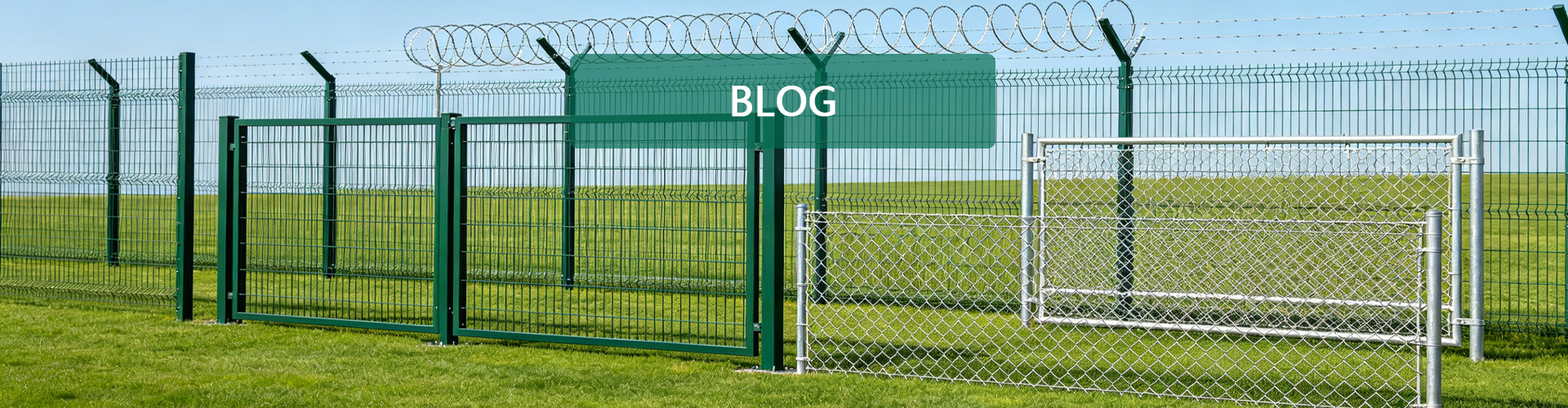
3D bending fence
Welded mesh panels with V-shaped bends provide a structured boundary for general industrial, commercial and public-space applications.
Double wire mesh fence
Double horizontal wire reinforcement may be suitable where the selected panel design requires additional stiffness.
Anti-climb mesh fence
Dense mesh openings can make climbing and cutting more difficult than with many conventional open-mesh fences. This configuration may be considered for restricted-access sites.
Chain link fence
Woven diamond mesh may be suitable for long boundaries and selected outdoor applications where flexible installation is useful.
Modular Components
A perimeter fencing system may include:
- Fence panels
- Supporting posts
- Panel clips and brackets
- Ground anchors or foundations
- Pedestrian and vehicle gates
- Post caps and other accessories
Key Design Considerations
Before ordering, confirm the fence height, panel width, mesh opening, wire diameter, post dimensions, fixing method, foundation requirements and surface treatment.
The selected components must work together as a complete system. Modular panels alone do not establish a particular security rating or impact-resistance level.
3. Modular Machine Guarding
Modular machine guarding establishes a physical boundary around hazardous machinery, robotic workstations and automated production equipment.
It can support workshop layout changes, but the guarding design must always reflect the machinery risk assessment and applicable safety requirements.
Common Configurations
Full-mesh guarding
Welded mesh panels allow visibility into the guarded area while providing a physical boundary.
Mesh with solid lower panels
This configuration combines mesh and solid sections. Suitability depends on the material or hazards that need to be contained.
Punched metal panels
Punched panels may be considered where a more enclosed appearance or specific opening pattern is required.
Modular access gates
Pedestrian and maintenance gates provide access for authorized personnel and equipment servicing.
Advantages of Modular Guarding
- Coordinated panel and post dimensions
- Easier replacement of selected sections
- Flexible placement of access gates
- Simplified planning for future changes
- Reduced need for on-site fabrication where appropriate
Safety Requirements
The mesh opening, panel position, guard height and distance from hazardous moving parts must be determined according to the machinery risk assessment.
Where safety interlocks are required, the gate and associated control functions must be suitable for the application and validated as part of the complete machine system.
Any layout modification must preserve the required guarding distances and safety functions. The equipment should not return to operation until any necessary safety review and validation are complete.
4. Modular Cable Management
Cable management systems support and organize power, control, communication and instrumentation cables.
Modular cable routing can help simplify additions, rerouting and selected maintenance tasks when the new components are compatible with the existing installation.
Common Cable Management Products
Mesh cable trays
Open-wire trays provide a ventilated supporting structure for compatible cable installations.
Perforated cable trays
Perforated trays provide a supporting base with openings that may assist ventilation and drainage.
Solid-bottom cable trays
Solid-bottom trays provide a continuous supporting surface for suitable cable installations.
Cable trunking
Cable trunking provides a more enclosed route for selected cables.
Components and Accessories
Depending on the system, cable management may include:
- Straight tray sections
- Horizontal and vertical bends
- Connectors and joining plates
- Brackets and supports
- Covers where required
- Mounting hardware
Key Design Considerations
Before selecting a cable management system, confirm:
- Cable types and estimated quantities
- Tray width and side height
- Total cable weight
- Support spacing and span
- Material and coating
- Connection compatibility
- Indoor or outdoor exposure
- Cable separation requirements
- Inspection and maintenance access
Load capacity depends on the tray design, support arrangement, span, connections and loading conditions. The actual configuration should be checked against the manufacturer’s technical data and applicable electrical installation requirements.
5. How the Three Modular Systems Work Together
Perimeter fencing, machine guarding and cable management have different functions, but their layouts can be coordinated during project planning.
| System | Primary Function | Main Coordination Requirements |
|---|---|---|
| Perimeter Fencing | Define external boundaries and manage access | Fence routes, foundations, gates and access roads |
| Machine Guarding | Separate people from hazardous machinery | Machine layout, access gates, maintenance clearance and safety functions |
| Cable Management | Support and organize cable routes | Cable schedules, tray routes, supports and electrical access |
| Shared Installation | Coordinate the overall site layout | Mounting points, installation sequence and maintenance routes |
Coordinated drawings can help identify conflicts before installation, such as a fence obstructing a vehicle route, a guard blocking maintenance access or a cable tray interfering with machinery.
The systems should still be specified and inspected according to their individual functions and applicable requirements.
6. Typical Modular System Specifications
Bendin can discuss customized configurations according to product design, manufacturing capabilities and project requirements.
Perimeter Fencing
| Parameter | What to Confirm |
|---|---|
| Fence Type | 3D bending / double wire / anti-climb / chain link |
| Panel Height and Width | According to the site layout |
| Mesh Opening | According to the intended function |
| Wire Diameter | Product-specific |
| Post Profile | Compatible with the selected panels |
| Connection Method | Clips / brackets / specified fasteners |
| Surface Treatment | Galvanized / powder coated / other specified finish |
| Gates | Pedestrian / vehicle access |
Machine Guarding
| Parameter | What to Confirm |
|---|---|
| Guard Type | Full mesh / mesh with solid panel / punched panel |
| Panel Dimensions | According to the machine layout |
| Mesh Opening | According to the risk assessment |
| Post and Fixing System | Compatible with the panels |
| Access Gates | According to operational and maintenance needs |
| Safety Interlocks | Where required by the validated safety design |
| Surface Treatment | According to the workshop environment |
Cable Management
| Parameter | What to Confirm |
|---|---|
| Tray Type | Mesh / perforated / solid-bottom / trunking |
| Tray Width and Height | According to the cable schedule |
| Material | Steel or other specified material |
| Surface Treatment | According to environmental exposure |
| Support Spacing | According to the installation design |
| Loading Requirements | Based on cable weight and applicable design criteria |
| Accessories | Connectors / brackets / supports / covers |
These are specification checklists rather than fixed product specifications. Actual dimensions, materials, coatings, loading requirements and connection arrangements should be confirmed before ordering.
7. Materials and Surface Treatment
Industrial safety products may be exposed to rain, humidity, airborne salt, cleaning agents, dust and industrial pollutants.
The appropriate material and coating depend on the actual product, manufacturing process and operating environment.
Hot-Dip Galvanizing
Hot-dip galvanizing provides a zinc coating that helps protect steel against corrosion.
The required coating specification should be confirmed for the selected product.
Powder Coating
Powder coating provides a decorative finish and an additional protective layer when applied over an appropriately prepared substrate.
Galvanizing Plus Powder Coating
A compatible galvanized substrate combined with powder coating may be suitable where both corrosion protection and appearance are important.
Cable trays and machine guarding components may require different coating specifications from outdoor perimeter fencing.
Service-life claims should be supported by product data and clearly defined environmental conditions.
8. Installation and Future Reconfiguration
A modular system can simplify some installation and modification tasks, but the actual process depends on the product design and site conditions.
Before Installation
Confirm:
- Approved layout drawings
- Component dimensions and quantities
- Foundation and mounting requirements
- Gate and access positions
- Cable routes and support locations
- Required tools and fasteners
- Applicable safety and inspection criteria
During Installation
Follow the manufacturer’s assembly instructions and verify component compatibility.
Check panel alignment, post stability, fixing security and the condition of the surface treatment.
Before Reconfiguration
Before moving or adding components, review the revised layout.
For machine guarding, verify that the modified arrangement preserves the required safety distances and safety functions. For cable management, check that tray supports, loading and cable routing remain suitable.
Modular components can be reused only when they remain compatible with the revised design and are in suitable condition.
9. Illustrative Project Example: Factory Layout Expansion
A manufacturing facility plans to add a production line while retaining parts of its existing perimeter fencing, machine guarding and cable management systems.
The project team evaluates which components can be retained and which require replacement or additional modules.
Preliminary Project Plan
| Area | Proposed Action | Main Verification |
|---|---|---|
| External Boundary | Extend compatible fence panels | Post spacing, connections and foundation requirements |
| New Production Line | Add modular machine guarding | Risk assessment, access gates and safety functions |
| Cable Routes | Extend compatible cable trays | Cable loading, support spacing and routing |
| Maintenance Access | Adjust gate and service positions | Safe access and operating clearance |
| Existing Components | Reuse suitable modules where permitted | Condition, compatibility and revised design |
Information Required Before Modification
The project team should prepare:
- Existing installation drawings
- Revised factory layout
- New machine dimensions
- Cable schedules and estimated loading
- Component inventory
- Required materials and surface treatments
- Applicable inspection criteria
This approach helps identify reusable components and necessary modifications before work begins.
This is an illustrative project scenario, not a completed Bendin customer installation.
10. How to Evaluate a Modular Safety System Supplier
When comparing suppliers, evaluate more than the availability of standard modules.
Component Compatibility
Confirm which panels, posts, connectors, gates and accessories are designed to work together.
Technical Documentation
Request the applicable drawings, product specifications, assembly instructions and load data.
Customization Capability
Confirm whether the supplier can accommodate the required dimensions, corners, access points and installation conditions.
Quality Inspection
Agree on the relevant dimensional, visual and performance checks for the actual product.
Spare Parts and Future Expansion
Confirm the availability of compatible replacement components and the information needed to reorder them.
Standards and Compliance
Identify the standards applicable to each product and project. Modular construction alone does not establish compliance.
11. Bendin Modular Industrial Safety Solutions
Bendin supplies customizable industrial fencing, machine guarding and cable management products for manufacturing plants, warehouses, logistics centers and infrastructure projects.
Depending on product design and manufacturing capabilities, customization may include:
- Fence type, panel dimensions and mesh openings
- Post profiles and fixing accessories
- Machine guarding layouts and access gates
- Galvanized and powder-coated finishes
- Cable tray dimensions and configurations
- Compatible supports and installation accessories
- Packaging and OEM requirements
Customers can provide drawings, site dimensions, machine layouts, cable schedules and technical specifications for review before ordering.
For projects that may expand in the future, identifying standard components and compatible interfaces at the specification stage can help simplify later procurement.
12. Frequently Asked Questions
What is a modular industrial safety system?
It is a system built from coordinated components that can be assembled into perimeter fencing, machine guarding or cable management installations according to the intended application.
Are modular safety systems as strong as fixed installations?
Performance depends on the panel, posts, connections, foundations and installation. A modular system must be specified and installed for the intended loads and operating conditions.
Can modular components be reused after a layout change?
Some components can be reused when they remain compatible with the revised layout and are in suitable condition. The revised installation must still meet the applicable requirements.
Can modular machine guarding include safety interlocks?
Compatible interlock provisions can be discussed. The complete safety function must be designed and validated by the responsible machine integrator or safety engineer.
Can cable trays be extended after installation?
Extensions may be possible when the new sections, connectors, supports and loading arrangements are compatible with the existing system.
Does modular construction automatically guarantee compliance?
No. Compliance depends on the product specifications, engineering design, installation and applicable requirements.
13. Request a Modular Industrial Safety Quotation
Modular industrial safety systems can help simplify installation, component replacement and selected layout changes when designed around the site’s actual requirements.
Bendin supplies customizable perimeter fencing, machine guarding and cable management products for international distributors, contractors and industrial customers.
For a quotation, provide:
- Intended application
- Site plan and boundary dimensions
- Machine or workshop layout
- Required panel and post specifications
- Cable tray type, dimensions and estimated loading
- Surface treatment and color
- Gate and accessory requirements
- Applicable project specifications
- Quantities and delivery destination
Bendin can review your requirements and discuss suitable modular product configurations for your