


Robot Safety Fence: Materials, Specifications and Applications
Robot safety fencing is an important component of industrial machine guarding. It creates a physical boundary around robotic workstations, automated assembly lines and other machinery, helping restrict unauthorized access to hazardous operating areas.
A suitable robot safety fence must balance structural stability, visibility, access requirements, corrosion protection and installation flexibility. Its design should be based on the machinery layout, identified hazards and applicable safety requirements rather than material strength alone.
Bendin (Hebei Bendin Industrial Technology Co., Ltd.) supplies customizable machine guarding systems for manufacturing plants, automation facilities and industrial equipment enclosures. Depending on the project, configurations may include welded steel mesh panels, reinforced frames, compatible posts, maintenance gates and specified surface treatments.
This guide explains robot safety fence construction, material options, technical specifications, installation considerations and practical applications for industrial automation projects.
1. What Is a Robot Safety Fence?
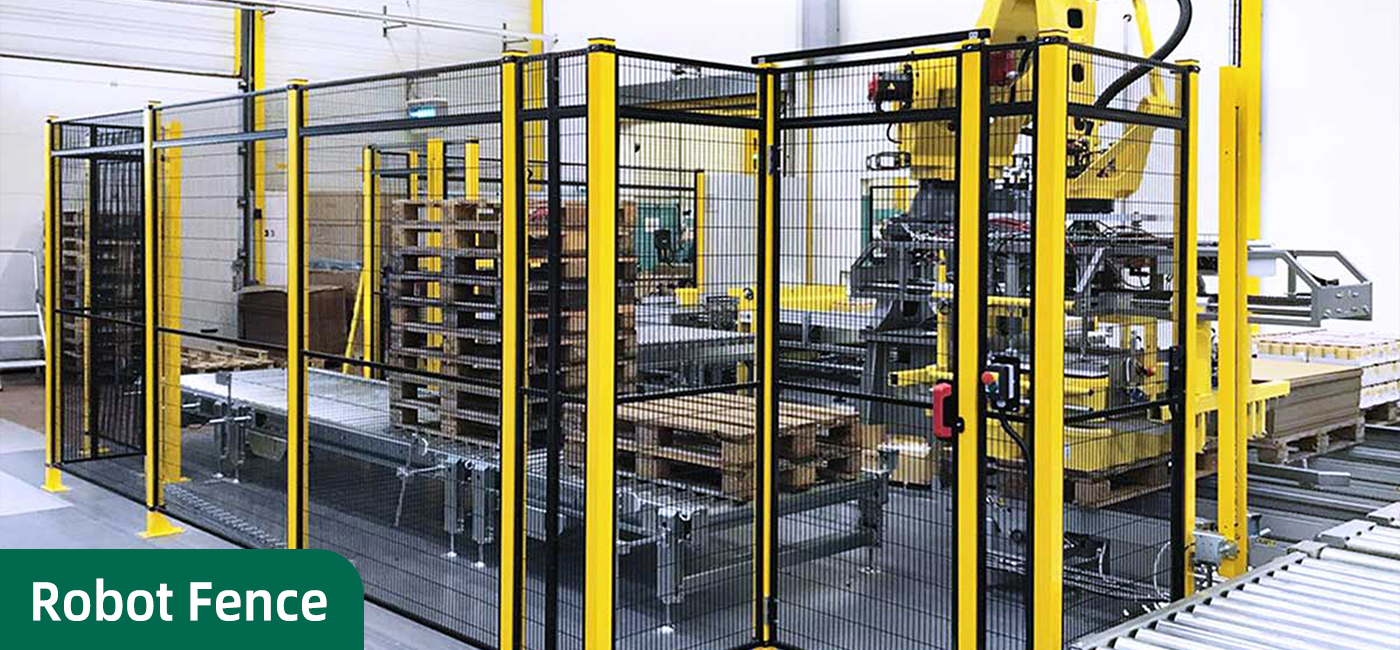
A robot safety fence is a physical guarding system installed around an industrial robot or automated process.
It helps separate personnel from hazardous machine movements and establishes controlled access to the operating area.
A typical system may include:
- Welded steel mesh panels
- Reinforced panel frames
- Supporting steel posts
- Mounting brackets and fixing accessories
- Pedestrian access gates
- Maintenance or equipment-access gates
- Compatible safety interlocks where required
- Galvanized or powder-coated finishes
The complete guarding arrangement should be designed around the robot’s operating envelope, surrounding equipment, maintenance requirements and site layout.
A robot fence is one part of the overall machine safety system. Its effectiveness depends on panel design, mesh openings, fence positioning, gate arrangements, mounting details and any required safety-related control functions.
2. Materials and Structural Construction
Material selection and frame design influence the rigidity, durability and installation requirements of robot safety fencing.
Welded Steel Mesh
Welded steel mesh creates a regular grid through resistance welding at intersecting wire points.
Potential benefits include:
- Consistent mesh openings
- Good visibility through the panel
- Modular panel construction
- Convenient integration with compatible steel frames
- Multiple wire and mesh configurations
Wire diameter, mesh opening, weld quality and panel dimensions should be selected according to the application.
Reinforced Steel Frames
Steel frames support the mesh panel and provide defined fixing points.
The appropriate frame dimensions depend on panel size, mounting method and the loads expected during normal use.
Frame thickness alone does not establish the performance of the complete guarding system. Posts, connections, foundations and installation quality also matter.
Supporting Posts and Fixings
Posts and mounting accessories connect the panels to the floor or supporting structure.
The post profile, wall thickness, fixing method and foundation arrangement should be confirmed against the approved layout.
Compatible clips, brackets and fasteners help maintain consistent panel alignment and support future replacement of individual sections where the system permits.
3. Typical Robot Safety Fence Specifications
Bendin can discuss customized configurations according to product design, manufacturing capabilities and project requirements.
| Parameter | Typical Options |
|---|---|
| Product Type | Robot Safety Fence / Machine Guard Fence |
| Main Material | Welded Steel Mesh and Steel Profiles |
| Mesh Opening | Common options may include 20 × 20 mm, 25 × 25 mm and 50 × 50 mm, subject to design |
| Wire Diameter | Product-specific |
| Panel Height | Approximately 1.2–2.5 m for selected applications, subject to the risk assessment |
| Panel Width | Customized according to the layout |
| Frame Type | Reinforced Steel Frame |
| Post Profile | Square / Rectangular / Other Compatible Profiles |
| Surface Treatment | Galvanized / Powder Coated / Duplex Coating |
| Gate Options | Pedestrian / Maintenance / Equipment Access |
| Interlock Provisions | Compatible devices where required |
| Mounting | Floor-Mounted Posts / Base Plates / Specified Fixings |
| Customization | Panel / Post / Gate / Color / Accessories |
These are indicative configuration options rather than a fixed specification for every product. Actual mesh openings, wire diameter, panel dimensions, post sections and fixing details should be confirmed before ordering.
The final fence height, mesh opening and distance from hazardous machinery must be determined according to the machine risk assessment and applicable requirements.
4. Corrosion Protection for Industrial Environments
Robot safety fencing may be installed in environments exposed to humidity, dust, oil residues, cleaning agents or other industrial conditions.
The appropriate surface treatment depends on the steel substrate, manufacturing process and expected exposure.
Hot-Dip Galvanizing
Hot-dip galvanizing provides a zinc coating that helps protect steel against corrosion.
For fabricated panels, the manufacturing sequence and treatment method should be confirmed, particularly where welding, cutting or drilling may affect the protective coating.
Powder Coating
Powder coating provides a decorative finish and an additional protective layer when applied over an appropriately prepared substrate.
It also allows guarding panels and posts to be coordinated with the factory layout or equipment appearance.
Galvanizing Plus Powder Coating
A compatible galvanized substrate combined with powder coating may be suitable where both corrosion protection and appearance are important.
The required coating specification depends on the operating environment and maintenance requirements.
A specific service-life claim should only be published when supported by product data and clearly defined environmental conditions.
5. Visibility and Workplace Layout
Visibility is an important consideration when selecting a robot safety fence.
Welded mesh panels allow operators and maintenance personnel to observe selected areas of the guarded equipment without entering the enclosure.
Benefits of Mesh Visibility
- Visual monitoring of equipment operation
- Easier observation of selected machine conditions
- Reduced visual obstruction compared with some solid-panel designs
- Clear identification of access gates and enclosure boundaries
Actual visibility depends on the mesh opening, viewing angle, lighting, equipment placement and surrounding structures.
Where cameras, sensors or other monitoring devices are used, their position should be coordinated with the guarding layout.
A mesh fence does not eliminate the need for appropriate monitoring, access control or machine safety functions.
6. Safety Gates and Interlocking Systems
Robot workstations often require access for inspection, cleaning, tooling changes and maintenance.
Access gates should be included in the guarding design from the beginning rather than added after the fence layout has been finalized.
Pedestrian Access Gates
Pedestrian gates provide access for authorized personnel.
Their dimensions, hinges, latches and opening direction should suit the available space and intended tasks.
Maintenance and Equipment-Access Gates
Larger openings may be needed when components, tools or equipment must pass through the enclosure.
The gate structure and supporting posts should be suitable for the opening size and operating loads.
Safety Interlocks
Where required by the risk assessment, a gate may incorporate a compatible safety interlock connected to the machine’s safety-control system.
The complete safety function must be suitable for the application and validated according to the applicable requirements.
A mechanical latch alone is not necessarily a safety interlock, and a physical fence alone does not establish compliance with all machinery safety requirements.
7. Robot Safety Fence for Different Applications
Robotic Assembly Lines
Robot fencing can define the operating area around automated assembly equipment.
The layout should account for the robot’s movement, adjacent conveyors, material supply points and maintenance access.
Robotic Welding Cells
Welding applications may require a combination of mesh guarding, specialized access arrangements and additional measures appropriate to the process hazards.
The fence should be coordinated with the equipment layout and the wider safety design.
Packaging and Palletizing Robots
Robot fencing can separate automated packaging or palletizing operations from nearby pedestrian routes.
Gate locations should support authorized access while maintaining the intended guarding function.
Machining and Material-Handling Systems
Selected machining and handling applications may use mesh enclosures to define hazardous operating areas.
The design should account for moving components, workpiece movement and any foreseeable ejection or impact hazards.
Automated Warehouses
Robot guarding may be used around selected automated handling equipment and robotic workstations.
The layout should coordinate guarding panels, equipment access, maintenance routes and cable routing.
The appropriate configuration depends on the actual application and its risk assessment.
8. Modular Design and Installation
Modular robot safety fencing uses coordinated panels, posts and accessories to simplify assembly and selected future modifications.
Benefits of Modular Construction
- Standardized panel dimensions
- Consistent post and fixing arrangements
- Replacement of individual panels
- Flexible placement of access gates
- Easier planning for future expansion
- Reduced need for on-site fabrication where the design permits
Installation Considerations
Before installation, confirm:
- Approved machine layout
- Guarding boundary and required clearances
- Panel and post dimensions
- Floor condition and anchoring requirements
- Gate positions
- Cable and service routes
- Required safety interlocks
- Inspection and acceptance criteria
After installation, inspect panel alignment, post stability, fixing security, gate operation and the condition of the surface treatment.
Any later layout modification should be reviewed before the machine returns to operation. Modular construction does not remove the need to verify the revised safety arrangement.
9. Quality Control for Robot Safety Fencing
Quality inspection should cover the mesh panels, frames, posts, connections and surface treatment.
Mesh and Panel Inspection
Check:
- Wire diameter
- Mesh opening
- Panel dimensions
- Panel flatness
- Weld appearance and integrity
Frame and Post Inspection
Confirm frame dimensions, post sections, mounting details and compatibility with the approved drawings.
Surface Inspection
Check coating condition and visible defects according to the agreed inspection requirements.
Gate and Accessory Inspection
Confirm that gates align correctly, latches operate as intended and specified accessories are supplied.
Documentation
Depending on the project, buyers may request product drawings, material information, coating specifications, inspection records and relevant test reports.
Any claimed performance rating should be supported by the relevant test method and acceptance criteria.