




How to Choose the Right Cable Tray Supplier for Your Project
Choosing the right cable tray supplier is an important decision for industrial, commercial, infrastructure and energy projects. Cable trays are not simply supporting components—they form an important part of an organized cable management system and must provide reliable support for power, control and communication cables throughout the project.
For contractors, distributors, EPC companies and project buyers, choosing a supplier based only on price can create problems such as unsuitable tray dimensions, poor corrosion resistance, inconsistent accessories, difficult installation and additional replacement costs.
A reliable cable tray supplier should provide more than standard products. The supplier should understand project specifications, offer suitable materials and tray types, support customization and maintain consistent manufacturing quality.
Bendin provides cable tray solutions for international projects, including standard products and customized systems according to project requirements.
What Is a Cable Tray?
A cable tray is a structural system designed to support and organize electrical cables, control cables, communication lines and other wiring in buildings and industrial facilities.
Compared with routing every cable through an individual conduit, cable tray systems can provide a more accessible and organized cable-routing structure for suitable applications.
A complete cable tray system may include:
- Straight cable tray sections
- Horizontal bends
- Vertical bends
- Tees
- Crosses
- Reducers
- Connectors
- Covers
- Support brackets
- Hangers
- Fasteners and accessories
The correct combination depends on cable quantity, load requirements, installation environment and project layout.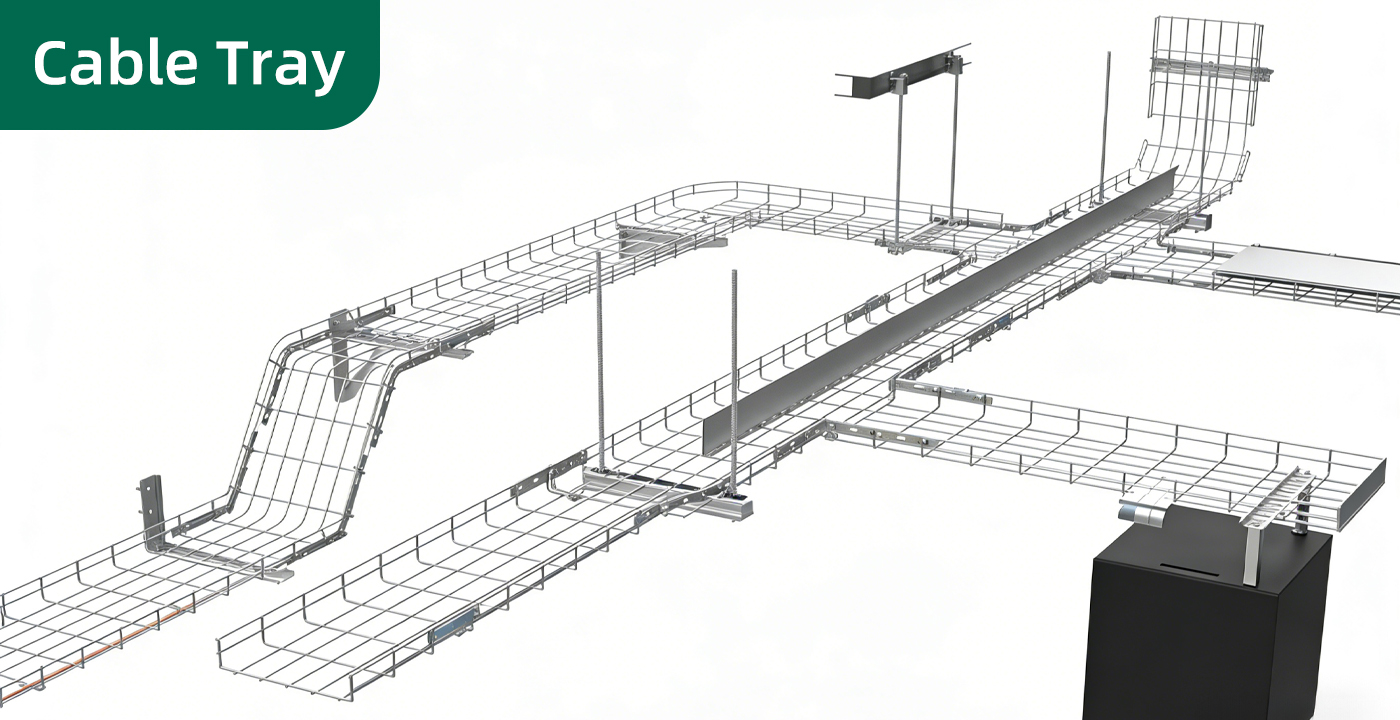
Main Types of Cable Tray
Different projects require different cable management structures. Understanding the main cable tray types is one of the first steps when selecting a system.
1. Wire Mesh Cable Tray
Wire mesh cable tray, also known as basket cable tray, is manufactured from welded steel wire to create an open mesh structure.
Its open design provides good ventilation around cables and allows installers to observe and access cable routes easily.
Wire mesh cable trays are commonly considered for:
- Data centers
- Communication systems
- Server rooms
- Commercial buildings
- Industrial facilities
- Control and instrumentation wiring
The modular structure also makes route changes relatively convenient when the cable layout needs to be adjusted.
2. Ladder Cable Tray
Ladder cable tray consists of two longitudinal side rails connected by transverse rungs.
The open structure provides ventilation and creates a strong cable-supporting system for suitable heavy-duty applications.
Typical applications can include:
- Industrial plants
- Power facilities
- Manufacturing facilities
- Large commercial projects
- Infrastructure projects
- Long cable routes
Tray dimensions and support spacing should be selected according to the cable load and engineering requirements.
3. Perforated Cable Tray
Perforated cable tray uses a formed steel structure with ventilation holes along the bottom.
It provides greater cable support than a fully open structure while still allowing ventilation.
It can be used for:
- Power cables
- Control cables
- Industrial electrical systems
- Commercial buildings
- Manufacturing facilities
- Infrastructure installations
Covers can also be added where the project requires additional cable protection.
4. Solid Bottom Cable Tray
Solid bottom cable trays provide continuous support underneath cables.
They may be selected for applications where greater physical separation or protection is required.
Because ventilation characteristics differ from open cable tray designs, engineers should select the tray configuration according to the cable system and project requirements.
What Should You Consider When Choosing a Cable Tray Supplier?
Selecting a cable tray supplier involves more than comparing unit prices.
For B2B and engineering procurement, several factors should be evaluated before placing an order.
1. Complete Product Range
A reliable supplier should be able to provide the main tray sections together with compatible fittings and accessories.
This is important because a real project rarely consists only of straight cable tray sections.
The installation may require:
- 90-degree bends
- 45-degree bends
- Vertical bends
- Tees
- Cross fittings
- Reducers
- Covers
- Connectors
- Support brackets
Purchasing a coordinated system from one supplier can simplify installation and reduce compatibility problems between components.
2. Material Selection
Cable trays can be manufactured from different materials and surface finishes depending on the installation environment.
Common options may include:
- Pre-galvanized steel
- Hot-dip galvanized steel
- Stainless steel
- Powder-coated steel
- Other project-specific materials or finishes
The appropriate material should be selected according to factors such as humidity, corrosion exposure, indoor or outdoor installation and project specifications.
For example, an indoor commercial project and an outdoor industrial facility may require different corrosion-protection strategies.
3. Load Requirements
Cable weight is an important consideration when selecting a tray system.
Before confirming specifications, project engineers and buyers should consider:
- Cable quantity
- Total cable weight
- Tray width
- Tray depth
- Support spacing
- Installation method
- Future cable expansion
Selecting a tray only according to dimensions without considering the actual load can result in an unsuitable cable support system.
4. Cable Tray Dimensions
Cable tray size should provide sufficient space for the required cables while considering installation and future expansion.
Common customizable dimensions include:
| Item | Available Options |
|---|---|
| Tray Width | According to project requirements |
| Tray Height | Multiple options |
| Tray Length | Standard or customized |
| Wire Diameter | According to mesh tray specification |
| Steel Thickness | According to tray type and requirement |
| Surface Treatment | Galvanized / stainless steel / coated |
| Accessories | Bends / tees / crosses / reducers |
| Covers | Available according to tray type |
Final dimensions should be confirmed according to project drawings and cable management requirements.
5. Corrosion Resistance
Corrosion can significantly affect the long-term performance of steel cable management systems.
The installation environment should therefore be considered before selecting the surface treatment.
Projects involving outdoor installation, coastal environments, chemical exposure or high humidity may require greater corrosion protection than standard indoor applications.
A professional cable tray supplier should help buyers select an appropriate material and finish based on the actual installation environment.
Why Custom Cable Tray Solutions Matter
Standard cable trays are suitable for many applications, but large engineering projects often have specific dimensional, routing or installation requirements.
Custom manufacturing can help address requirements such as:
- Non-standard widths
- Special heights
- Different steel thicknesses
- Customized lengths
- Special fittings
- Customized surface treatment
- Project-specific support components
- Special packaging
- OEM requirements
Bendin supports customized cable tray manufacturing according to confirmed drawings and project specifications.
For contractors and project buyers, providing detailed specifications before production helps reduce installation changes after products arrive at the job site.
Cable Tray Applications
Cable tray systems are used across a wide range of industries.
Industrial Manufacturing
Factories may contain large numbers of power, control and communication cables connecting machines and production equipment.
Cable trays help organize these cable routes and provide accessible infrastructure for maintenance and future modifications.
Data Centers
Data centers require organized routing of communication, network and power cables.
Wire mesh cable trays are commonly considered where accessibility and airflow are important design considerations.
Commercial Buildings
Office buildings, shopping centers and other commercial facilities can use cable trays to organize electrical and communication infrastructure.
Power and Energy Projects
Power facilities and energy projects can require extensive cable routing between equipment and operating areas.
The tray material, structural configuration and surface treatment should be selected according to the project environment and engineering requirements.
Warehouses and Logistics Centers
Modern logistics facilities use electrical equipment, automated systems, conveyors, lighting and communication infrastructure.
Cable tray systems provide organized routes for the associated cabling.
Infrastructure Projects
Transportation, utility and other infrastructure projects may require long cable routes and a large number of fittings.
For these projects, manufacturing consistency and accessory compatibility become particularly important.
Bendin Custom Cable Tray Manufacturing
Every engineering project has different requirements.
Bendin supports standard and customized cable tray manufacturing for distributors, electrical contractors, EPC companies and industrial project buyers.
Customization can include:
- Tray width
- Tray height
- Material thickness
- Tray length
- Surface treatment
- Fitting dimensions
- Covers
- Support accessories
- Packaging
- OEM production
Customers can provide drawings, bills of quantities or technical specifications for review before quotation.
Quality Control for Cable Tray Production
Consistent quality is particularly important for large-volume project orders.
Depending on the agreed specification, cable tray quality control can include inspection of:
- Raw materials
- Product dimensions
- Steel thickness
- Welding condition for mesh products
- Forming quality
- Surface finish
- Connection points
- Fittings
- Accessories
- Packaging
Products should be checked against the confirmed order specifications before shipment.
Why Work With Bendin as Your Cable Tray Supplier?
When you choose Bendin as your cable tray supplier, you are not simply purchasing individual tray sections.
Our goal is to support buyers with a complete cable management solution based on their actual project requirements.
Complete Cable Tray Solutions
Bendin can provide cable tray sections together with compatible fittings and accessories, helping buyers simplify sourcing for project installations.
Standard and Custom Manufacturing
We support both standard cable tray specifications and customized production according to project requirements.
B2B Project Support
Our cable tray solutions are suitable for different types of professional buyers, including:
- Electrical contractors
- EPC companies
- Importers
- Distributors
- Wholesalers
- Industrial facilities
- Engineering companies
- Infrastructure project buyers
Project-Based Quotations
Instead of offering only a general unit price, quotations can be prepared according to product type, dimensions, quantity, material, surface treatment, accessories and destination.
This provides buyers with a more useful basis for evaluating total procurement costs.
Export Support
For international orders, appropriate packaging and shipping preparation are important to reduce product damage and simplify receiving.
Bendin can provide export-oriented packaging and coordinate order information according to the agreed project requirements.
How to Request an Accurate Cable Tray Quote
To receive a more accurate quotation, buyers should provide the following information where available:
- Cable tray type
- Required width and height
- Required length
- Material
- Steel thickness or wire diameter
- Surface treatment
- Required quantity
- Fitting types and quantities
- Cover requirements
- Support accessories
- Project drawings or BOQ
- Destination country or port
If your project is still in the preliminary stage, you can provide available drawings and application information for discussion.
FAQ About Cable Tray Supply
What types of cable tray does Bendin supply?
Bendin can provide different cable management solutions, including wire mesh cable trays and other cable tray configurations according to project requirements and manufacturing capability.
Can cable tray dimensions be customized?
Yes. Dimensions such as width, height, length and other specifications can be manufactured according to confirmed project requirements.
Can Bendin manufacture cable trays according to drawings?
Project drawings, specifications and bills of quantities can be provided for review before quotation and production.
Can I order cable tray fittings together with straight sections?
Yes. A complete project may require bends, tees, crosses, reducers, connectors and other accessories. Required fittings should be included in the project list when requesting a quotation.
Which cable tray material should I choose?
The appropriate material depends on installation conditions, corrosion exposure, project specifications and budget. Indoor, outdoor, coastal and industrial environments may require different materials or surface treatments.
Can I request a sample before bulk purchasing?
Sample requirements can be discussed before a bulk order so buyers can evaluate the relevant product specifications and workmanship.
Choose Bendin as Your Cable Tray Partner
Choosing the right cable tray supplier can help improve product consistency, simplify project sourcing and reduce unnecessary installation problems.
At Bendin, we combine manufacturing capability, product customization and project support to provide cable management solutions for international buyers.
Whether you need standard cable trays for distribution or customized cable management systems for an industrial or infrastructure project, our team can work according to your specifications.
Contact Bendin with your cable tray type, dimensions, material, quantity and destination to request a quotation or discuss a customized solution for your project.