



Fence Gate Types: How to Choose Single, Double and Sliding Gates
A reliable perimeter fencing system is only as effective as its access points. Whether protecting an industrial facility, residential community, logistics warehouse or public infrastructure project, the right fence gate helps balance security, accessibility and daily operational efficiency.
Choosing between a single swing gate, double swing gate and sliding fence gate requires more than comparing appearance. Buyers must consider opening width, available installation space, vehicle movement, gate weight, operating frequency and the surrounding fence structure.
BenDin (Hebei Bendin Industrial Technology Co., Ltd.) supplies customizable steel fence gates designed to work with different perimeter fencing systems, including 358 security fencing, welded mesh fencing, tubular steel fencing and chain link fencing.
This guide explains the main gate types, their technical characteristics, typical specifications and practical applications to help contractors, distributors and project owners select suitable access solutions.

1. What Is a Fence Gate?
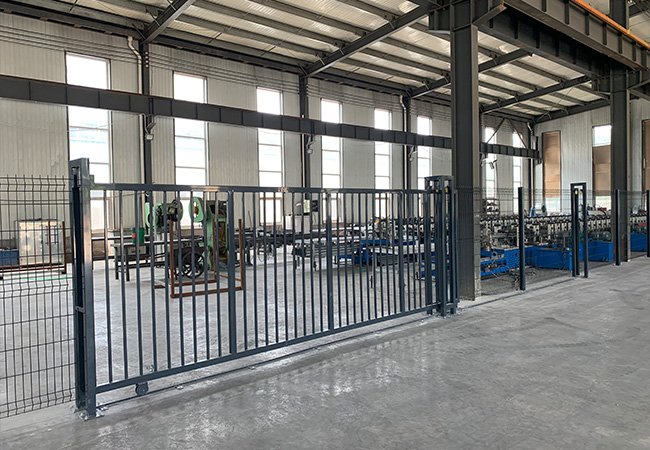

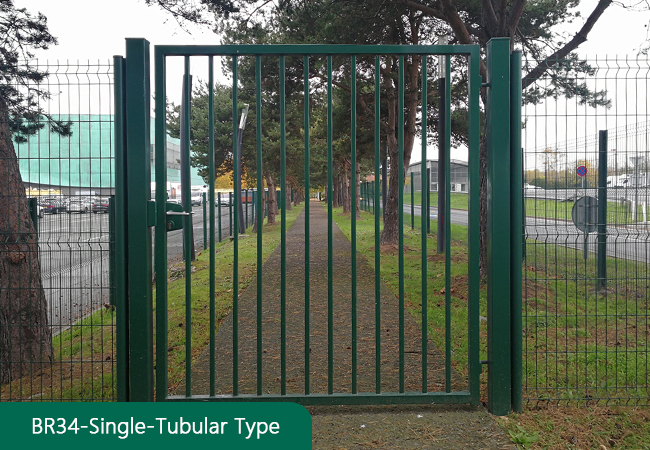
A fence gate is an access component installed within a perimeter fencing system to control the movement of people, vehicles and equipment.
Unlike fixed fence panels, gates include moving parts and require additional consideration of structural support, hinges or rollers, locking systems and operational clearances.
A complete fence gate assembly may include:
- Steel gate frame and infill panels
- Supporting posts
- Hinges or sliding rollers
- Latches and locking devices
- Ground stops or guide rails
- Optional automation and access control equipment
The correct configuration depends on the required opening size, security level and site conditions.
2. Three Main Types of Fence Gates
Single Swing Gate: A Practical Choice for Pedestrian Access
A single swing gate consists of one hinged gate leaf that opens inward or outward.
It is commonly used where access openings are relatively narrow and sufficient swing clearance is available.
Typical applications:
- Residential garden entrances
- School pedestrian access points
- Factory personnel entrances
- Park and recreational area access
- Equipment maintenance passages
Main advantages:
- Relatively simple construction
- Convenient manual operation
- Straightforward installation
- Compatibility with different fence infill styles
- Suitable for controlled pedestrian access
A single swing gate is often an economical solution for smaller openings.
However, the opening direction must not obstruct walkways, emergency routes or nearby equipment.
Double Swing Gate: Wider Access for Vehicles and Equipment
A double swing gate uses two hinged leaves that meet at the center of the opening.
This arrangement is commonly selected when the entrance must accommodate vehicles, deliveries or maintenance equipment.
Typical applications:
- Industrial park entrances
- Construction site vehicle access
- Agricultural property entrances
- Commercial premises
- Warehouse service roads
Main advantages:
- Wider usable entrance
- Balanced two-leaf configuration
- Manual or automated operation
- Customizable opening dimensions
- Compatible with matching fence designs
For example, a 4-meter-wide entrance may be designed using two gate leaves approximately 2 meters wide, subject to the required clear opening and hardware arrangement.
Double swing gates require sufficient clearance for both leaves to open safely.
Sliding Fence Gate: Efficient Access Without Swing Clearance
A sliding fence gate moves horizontally along the fence line rather than swinging into the entrance area.
This makes sliding gates especially useful where driveway depth is limited or vehicle movement must remain unobstructed.
Typical applications:
- Logistics centers
- Factory entrances
- Commercial parking areas
- Industrial warehouses
- Large security compounds
Main advantages:
- No inward or outward swing arc
- Suitable for wider vehicle openings
- Can support automated operation
- Useful for frequent vehicle access
- Compatible with access control systems
Two common configurations are available.
Track Sliding Gate
The gate travels along a ground-mounted track.
This configuration requires suitable ground conditions and regular track maintenance to prevent debris from affecting movement.
Cantilever Sliding Gate
The gate is supported by a cantilever mechanism without a track crossing the driveway.
This can be useful where the entrance surface must remain clear, although additional side space and a properly engineered support system are required.
3. Single vs Double vs Sliding Fence Gates
| Feature | Single Swing Gate | Double Swing Gate | Sliding Gate |
|---|---|---|---|
| Opening mechanism | One hinged leaf | Two hinged leaves | Horizontal movement |
| Typical use | Pedestrian access | Vehicle access | Industrial vehicle access |
| Space requirement | Swing clearance | Two-leaf swing clearance | Side storage space |
| Installation complexity | Generally lower | Moderate | Generally higher |
| Automation | Optional | Optional | Optional |
| Maintenance focus | Hinges and latch | Hinges, stops and latch | Rollers, guides and drive |
| Suitable for wide openings | Limited | Yes, subject to design | Yes, subject to design |
The best gate type depends on site layout and structural requirements rather than gate width alone.
4. Typical Fence Gate Specifications
BenDin can discuss customized gate configurations based on project drawings and technical requirements.
The following figures are indicative planning ranges, not a fixed catalog or guaranteed engineering limits.
| Parameter | Typical Planning Options |
|---|---|
| Gate Type | Single Swing / Double Swing / Sliding |
| Frame Material | Carbon Steel / Galvanized Steel |
| Single Gate Opening | Approximately 1.0–2.0 m |
| Double Gate Opening | Approximately 3.0–6.0 m |
| Sliding Gate Opening | Approximately 3.0–10.0 m |
| Gate Height | Approximately 1.2–3.0 m |
| Frame Profiles | Square / Rectangular Steel Tube |
| Infill Options | Welded Mesh / Tubular / Chain Link / Security Mesh |
| Surface Finish | Galvanized / Powder Coated / Duplex Coating |
| Common Colors | RAL 6005 / RAL 7016 / RAL 9005 |
| Operation | Manual / Automated |
| Locking Options | Mechanical Lock / Electric Lock / Access Control |
Important: Actual dimensions, steel section sizes, hinge capacity, foundations and automation equipment must be confirmed for the specific gate design and expected loading.
5. Matching Fence Gates with Different Fencing Systems
A fence gate should complement the main perimeter fence in both appearance and security performance.
358 Security Fence Gates
358 security fencing is commonly selected for locations requiring restricted access and enhanced perimeter protection.
Matching gates may use closely spaced welded mesh infill and appropriate locking hardware.
Potential applications include:
- Utility compounds
- Industrial security zones
- Data center perimeters
- Restricted infrastructure facilities
Gate frames, gaps, locks and access control equipment should be evaluated as part of the complete security design.
3D Welded Mesh Fence Gates
3D welded mesh fencing is widely used for schools, industrial parks, residential communities and commercial boundaries.
Matching gates can use welded mesh infill, coordinated colors and compatible supporting posts.
This helps maintain a consistent appearance across the perimeter.
Tubular Steel Fence Gates
Tubular steel gates are suitable for projects that require an architectural or decorative appearance.
Common applications include:
- Residential developments
- Commercial buildings
- Municipal facilities
- Public entrances
Vertical pickets, horizontal rails and powder-coated finishes can be coordinated with the surrounding fence.
Chain Link Fence Gates
Chain link gate systems offer a practical solution for sports facilities, agricultural properties, construction sites and industrial yards.
They commonly use steel tube frames with chain link mesh infill.
Available configurations may include pedestrian swing gates, double vehicle gates and larger sliding entrances.
6. How to Choose the Right Fence Gate
Step 1: Confirm the Required Clear Opening
Measure the actual usable width needed for people, vehicles or equipment.
Do not confuse the overall gate frame width with the clear passage width.
For vehicle entrances, consider:
- Vehicle width
- Turning radius
- Delivery frequency
- Emergency access requirements
Step 2: Evaluate Available Installation Space
For swing gates, confirm that the leaves can open without blocking traffic or nearby structures.
For sliding gates, verify that sufficient unobstructed space exists along the fence line.
Cantilever sliding gates generally require additional side storage length beyond the clear opening.
Step 3: Select the Appropriate Frame Structure
Gate frames must support their own weight and resist expected operating and environmental loads.
The design should consider:
- Gate dimensions
- Infill weight
- Wind exposure
- Hinge or roller loads
- Opening frequency
Larger gates may require reinforced frames, posts and foundations.
Step 4: Choose Surface Protection
Outdoor gates are exposed to moisture, temperature changes and repeated handling.
Common options include:
Hot-Dip Galvanizing
Provides zinc-based corrosion protection for steel components.
Powder Coating
Offers decorative colors and additional surface protection when applied over a suitable prepared substrate.
Galvanizing Plus Powder Coating
A duplex finish may be selected for projects requiring both corrosion protection and architectural appearance.
Coating selection should reflect the installation environment and project specifications.
Step 5: Determine Access Control Requirements
A basic pedestrian gate may only need a mechanical latch.
An industrial vehicle entrance may require:
- Electric locking
- Access card readers
- Remote controls
- Vehicle detection
- Emergency release arrangements
- Safety sensors
Automated gates require an appropriate safety assessment and suitable protective devices. Relevant requirements depend on the destination market, gate design and installation.
7. Illustrative Project Example: Logistics Warehouse Access
Consider a logistics facility requiring controlled access through an industrial perimeter fence.
The proposed project has two entrance types:
- Main truck entrance
- Separate personnel entrance
Example Configuration
| Item | Main Vehicle Entrance | Personnel Entrance |
|---|---|---|
| Gate Type | Sliding Gate | Single Swing Gate |
| Clear Opening | 6.0 m | 1.2 m |
| Gate Height | 2.0 m | 2.0 m |
| Infill | Welded Mesh | Welded Mesh |
| Frame | Reinforced Steel | Steel Tube |
| Finish | Galvanized + Powder Coated | Galvanized + Powder Coated |
| Operation | Automated | Manual |
| Access Control | Vehicle Access System | Mechanical / Electronic Lock |
Why This Configuration?
The sliding gate avoids the large swing area that a truck entrance would otherwise require.
The separate pedestrian gate allows personnel to enter without opening the vehicle gate.
Matching mesh infill and finishes maintain visual consistency across the facility.
This arrangement can help organize access routes and reduce unnecessary vehicle-gate operations.
This is an illustrative design scenario, not a completed BenDin customer project. Final specifications require site measurements, structural design and a safety assessment.
8. Installation and Maintenance Considerations
Proper installation is essential for reliable gate operation.
Supporting Posts and Foundations
Gate posts must be designed for the forces generated by the gate leaf or sliding mechanism.
A post suitable for a fixed fence panel may not be sufficient for a large gate.
Alignment and Movement
Check that:
- Hinges are aligned
- Gate leaves move smoothly
- Sliding guides operate correctly
- Locks engage reliably
- Ground clearance is appropriate
Regular Maintenance
Routine inspections should include:
- Hinges and bearings
- Rollers and guide components
- Fasteners
- Locks
- Coating damage
- Automation and safety devices
Damaged protective coatings should be repaired using an appropriate method to reduce corrosion risk.
9. Common Fence Gate Selection Mistakes
Choosing a Gate Based Only on Price
The cheapest gate may not provide the right frame strength or hardware for frequent operation.
Ignoring Opening Clearance
A double swing gate may be unsuitable where parked vehicles or equipment occupy the swing area.
Using Undersized Gate Posts
Gate posts carry different loads from ordinary fence posts and must be designed accordingly.
Overlooking Automation Safety
Motorized gates introduce moving-part hazards and require suitable safety devices, controls and installation procedures.
Selecting the Wrong Surface Finish
A finish suitable for a sheltered inland location may not be appropriate for a highly corrosive coastal or industrial environment.
10. BenDin Custom Fence Gate Solutions
BenDin offers project-based customization for matching fence gate systems.
Available design considerations include:
- Single, double and sliding configurations
- Custom opening widths and heights
- Steel frame profiles
- Mesh and tubular infill styles
- Supporting posts
- Surface treatment and RAL colors
- Manual locking hardware
- Automation-compatible configurations
- Matching pedestrian and vehicle gates
For international projects, buyers should provide technical drawings or site measurements so that gate dimensions and component requirements can be confirmed before manufacturing.
11. Frequently Asked Questions
What is the difference between a single swing gate and a double swing gate?
A single swing gate uses one hinged leaf, while a double swing gate uses two leaves. Single gates are commonly selected for pedestrian access, whereas double gates are frequently used for wider vehicle entrances.
Is a sliding gate better than a swing gate?
Not necessarily. Sliding gates are useful when swing clearance is limited, but they require sufficient side space and a suitable support mechanism. The best option depends on site conditions.
Can a sliding gate be automated?
Yes. Sliding gates can be configured for automated operation using suitable motors, controls and safety devices.
Can BenDin match gates to existing fence panels?
Gate infill, dimensions and finishes can be customized to coordinate with compatible fencing systems. Existing fence specifications should be provided for confirmation.
Which fence gate is suitable for industrial warehouses?
Double swing gates and sliding gates are both common choices. Sliding gates are often practical for vehicle entrances where driveway clearance is limited.
What information is required for a fence gate quotation?
Buyers should provide the gate type, clear opening width, height, fence style, operating method, coating requirements, installation conditions and destination.
Conclusion: Choose a Complete Fence and Gate System
A well-designed fence gate supports both perimeter security and efficient site access.
Single swing gates are practical for pedestrian entrances, double swing gates accommodate wider passages, and sliding gates offer an alternative where swing clearance is restricted.
The most suitable gate depends on the complete installation, including the surrounding fence, gate posts, foundation, hardware and access control requirements.
BenDin provides customizable fence gate solutions for residential, commercial, industrial and infrastructure applications.
Request a Custom Fence Gate Quotation
Contact BenDin with your project requirements:
Gate type + clear opening width + height + fence infill + surface finish + manual or automatic operation + destination.
Our team can discuss a suitable gate configuration and provide a quotation based on confirmed specifications.