


Edge Protection Barrier Systems for Construction and Industrial Safety
Edge protection barriers are designed to reduce the risk of falls from exposed edges in construction, industrial maintenance and elevated work areas. They provide a physical boundary around locations such as rooftops, floor openings, stairwell edges, platforms and industrial mezzanines.
For contractors and facility managers, selecting an appropriate edge protection system requires more than choosing a guardrail height. The barrier, posts, connections, mounting brackets and supporting structure must work together to provide suitable protection under the expected site conditions.
Bendin (Hebei Bendin Industrial Technology Co., Ltd.) supplies customizable steel safety barriers and welded mesh protection systems for construction and industrial applications. Depending on the project, the system can be configured with different rail arrangements, mesh infill, toe boards, mounting methods and surface treatments.
This guide explains the main edge protection components, specification options, installation considerations and applications for construction and industrial projects.

1. What Is an Edge Protection Barrier?
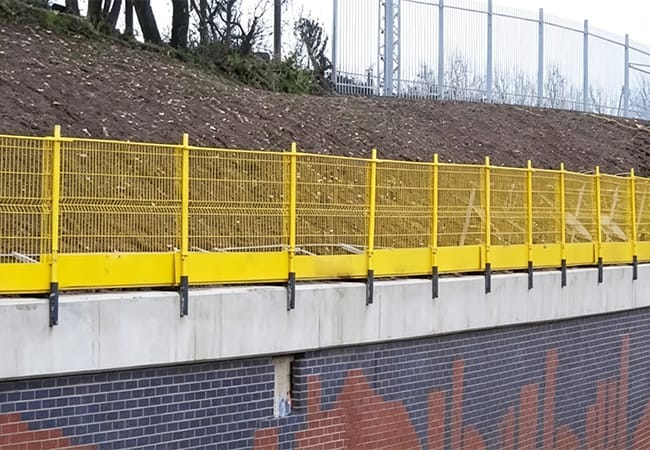
An edge protection barrier is a physical guardrail system installed near an exposed edge to help prevent people from falling to a lower level.
Unlike ordinary perimeter fencing, edge protection is specifically designed around the hazards associated with elevated work areas.
Typical applications include:
- Building rooftops
- Exposed floor edges
- Stairwell openings
- Construction platforms
- Industrial mezzanines
- Loading platforms
- Maintenance walkways
- Selected bridge and infrastructure work areas
A complete system may include:
- Top rails
- Intermediate rails
- Steel posts
- Mesh or other infill
- Toe boards where required
- Base plates or mounting brackets
- Clamps and fasteners
- Corner and end connections
The required configuration depends on the application, the potential fall hazard, the supporting structure and the applicable safety requirements.
2. Main Components of an Edge Protection System
Top Rail
The top rail provides the main upper barrier and must be designed to meet the applicable height and loading requirements.
Intermediate Rail
An intermediate rail or equivalent infill helps reduce the open space between the top rail and the working surface.
Posts
Posts support the rails and transfer loads into the supporting structure.
Their dimensions, spacing, connections and mounting method influence the stability of the complete system.
Mesh Infill
Welded mesh infill can be used where a more continuous barrier is required.
It may help prevent people from passing through larger openings and can provide additional containment for certain small objects when properly designed.
Toe Board
A toe board may be required where there is a risk of tools, materials or other objects falling from an elevated work area.
The required height and construction depend on the applicable standard and project conditions.
Mounting Brackets
Mounting components connect the barrier to the supporting structure.
Possible configurations include:
- Top-mounted brackets
- Side-mounted brackets
- Clamp-mounted supports
- Counterweighted systems for suitable applications
Not every mounting method is suitable for every roof, slab or platform. The supporting structure and the anticipated loads must be evaluated before installation.
3. Typical Edge Protection Specifications
Bendin can discuss customized barrier configurations according to project drawings and technical requirements.
The following table provides indicative manufacturing options rather than a universal safety specification.
| Parameter | Typical Options |
|---|---|
| Product Type | Edge Protection Barrier |
| Main Material | Carbon Steel / Galvanized Steel |
| Rail Configuration | Top Rail + Intermediate Rail |
| Typical Barrier Height | Approximately 1.0–1.2 m, subject to applicable requirements |
| Infill | Open Rails / Welded Mesh / Project-Specific |
| Toe Board | Optional or required according to the application |
| Post Type | Square / Rectangular Steel Tube |
| Mounting | Base Plate / Side Bracket / Clamp / Engineered Support |
| Surface Treatment | Hot-Dip Galvanized / Powder Coated |
| Colors | Galvanized Finish / Yellow / RAL Colors |
| Panel Width | Customized according to project |
| Connection | Bolted / Clamped / Project-Specific |
| Customization | Height / Width / Brackets / Infill / Accessories |
Final dimensions, material grades, post spacing and connection details must be confirmed against the relevant project specification and applicable safety requirements.
4. Edge Protection for Rooftops
Rooftop work can expose workers to unprotected edges, roof openings and changes in level.
An appropriate edge protection system can establish a physical boundary around designated work areas.
Before selecting a rooftop barrier, the project team should confirm:
- Roof edge geometry
- Parapet height
- Roof construction
- Waterproofing requirements
- Available mounting locations
- Wind exposure
- Maintenance access
- Required fall protection arrangement
Where drilling could damage waterproofing or the roof structure, an alternative mounting method may be considered, provided the complete system meets the applicable engineering and safety requirements.
Counterweighted systems must be specifically designed for the site. Their stability should not be assumed based solely on the weight of the base.
5. Edge Protection for Floor Edges and Stairwell Openings
Construction floors and stairwell openings may change throughout a project as structural work progresses.
Modular edge protection can help contractors establish temporary barriers and relocate them as construction advances.
A suitable configuration may include:
- Steel guardrail panels
- Intermediate rails or mesh infill
- Secure post connections
- Appropriate base or slab-edge mounting
- Toe boards where required
- Clearly identified access points
Openings used for material transport or stair access need particular attention because a barrier must not obstruct necessary access or create additional hazards.
The installation should be inspected whenever the barrier is moved or modified.
6. Edge Protection for Industrial Mezzanines and Platforms
Industrial mezzanines and elevated platforms may be used for equipment access, storage, maintenance and production operations.
The edge protection system should consider:
- Personnel movement
- Material handling
- Equipment access
- Potential falling objects
- Cleaning and maintenance
- Exposure to industrial environments
Welded mesh infill can be considered where a more enclosed barrier is appropriate.
For loading platforms or areas where materials are transferred, the system may need additional components or a separate loading-gate arrangement.
The final design should be coordinated with the facility’s operating procedures and applicable safety requirements.
7. Material Selection and Corrosion Protection
Steel edge protection may be exposed to rain, humidity, industrial contaminants and outdoor temperature changes.
Bendin can discuss several surface treatment options.
Hot-Dip Galvanizing
Hot-dip galvanizing provides a zinc coating that helps protect fabricated steel components against corrosion.
It can be considered for outdoor construction and industrial applications.
Powder Coating
Powder coating provides a decorative finish and additional surface protection when applied over an appropriately prepared substrate.
High-visibility colors may be selected where required by the project.
Galvanizing Plus Powder Coating
A duplex coating system combines zinc protection with a decorative organic finish.
The appropriate coating depends on the environmental exposure, maintenance requirements and project specification.
Corrosion resistance alone does not establish that a barrier is suitable for a particular safety application. Structural strength, connections, installation and inspection remain essential.
8. Edge Protection Standards: What Buyers Should Check
Edge protection requirements differ according to the type of installation and the country where the system will be used.
ISO 14122-3
ISO 14122-3:2016 covers stairs, stepladders and guardrails associated with permanent means of access to machinery. It can also apply to certain building or civil-construction access structures when their main function is to provide access to machinery. It should not be treated as a universal certification for every temporary construction edge protection system. (ISO official standard page)
United States OSHA Requirements
For construction work in the United States, OSHA 29 CFR 1926.502(b) specifies requirements for guardrail systems, including top-rail height and load resistance. The applicable requirements should be checked for the specific work activity and installation. (OSHA 1926.502)
For example, the construction guardrail provisions generally specify a top-rail height of 42 inches, plus or minus 3 inches, above the walking or working level, along with requirements for intermediate protection and structural loading. (OSHA guardrail guidance)
Project-Specific Requirements
Depending on the destination market, other national standards, temporary works requirements, building codes and client specifications may apply.
Before manufacturing, the buyer should identify:
- The relevant standard and edition
- Whether the system is temporary or permanent
- Required barrier height
- Required load or test criteria
- Permitted mounting method
- Toe-board requirements
- Required inspection documents
Bendin can review customer specifications and discuss a suitable product configuration. Compliance should only be claimed when supported by the relevant design, testing and documentation.
9. Installation Considerations
Correct installation is essential to the performance of an edge protection system.
Step 1: Site Assessment
Confirm the exposed edge, supporting structure, access requirements and potential fall hazards.
Step 2: Select the Mounting Method
Choose the bracket, base plate or other mounting arrangement according to the structural design and site conditions.
Step 3: Install Posts
Position the posts according to the approved layout and secure them using the specified fixing method.
Step 4: Fit Rails and Infill
Install top rails, intermediate rails, mesh panels and toe boards where required.
Step 5: Inspect Connections
Check fasteners, clamps, brackets and rail connections.
Step 6: Verify the Complete System
The responsible competent person should inspect the completed installation against the applicable project requirements before the protected area is used.
Any modification or relocation should be followed by the required reinspection.
10. Illustrative Project Example: Industrial Mezzanine
An industrial facility plans to install edge protection around a maintenance mezzanine used by technicians and maintenance personnel.
The preliminary system may include:
| Item | Example Configuration |
|---|---|
| Application | Industrial Mezzanine |
| Barrier Type | Steel Guardrail |
| Top Rail | Steel Tube |
| Intermediate Protection | Rail or Welded Mesh |
| Toe Board | According to risk assessment and requirements |
| Mounting | Engineered Base Plate |
| Surface Treatment | Galvanized or Powder Coated |
| Access | Designated Gate or Controlled Opening |
| Inspection | According to project requirements |
The project team should verify the slab structure, fixing capacity, barrier height, loading requirements, and any risk of tools or materials falling to the level below.
This is an illustrative configuration, not a completed Bendin customer project or a certified system design.
11. Common Edge Protection Selection Mistakes
Choosing Height Without Checking the Standard
Barrier height should be determined according to the applicable requirements rather than a universal product dimension.
Ignoring the Supporting Structure
A strong guardrail can still fail if its bracket, anchor or supporting slab is unsuitable.
Omitting Intermediate Protection
Top rails alone may leave openings that do not meet the requirements of the application.
Forgetting Falling-Object Risks
Where tools or materials could fall from an elevated platform, toe boards or additional containment may be necessary.
Treating Every Mounting Method as Interchangeable
A base plate, clamp and counterweighted base transfer loads differently and require appropriate design.
Assuming a Product Is Certified for All Markets
Compliance depends on the specific system, intended use, applicable standard and supporting documentation.
12. Bendin Edge Protection Customization
Bendin supplies customizable steel safety barriers for construction and industrial applications.
Project-specific options may include:
- Barrier height
- Panel width
- Rail dimensions
- Mesh infill
- Post profile
- Toe boards
- Mounting brackets
- Base plates
- Surface treatment
- Color
- Gate or access configuration
- Packaging and export requirements
Customers can provide drawings, site dimensions, applicable standards and installation details for review before production.
For high-risk applications, the final design and installation should be reviewed by the responsible engineer or competent safety professional.
13. Frequently Asked Questions
What is an edge protection barrier?
It is a physical guardrail or barrier installed near an exposed edge to help prevent people from falling to a lower level.
Where are edge protection barriers used?
Common applications include rooftops, floor edges, stairwell openings, mezzanines, elevated platforms and maintenance walkways.
Is ISO 14122-3 applicable to all edge protection systems?
No. ISO 14122-3 addresses stairs, stepladders and guardrails associated with permanent access to machinery, including certain access structures in buildings or civil construction. Other applications may require different standards or regulations.
Can edge protection barriers include mesh panels?
Yes. Welded mesh can be used as intermediate protection where appropriate, subject to the system design and applicable requirements.
Can Bendin customize the mounting system?
Mounting options can be discussed according to the supporting structure, site dimensions and project requirements. The final mounting method must be suitable for the intended loads and installation conditions.
Is galvanizing sufficient for every outdoor application?
Not necessarily. Coating selection depends on environmental exposure, maintenance requirements and the specified service conditions.
14. Request an Edge Protection Barrier Quotation
An effective edge protection system combines a suitable barrier structure with correctly designed posts, connections, mounting components and installation procedures.
For construction and industrial projects, the required configuration should be determined by the exposed-edge hazards, applicable standards, supporting structure and intended use.
Bendin supplies customizable steel safety barriers for project-specific applications.
For a quotation, provide:
- Application and installation location
- Required barrier height and length
- Rail or mesh configuration
- Mounting method
- Toe-board requirements
- Applicable standard
- Surface treatment
- Project quantity
- Delivery destination
Bendin can review the available information and discuss a suitable product configuration for your project.