


Diamond Mesh Fence: Chain Link Mesh Specifications, Materials and Applications
Diamond mesh fencing is a versatile perimeter protection solution used in sports facilities, industrial properties, agricultural land, residential boundaries and outdoor enclosures.
Also known as chain link fencing, diamond wire mesh fencing is manufactured by interweaving steel wires into a continuous diamond-shaped pattern. Its flexible structure, open visibility and range of material options make it suitable for projects requiring practical boundary protection.
BenDin (Hebei Bendin Industrial Technology Co., Ltd.) provides customizable chain link and diamond mesh fencing products for contractors, distributors, project developers and international buyers.
This guide explains how diamond mesh fencing is manufactured, which specifications are commonly available and how to choose the right material and mesh configuration for different applications.
1. What Is a Diamond Mesh Fence?
A diamond mesh fence is a woven wire fencing system formed by interlocking spirally shaped steel wires.
Unlike welded mesh panels, which use welded intersections, chain link mesh is created through a weaving process.
The resulting mesh features repeating diamond-shaped openings.
A complete diamond mesh fence system typically includes:
- Woven steel wire mesh
- Terminal and intermediate posts
- Tension wires or rails
- Tension bars and fittings
- Optional gates
- Ground anchoring or foundations
Diamond mesh fencing is often supplied in rolls, making transportation and installation practical for long perimeter projects.
The mesh is flexible, but the overall strength and security of the finished fence depend on wire diameter, mesh opening, post spacing, tensioning and installation quality.

2. How Diamond Mesh Fence Is Manufactured
Step 1: Steel Wire Selection
The manufacturing process begins with steel wire selected according to the required diameter, strength and surface protection.
Common material options include:
- Galvanized low-carbon steel wire
- PVC-coated galvanized steel wire
- Stainless steel wire
Each material has different characteristics and cost implications.
Step 2: Wire Forming and Weaving
Specialized chain link weaving equipment forms wire into spiral shapes.
Adjacent wire spirals are interlocked to create a continuous diamond-shaped mesh.
This process produces a flexible woven structure without welded intersections.
Step 3: Edge Finishing
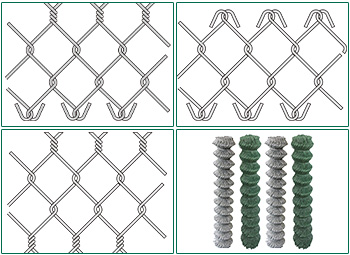
Depending on the application, mesh edges may be finished with:
- Knuckled edges
- Twisted edges
- Knuckled and twisted edges
Knuckled edges are often selected where a smoother edge is desirable.
Twisted edges may be specified for certain security fencing applications.
The appropriate edge treatment depends on the project requirements and safety considerations.
Step 4: Rolling and Packaging
Finished mesh is rolled for transportation and storage.
Roll dimensions, packaging and labeling can be selected according to the order requirements.
3. Typical Diamond Mesh Fence Specifications
BenDin can discuss customized mesh specifications based on the intended application.
| Parameter | Typical Options |
|---|---|
| Product Name | Diamond Mesh Fence / Chain Link Fence |
| Material | Low-Carbon Steel / Stainless Steel |
| Wire Diameter | 2.0 / 2.5 / 3.0 / 3.5 / 4.0 / 5.0 mm |
| Mesh Opening | 25 × 25 / 40 × 40 / 50 × 50 / 60 × 60 / 75 × 75 mm |
| Mesh Height | 1.0–3.6 m |
| Roll Length | 10 / 15 / 20 / 25 / 30 m |
| Surface Treatment | Galvanized / PVC-Coated |
| Common Colors | Green / Black / Custom |
| Edge Treatment | Knuckled / Twisted |
| Installation | Steel Posts and Tensioning Accessories |
| Customization | Wire Size / Mesh Opening / Roll Dimensions / Color |
These are indicative specification options. Actual manufacturing availability, wire diameter measurement and mesh tolerances should be confirmed before ordering.
For PVC-coated products, buyers should clarify whether the specified wire diameter refers to the steel core or the finished coated wire.
4. Diamond Mesh Fence Material Options
Galvanized Diamond Mesh Fence
Galvanized chain link mesh uses zinc-coated steel wire to provide corrosion protection.
It is commonly selected for:
- Industrial boundaries
- Agricultural fencing
- Construction areas
- General outdoor perimeter projects
The level of corrosion protection depends on the galvanizing process, zinc coating characteristics and environmental exposure.
PVC-Coated Diamond Mesh Fence
PVC-coated chain link fencing combines a steel wire core with an external polymer coating.
Typical advantages include:
- Decorative color options
- Additional surface protection
- Compatibility with landscape settings
Common applications include:
- Sports facilities
- Residential properties
- Parks
- Schools
The coating specification should be selected according to the expected outdoor conditions.
Stainless Steel Diamond Mesh Fence
Stainless steel mesh may be considered for projects requiring specific corrosion resistance or material properties.
The appropriate stainless steel grade depends on the environment and application.
It generally has a higher material cost than conventional galvanized steel mesh.
5. Diamond Mesh Fence Applications
Sports Courts and Athletic Facilities
Chain link fencing is commonly used around:
- Tennis courts
- Basketball courts
- Multi-purpose sports grounds
- Recreational facilities
Its open mesh structure maintains visibility and allows airflow.
For sports applications, the selected mesh opening, wire diameter, height and tensioning system should reflect the type of activity and expected ball impact.
A suitable sports fence may also require additional top rails, reinforcement or protective details.
Industrial and Warehouse Perimeters
Diamond mesh fencing provides a practical boundary solution for industrial sites.
Typical applications include:
- Factory boundaries
- Warehouse compounds
- Storage yards
- Logistics facilities
- Equipment separation areas
For higher-security applications, additional measures such as controlled gates, surveillance and suitable anti-climb design may be necessary.
Agricultural and Farm Fencing
Chain link mesh can be used to define boundaries around agricultural properties.
Applications include:
- Farm boundaries
- Equipment storage areas
- Selected livestock enclosures
- Agricultural facilities
Mesh opening, fence height and wire strength should be chosen according to the animals and intended containment function.
Residential and Garden Fencing
PVC-coated diamond mesh is frequently selected for residential boundaries and outdoor recreational spaces.
Its flexible construction can accommodate changes in terrain when supported by a suitable post and tensioning system.
Animal Enclosures
Diamond mesh may be used in selected animal enclosure applications.
However, the wire material, opening size, edge treatment and installation details must be selected for the particular species.
A general-purpose chain link mesh is not automatically suitable for every animal enclosure.
6. How to Choose the Right Mesh Opening
Mesh opening affects visibility, material usage and the types of objects that can pass through the fence.
| Mesh Opening | General Selection Considerations |
|---|---|
| 25 × 25 mm | Smaller openings for selected enclosure or specialty uses |
| 40 × 40 mm | Smaller-opening perimeter applications |
| 50 × 50 mm | Common general-purpose fencing option |
| 60 × 60 mm | General perimeter fencing where larger openings are acceptable |
| 75 × 75 mm | Larger-opening fencing for suitable low-security applications |
These are general selection examples, not universal rules.
The final opening size should reflect security needs, sports requirements, animal containment or other project-specific criteria.
7. How Wire Diameter Affects Fence Performance
Wire diameter is an important factor in chain link fence selection.
Thicker steel wire generally provides greater individual wire strength and stiffness, although finished fence performance also depends on material grade, mesh size and installation.
For example:
2.0–2.5 mm wire
May be considered for selected light-duty applications.
3.0–3.5 mm wire
Commonly considered for general-purpose perimeter fencing.
4.0–5.0 mm wire
May be selected for applications requiring a heavier-duty mesh structure.
The correct wire diameter should be determined by the expected loading and required performance rather than by thickness alone.
8. Diamond Mesh Fence vs Welded Mesh Fence
Both chain link and welded mesh fencing are widely used for perimeter protection, but their construction methods differ.
| Feature | Diamond Mesh Fence | Welded Mesh Fence |
|---|---|---|
| Manufacturing | Interwoven Wire | Welded Wire Intersections |
| Mesh Pattern | Diamond | Usually Rectangular or Square |
| Structure | Flexible | Generally More Rigid |
| Supply Form | Commonly Rolls | Commonly Panels |
| Terrain Adaptability | Flexible Mesh Can Assist Installation | Requires Suitable Panel Arrangement |
| Common Applications | Sports, Agriculture, General Perimeters | Residential, Industrial, Security |
| Installation | Posts and Tensioning | Posts and Panel Fixings |
Neither system is universally better.
Diamond mesh fencing is useful where a continuous woven mesh and adaptable installation are preferred.
Welded mesh fencing may be more suitable where rigid prefabricated panels and a particular architectural appearance are required.
9. Illustrative Project Example: Outdoor Tennis Court Fencing
Consider a sports facility planning a chain link fence around a group of outdoor tennis courts.
The proposed fencing system has the following preliminary requirements.
| Item | Example Specification |
|---|---|
| Application | Outdoor Tennis Court Boundary |
| Approximate Fence Length | 240 m |
| Fence Height | 3.0 m |
| Mesh Opening | 45–50 mm Nominal |
| Wire Diameter | 3.0 mm Steel Core |
| Finish | PVC-Coated Galvanized Wire |
| Color | Green |
| Support | Steel Posts with Rails and Tensioning |
| Access | Pedestrian Gates |
Preliminary Mesh Quantity
If the selected roll length is 20 meters:
240 m ÷ 20 m = 12 nominal rolls
This calculation is for initial material planning only.
Actual quantities should account for:
- Gate openings
- Mesh joining
- Tensioning details
- Cutting allowances
- Site geometry
- Installation waste
The post layout, foundation design and sports-specific requirements must be established separately.
This is an illustrative project example, not a completed BenDin customer project.
10. Installation Considerations
A diamond mesh fence performs best when the complete installation system is designed correctly.
Post Spacing
Post spacing depends on the fence height, wire specifications, expected loads and support arrangement.
Mesh Tension
Proper tensioning helps maintain mesh alignment and reduces excessive sagging.
Terminal and Corner Posts
End posts, corner posts and gate posts often experience different loads from intermediate posts.
They should be designed accordingly.
Ground Conditions
Installation methods should consider soil type, slope, drainage and foundation requirements.
Gates and Access Points
Matching gates should provide the required clear opening and appropriate locking arrangements.
11. Custom Diamond Mesh Fence Manufacturing
BenDin provides project-based customization for chain link and diamond mesh fencing.
Customization can include:
- Steel wire diameter
- Mesh opening
- Fence height
- Roll length
- Galvanized or polymer-coated finishes
- Colors
- Edge treatment
- Compatible posts and accessories
- Packaging requirements
For OEM and ODM inquiries, buyers should provide drawings, technical specifications or reference samples where available.
12. Quality Inspection
A practical quality inspection process for diamond mesh fencing may include:
- Wire diameter measurement
- Mesh opening inspection
- Roll height and length verification
- Edge finish inspection
- Coating appearance checks
- Packaging verification
Where coating thickness, tensile properties or other performance criteria are required, the relevant test methods and acceptance values should be agreed upon in advance.
13. Frequently Asked Questions
Is diamond mesh fence the same as chain link fence?
Yes. Diamond mesh fence is a common descriptive name for chain link fencing because the woven wires form diamond-shaped openings.
Is diamond mesh fence the same as gabion mesh?
No. Chain link fencing is typically made from interwoven wire spirals, while gabion mesh is used in stone-filled retaining or erosion-control structures and commonly has a different construction.
Which coating is better for outdoor use?
Galvanized and PVC-coated options can both be suitable. Selection depends on climate, desired appearance, coating specifications and maintenance expectations.
Can diamond mesh fencing be used for tennis courts?
Yes. Chain link fencing is commonly used for tennis courts, provided that mesh size, height, wire strength and installation details meet the facility’s requirements.
Can BenDin customize mesh size and wire diameter?
Yes. Custom dimensions can be discussed according to production capabilities and project specifications.
Is diamond mesh suitable for uneven terrain?
Its flexible woven structure can help accommodate certain changes in terrain, but correct post placement, tensioning and ground clearance remain important.
14. Request a Diamond Mesh Fence Quotation
BenDin supplies customizable diamond mesh and chain link fencing solutions for sports facilities, industrial properties, agricultural projects and general perimeter applications.
For an accurate quotation, please provide:
Application + mesh opening + wire diameter + fence height + roll length + surface finish + quantity + destination.
Contact BenDin to discuss a diamond mesh fencing configuration based on your project requirements.