



Australian Standard Temporary Fence: AS/NZS 4687 Guide, Specifications & Applications
Temporary fencing is an essential part of construction-site safety, public-area management, road works, events, and temporary access control. In Australia and New Zealand, temporary fencing systems must be selected with particular attention to structural stability, wind conditions, visibility, corrosion resistance, connection methods, and site-specific safety requirements.
For contractors, distributors, and project managers sourcing temporary fencing from China, understanding the requirements behind AS/NZS 4687 is important before selecting a supplier or finalizing a project specification.
Bendin (BenDin) provides temporary fence panels and accessories for international projects, with customizable panel dimensions, wire configurations, frame sizes, surface treatments, bases, clamps, and safety accessories.
What Is Australian Standard Temporary Fencing?
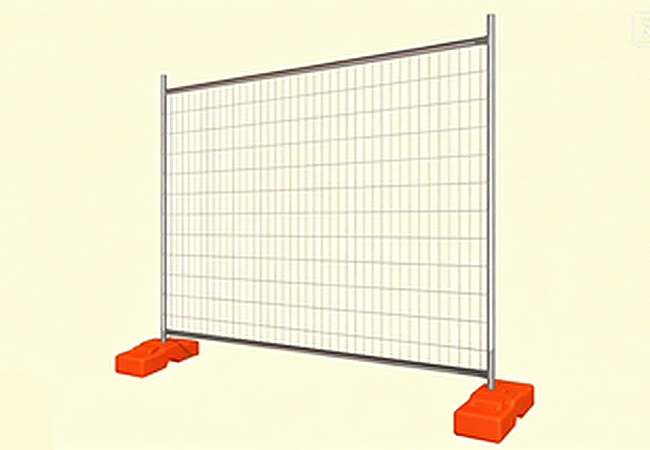
Australian standard temporary fencing generally refers to temporary barrier systems designed for controlled separation of construction areas, public spaces, work zones, events, and other locations where permanent fencing is not required.
Unlike a simple wire barrier, a complete temporary fencing system normally consists of:
- Welded wire mesh panels
- Steel perimeter frames
- Temporary fence feet or bases
- Panel clamps or connectors
- Gates where required
- Warning or safety signage
- Optional privacy screening
- Optional bracing and wind-stabilization components
The complete system must be considered as a unit. Panel strength alone does not determine the stability of a temporary fence. Ground conditions, panel configuration, base weight, connection method, wind exposure, and installation arrangement can all affect actual performance.
For projects requiring compliance with AS/NZS 4687, the applicable requirements should be confirmed for the specific installation, location, configuration, and project conditions rather than assuming that a standard panel automatically meets every site requirement.
Why AS/NZS 4687 Matters for Temporary Fence Projects
Temporary fencing is frequently installed in environments where conditions can change quickly. A construction site may experience strong winds, heavy equipment movement, frequent access, temporary pedestrian routes, and repeated installation and removal.
A suitable temporary fence therefore needs to balance five major factors:
1. Structural Stability
The panel, frame, base, and connector should work together as a stable system. Heavy-duty bases can improve resistance to movement, while additional bracing may be required for exposed or high-wind locations.
2. Safe Connections
Panel-to-panel connections should be secure while still allowing rapid installation and removal. Proper clamps reduce unwanted movement between adjacent panels.
3. Visibility
Open welded mesh allows workers and site managers to maintain visual contact with the protected area. High-visibility mesh or warning accessories can further improve awareness around construction zones.
4. Corrosion Resistance
Temporary fences are often stored outdoors and reused on multiple projects. Galvanized or coated steel can reduce corrosion and extend the usable life of the panels.
5. Reusability
A modular system can be dismantled, transported, stored, and installed again. This makes temporary fencing particularly economical for contractors managing multiple projects.
Bendin Temporary Fence System for Australian Projects
Bendin manufactures welded temporary fence panels using automated welding equipment designed to maintain consistent mesh openings, frame dimensions, and welding quality.
The system can be configured according to the requirements of different construction and infrastructure projects.
Typical Temporary Fence Specifications
| Item | Typical Options |
|---|---|
| Panel Type | Welded wire mesh panel |
| Panel Length | 2.0 m, 2.1 m, 2.4 m, 2.5 m and customized |
| Panel Height | 1.8 m, 2.0 m, 2.1 m and customized |
| Wire Diameter | Approx. 3.0–5.0 mm |
| Mesh Opening | Commonly 50 × 100 mm, 60 × 150 mm and customized |
| Frame Tube | Round or square steel tube |
| Surface Treatment | Electro-galvanized, hot-dip galvanized, powder coated |
| Mesh Color | Galvanized, green, black, orange, yellow or customized |
| Base | Plastic, recycled material or heavy-duty steel base options |
| Connection | Temporary fence clamps / couplers |
| Gate | Single gate, double gate or customized access gate |
| Accessories | Bracing, signage, privacy screen, wheels and safety accessories |
Final dimensions and material specifications should be confirmed according to the project drawings, applicable local requirements, wind conditions, and installation method.
Heavy-Duty Base Options
The base is one of the most important components of a temporary fencing system.
For normal construction sites, standard temporary fence feet can provide a practical combination of stability and portability. For exposed locations or projects subject to stronger wind loads, heavier bases and additional bracing can be specified.
Bendin can customize base dimensions, material, weight, connector position, and panel compatibility according to project requirements.
This allows contractors to select a configuration according to actual site conditions rather than using one identical system for every project.
Surface Treatment for Australian Outdoor Conditions
Australia contains a wide range of climates, from dry inland environments to humid coastal regions. Temporary fencing used outdoors therefore requires appropriate corrosion protection.
Electro-Galvanized Finish
Electro-galvanized wire provides a smooth appearance and basic corrosion resistance. It can be suitable for temporary projects where exposure time and environmental conditions are relatively moderate.
Hot-Dip Galvanized Finish
Hot-dip galvanizing provides a thicker zinc coating and is generally more suitable for repeated outdoor use and projects exposed to moisture.
Galvanized + Powder Coating
A duplex system combining galvanizing with powder coating provides an additional protective layer and allows the fence to be supplied in different colors.
For projects near the coast or in particularly aggressive environments, the required coating system should be selected according to the expected exposure conditions and project service requirements.
High-Visibility Temporary Fence for Construction Sites
Visibility is particularly important where temporary fencing separates construction areas from pedestrians, vehicles, workers, or public access routes.
Bendin temporary fencing can be supplied with high-visibility mesh or colored coatings, including commonly requested orange and yellow configurations.
Additional safety features can include:
- Warning signs
- Reflective strips
- High-visibility mesh
- Access gates
- Pedestrian gates
- Privacy screening
- Safety barriers
- Stabilizing braces
The objective is not simply to make the fence more visible, but to make the temporary work boundary easier for workers, visitors, and pedestrians to recognize.
Australian Temporary Fence Applications
1. Construction Sites
Temporary fence panels can establish a clear boundary around residential construction, commercial buildings, infrastructure works, and renovation projects.
The modular structure allows the fence line to be changed as construction progresses.
2. Road and Municipal Works
Temporary fencing can separate roadwork areas from pedestrians and vehicles while providing controlled access for workers and equipment.
For projects involving public roads, the complete traffic-management and barrier arrangement should be designed according to the applicable local requirements.
3. Mining and Industrial Projects
Large industrial projects often require temporary boundaries around equipment, storage areas, material yards, and construction zones.
Heavy-duty panels and reinforced bases can be selected for demanding environments.
4. Events and Public Areas
Temporary fencing is also suitable for exhibitions, outdoor events, sports activities, concerts, and temporary crowd-management areas.
Different configurations can be used for pedestrian channels, restricted areas, service entrances, and temporary gates.
5. Emergency and Temporary Isolation
When a damaged structure, construction area, or restricted zone requires rapid isolation, modular temporary fence panels can be transported and installed quickly.
Project Example: Temporary Construction-Site Perimeter
A typical Australian construction project may require temporary fencing around a developing commercial site.
Instead of installing permanent fencing at the beginning of construction, the contractor can use modular temporary panels to create the initial site boundary.
A practical configuration may include:
- 2.1 m high welded mesh panels
- Heavy-duty temporary fence bases
- Galvanized steel frames
- Panel-to-panel clamps
- Dedicated vehicle access gate
- Pedestrian access gate
- High-visibility warning signs
- Optional privacy screening along selected sections
As construction progresses, individual panels can be removed and repositioned without dismantling the entire fence line.
This reduces material waste and allows the temporary perimeter to follow changes in the construction layout.
Project Example: Coastal Construction Environment
A coastal project presents a different challenge because temporary fencing may be exposed to humid air and salt-laden conditions.
For this type of application, the contractor may specify:
- Hot-dip galvanized welded panels
- Additional powder coating where appropriate
- Heavy-duty bases
- Corrosion-resistant connectors
- Regular inspection of joints and coating condition
The exact coating specification should be selected according to the project’s exposure category, expected service period, and maintenance plan.
For long-term outdoor use, corrosion protection should be evaluated as part of the complete procurement specification rather than judged only by the appearance of the finished panel.
How to Select Temporary Fence for an Australian Project
Before placing an order, buyers should provide the supplier with several key project details.
Site Information
- Project location
- Installation period
- Ground condition
- Expected wind exposure
- Coastal or inland environment
- Public or restricted-access location
Fence Requirements
- Required height
- Panel length
- Mesh opening
- Wire diameter
- Frame tube size
- Surface treatment
- Color
- Base type
- Connection system
Access Requirements
- Number of pedestrian gates
- Vehicle gate dimensions
- Gate opening direction
- Locking system
- Required access-control equipment
Safety Requirements
- Warning signs
- Reflective materials
- Privacy screening
- Additional bracing
- Special pedestrian protection
Providing this information before production allows the supplier to recommend a more suitable configuration and reduces the risk of changes after manufacturing.
Bendin Temporary Fence Customization
Bendin supports OEM and ODM production for international temporary fencing projects.
Customization can include:
Panel Dimensions:
Panel height and width can be adjusted according to project requirements.
Mesh:
Different mesh openings and wire diameters can be selected for different applications.
Frame:
Round and square tube frames are available in different dimensions and wall thicknesses.
Surface Treatment:
Electro-galvanizing, hot-dip galvanizing, powder coating, and other project-specific finishes can be considered.
Bases:
Base dimensions, weight, material, and connector position can be customized.
Gates:
Single pedestrian gates, double gates, vehicle gates, and other access configurations can be integrated into the temporary fencing system.
Branding:
Project-specific colors, warning signs, labels, and selected branding elements can be supplied where required.
Quality Control from Wire to Finished Panel
A temporary fence system must maintain dimensional consistency because panels need to connect correctly during installation.
Bendin’s production process can include inspection of:
- Steel wire and tube materials
- Wire diameter
- Mesh opening
- Panel dimensions
- Welding points
- Frame alignment
- Surface coating
- Base dimensions
- Connector compatibility
- Final packaging
Automated welding and bending equipment helps improve production consistency, while final inspection helps identify dimensional or surface-treatment issues before shipment.
For projects requiring specific testing or documentation, inspection requirements should be agreed before production.
Temporary Fence Supply for Australia and New Zealand
For distributors and contractors importing temporary fencing from China, product quality is only one part of the procurement decision.
A reliable supply program should also consider:
- Product specifications
- Compliance documentation
- Packaging method
- Container utilization
- Replacement components
- Spare clamps and bases
- Production lead time
- Installation instructions
- Technical communication
- After-sales support
Bendin works with international buyers to develop temporary fencing configurations according to project requirements, providing product customization and technical support from specification confirmation through shipment.
Why Choose Bendin Temporary Fencing?
Bendin combines fencing manufacturing experience with flexible production capabilities for international projects.
Customers can work with one supplier for:
- Temporary fence panels
- Heavy-duty bases
- Panel clamps
- Temporary gates
- Bracing components
- Warning signs
- Privacy screens
- Customized fencing systems
This integrated approach makes it easier for contractors and distributors to maintain consistent specifications across different project orders.
Frequently Asked Questions
What is AS/NZS 4687?
AS/NZS 4687 is an Australian/New Zealand standard associated with temporary fencing and temporary barrier systems. The applicable requirements should be reviewed according to the specific product configuration and installation conditions.
Can temporary fencing be used in coastal Australia?
Yes, temporary fencing can be used in coastal environments, but the corrosion-protection system should be selected according to the exposure conditions and expected project duration. Hot-dip galvanizing and duplex coating options can be considered for demanding environments.
What height is commonly used for temporary fencing?
Around 1.8–2.1 m is common for many construction and temporary-site applications, but the appropriate height depends on the project’s safety, access-control, and local requirements.
Can Bendin customize temporary fence panels?
Yes. Bendin can customize panel dimensions, mesh, wire diameter, frame tubes, surface treatment, color, bases, connectors, gates, and selected accessories.
Are temporary fence panels reusable?
Yes. One of the major advantages of modular temporary fencing is that panels can be dismantled, transported, stored, and reused on subsequent projects when they remain in suitable condition.
Get a Temporary Fence Configuration for Your Project
Choosing an Australian temporary fence should begin with the project environment rather than simply selecting the lowest-cost panel.
The right combination of mesh, wire diameter, frame, base, connection system, surface treatment, access gates, and site stabilization can provide a safer and more practical temporary perimeter.
Bendin / BenDin supplies customizable temporary fencing systems for construction, infrastructure, industrial, municipal, event, and temporary isolation applications.
For an Australian or New Zealand project, send us the required fence height, panel dimensions, site location, installation period, mesh specification, and estimated quantity. Our team can recommend a suitable configuration and prepare a quotation for your project.