


ASTM-Ready Temporary Fence Panels for North American Construction Projects
Temporary fencing plays an important role in controlling access, protecting workers, securing equipment, and separating active work areas from the public. For construction companies, event organizers, contractors, and site managers in North America, a temporary fence must do more than simply create a visible boundary. Panel stability, connection strength, corrosion resistance, installation efficiency, transportation, and site-specific wind conditions all need to be considered.
Bendin, the fencing brand of Hebei Bending Fence Technology Co., Ltd., supplies modular temporary fence systems designed for construction sites, infrastructure projects, municipal works, public events, warehouses, and temporary security applications.
The system can be configured according to project requirements, including panel dimensions, wire diameter, frame tube, surface treatment, base type, clamps, gates, warning accessories, and other site-specific components.
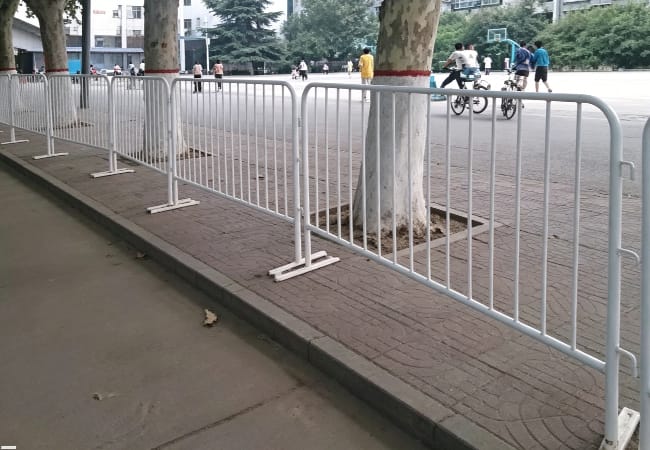
Why Choose Bendin Temporary Fence Panels?
A temporary fence is normally installed for a limited period and may need to be moved, extended, or reconfigured several times during a project. This makes modular construction particularly important.
Bendin temporary fence panels are designed around five practical requirements:
- Fast deployment: Freestanding panels can be installed without constructing a permanent foundation.
- Reusable construction: Panels, bases, clamps, and accessories can be dismantled and reused on another site.
- Flexible configuration: Panel dimensions, mesh, frame, bases, and gates can be adapted to different applications.
- Improved site visibility: Open mesh allows workers and security personnel to maintain visibility across the perimeter.
- Export-oriented production: Products can be manufactured according to customer drawings and project specifications.
For North American projects, the final fence configuration should always be checked against the project documents, local regulations, site conditions, wind requirements, and the applicable specification.
Temporary Fence Panel Specifications
Bendin provides several configurations so that distributors and contractors can select a suitable combination rather than being limited to one standard panel.
| Item | Typical Options |
|---|---|
| Panel Height | 4 ft, 6 ft, 8 ft / Customized |
| Panel Width | 6.5 ft, 7 ft, 8 ft / Customized |
| Wire Diameter | Approx. 3.0–5.0 mm / Customized |
| Mesh Opening | Approx. 50 × 100 mm, 55 × 100 mm / Customized |
| Frame Tube | Round or square steel tube |
| Surface Treatment | Hot-dip galvanized, powder coated, PVC/PE coated |
| Common Color | Safety orange, yellow, green, black / RAL colors |
| Base | Concrete, recycled rubber, HDPE or project-specific base |
| Connection | Clamps, couplers or customized locking accessories |
| Gate Options | Pedestrian gate, vehicle gate, double gate |
| Accessories | Clamps, warning signs, reflective elements, feet and braces |
| Customization | OEM / ODM / Project drawings supported |
The exact specification should be confirmed according to the required installation height, mesh configuration, frame strength, environmental conditions, and local project requirements.
Surface Treatment for Outdoor Construction Sites
Temporary fencing is often exposed to rain, sunlight, dust, mud, temperature changes, and coastal environments. Surface treatment therefore has a direct effect on service life and appearance.
Hot-Dip Galvanized Steel
Hot-dip galvanizing provides a zinc protective layer around the steel components and is suitable for outdoor temporary fencing where corrosion resistance is important.
Galvanized + Powder Coating
For projects that require both corrosion protection and a specific appearance, galvanized steel can be combined with powder coating.
This configuration is particularly useful when the temporary fence needs to remain highly visible around public areas, construction entrances, roads, or commercial developments.
PVC or PE Coating
Coated mesh can provide additional protection and allows the customer to select highly visible colors for site management and public safety.
For coastal projects or locations with aggressive environmental exposure, the coating system should be selected according to the expected service conditions rather than relying only on a standard configuration.
What Makes a Temporary Fence Suitable for North American Projects?
The term “temporary fence” covers many different products. A suitable system should be selected based on the actual site rather than simply choosing the lowest-cost panel.
1. Panel Stability
The base is one of the most important components of a freestanding temporary fence.
For normal construction areas, standard bases may be sufficient. Sites exposed to stronger wind, pedestrian impact, temporary screening, or uneven ground may require heavier bases, braces, additional anchoring, or an engineered configuration.
This is particularly important when privacy screens or solid windbreak materials are attached. A screen can significantly increase wind loading and should not automatically be treated as equivalent to an open mesh fence.
2. Connection Strength
Panels should be securely connected so that the perimeter behaves as a continuous barrier.
Bendin can supply different clamp and connection configurations according to the panel frame and project requirements.
3. Visibility
Open mesh temporary fencing provides a clear visual boundary while allowing workers and security personnel to observe activity on both sides.
For construction projects close to roads or public areas, high-visibility colors and warning accessories can further improve site awareness.
4. Transportation Efficiency
A modular panel system can be dismantled after a project and transported to another location.
For contractors managing multiple construction sites, reusable panels can reduce the need to purchase a new fence system for every project.
Recommended Applications
Bendin temporary fence panels can be configured for a variety of temporary perimeter applications.
Construction Sites
Temporary construction fencing creates a defined boundary around active work zones and helps control unauthorized access.
Typical applications include:
- Building construction
- Road construction
- Bridge projects
- Utility works
- Commercial developments
- Renovation projects
Infrastructure and Municipal Projects
Temporary fencing can be used around roadworks, public construction zones, drainage projects, utility works, and other municipal activities.
The fence layout can be adapted to changing project stages, allowing contractors to relocate sections as construction progresses.
Events and Public Areas
Temporary fencing is also suitable for concerts, exhibitions, sporting events, festivals, outdoor activities, and temporary crowd-control areas.
In these applications, visibility, rapid installation, pedestrian flow, and gate configuration become particularly important.
Industrial and Warehouse Projects
When a warehouse, factory, or logistics facility is under construction or renovation, temporary fencing can separate workers, equipment, storage areas, and vehicle routes.

Bendin Temporary Fence System Configuration
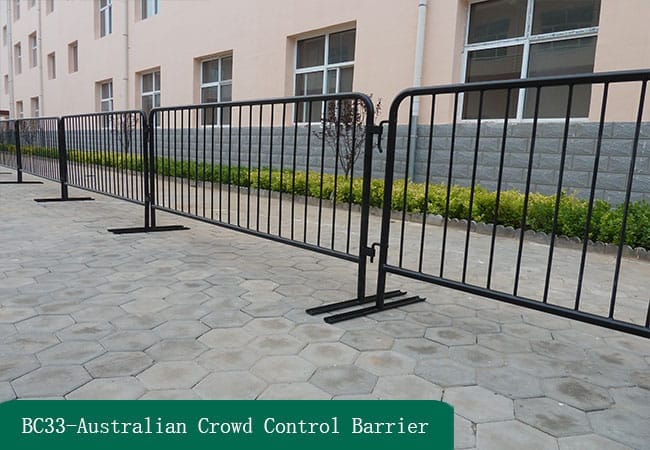
A complete temporary fence system can include more than the panel itself.
A typical configuration consists of:
Temporary Fence Panel → Base → Clamp → Gate → Brace → Warning Accessories
For example, a construction project may use 8-ft-high panels with galvanized frames, safety-orange mesh, heavy-duty bases, clamps, and a vehicle gate.
For a project with higher wind exposure, the same basic system can be supplemented with additional bracing or anchoring after site conditions have been evaluated.
This system-based approach is more practical than selecting panels independently from bases and accessories.
Example Project Configurations
The following examples illustrate how Bendin can configure temporary fencing according to different site requirements.
Case Example 1: Urban Building Construction
Application: Commercial building construction site
Typical configuration:
- 6–8 ft temporary panels
- Welded wire mesh
- Galvanized steel frame
- Heavy-duty freestanding bases
- Panel clamps
- Vehicle access gate
- High-visibility warning signage
Key requirement: Rapid installation and clear separation between the construction area and surrounding pedestrian zones.
Case Example 2: Road and Municipal Works
Application: Temporary roadwork and utility construction
Typical configuration:
- High-visibility temporary panels
- Corrosion-resistant surface treatment
- Modular bases
- Reflective warning accessories
- Pedestrian access sections where required
Key requirement: The fence needs to be easy to relocate as the construction area changes.
Case Example 3: Large Outdoor Event
Application: Temporary perimeter and controlled access
Typical configuration:
- Lightweight modular panels
- High-visibility coating
- Reinforced bases
- Pedestrian gates
- Vehicle access gates
- Warning and identification signage
Key requirement: Fast deployment, removal, and reconfiguration.
These are representative configurations rather than claims of specific completed projects. The final system should be selected according to the actual site and engineering requirements.
Installation Considerations
Before installation, contractors should evaluate:
- Ground condition
- Expected wind exposure
- Fence height
- Panel length
- Base weight and stability
- Whether privacy screening will be installed
- Required pedestrian and vehicle access
- Local safety requirements
- Required warning and reflective accessories
- Duration of temporary installation
The fence should form a continuous and stable barrier, with panels properly connected and bases positioned on suitable ground.
Where local regulations or project specifications require engineered wind-load calculations, anchoring, or additional bracing, those requirements should take priority over a standard temporary fence configuration.
North American Specification and ASTM Considerations
For customers purchasing temporary construction fencing for the United States or Canada, compliance should be considered at the project level, not simply by attaching an “ASTM compliant” label to a generic product.
ASTM F3342-19 provides guidance for temporary fence applications at construction sites, including temporary construction fence enclosures and requirements concerning continuous barriers and secure panel connections.
Bendin can review customer drawings, specifications, dimensions, connection requirements, and site conditions before production so that the proposed configuration can be matched to the intended application.
Where a project specifies a particular ASTM standard, local building code, engineering requirement, or owner specification, customers should provide those documents during the quotation stage.
OEM and ODM Temporary Fence Manufacturing
Different markets often require different panel dimensions, colors, frame profiles, bases, and connection systems.
Bendin supports customization including:
- Panel height and width
- Mesh opening
- Wire diameter
- Frame tube size
- Base dimensions
- Clamp design
- Surface treatment
- Powder coating color
- Gate configuration
- Warning accessories
- Customer packaging
- Product labels
- OEM branding
For distributors, Bendin can also manufacture according to customer drawings and established product specifications.
Why Work with Bendin?
As a fencing manufacturer based in Anping, Hebei, Bendin focuses on welded fencing, temporary fencing, security fencing, tubular fencing, chain link fencing, and related perimeter protection products.
The manufacturing process can cover wire processing, mesh welding, frame fabrication, surface treatment, assembly, inspection, and export packaging.
This integrated production approach allows customers to coordinate panels and related components through one supplier instead of sourcing every component separately.
For importers and distributors, this can simplify:
- Product specification management
- OEM customization
- Container loading
- Packaging coordination
- Quality inspection
- Spare-part supply
- Project-based procurement
How to Select the Right Temporary Fence
Before requesting a quotation, buyers should prepare the following information:
1. Project location: Country, state/province, city, and environmental conditions.
2. Application: Construction, roadwork, event, warehouse, municipal project, or another temporary use.
3. Required height: For example, 6 ft or 8 ft.
4. Total quantity: Number of panels or total perimeter length.
5. Ground condition: Concrete, asphalt, soil, gravel, or another surface.
6. Wind exposure: Open area, coastal area, high-rise construction area, or normal urban environment.
7. Access requirements: Number and size of pedestrian and vehicle gates.
8. Surface treatment: Galvanized, powder coated, PVC/PE coated, or another requested finish.
Providing this information allows Bendin to recommend a more appropriate panel, base, connection, and accessory configuration.
Bendin Temporary Fence Panels for Global Projects
Temporary fencing is no longer simply a low-cost construction accessory. For professional contractors, it is part of the overall site safety and access-management system.
A well-designed temporary fence should balance stability, visibility, durability, installation speed, transportation, reusability, and project-specific compliance requirements.
Bendin provides customizable temporary fence panels and complete system components for customers in North America and other international markets.
Whether you are a distributor looking for a repeatable product range, a contractor managing multiple construction sites, or a project owner requiring a customized temporary perimeter system, Bendin can develop a configuration around your actual project requirements.
Contact Bendin for temporary fence panel specifications, drawings, OEM/ODM options, and a project-based quotation.