


Anti-Climb Fence: Mesh Specifications, Security Features and Applications
Anti-climb fencing is a high-security perimeter fencing solution designed to make unauthorized climbing and cutting more difficult. Its tightly spaced mesh openings, steel wire construction and compatible post systems help create a physical barrier for facilities that require controlled access and clearly defined security boundaries.
Anti-climb fencing is commonly considered for airports, seaports, industrial facilities, data centers, power substations, correctional facilities and other restricted-access locations. The appropriate configuration depends on the site’s security assessment, required fence height, mesh design, installation conditions and applicable project specifications.
Bendin (Hebei Bendin Industrial Technology Co., Ltd.) supplies customizable security fencing systems for international infrastructure, industrial and commercial projects. Available configurations may include 358 mesh panels, other welded mesh designs, square and rectangular posts, I-posts, compatible fixing accessories and galvanized or powder-coated finishes.
This guide explains anti-climb fence construction, mesh specifications, post compatibility, corrosion protection, installation and selection considerations for high-security projects.
1. What Is an Anti-Climb Fence?
An anti-climb fence is a physical security barrier designed to reduce opportunities for unauthorized climbing.
Many high-security systems use closely spaced welded steel wires to create narrow mesh openings. These openings limit the available space for fingers and tools to gain purchase, making climbing and cutting more difficult than with many conventional open-mesh fences.
A typical system may include:
- Welded steel mesh panels
- Closely spaced vertical and horizontal wires
- Supporting steel posts
- Anti-tamper fixing clips or brackets, where specified
- Security fasteners
- Ground-level connections
- Compatible pedestrian and vehicle gates
- Galvanized or powder-coated finishes
- Optional security enhancements specified by the project
The overall security performance depends on the mesh, wire dimensions, weld quality, post arrangement, connections, foundation and installation quality.
A dense mesh panel alone does not guarantee that a perimeter is completely climb-proof or cut-proof. The complete system must be selected according to the site’s security requirements.
2. Why Choose a 358 Anti-Climb Fence?
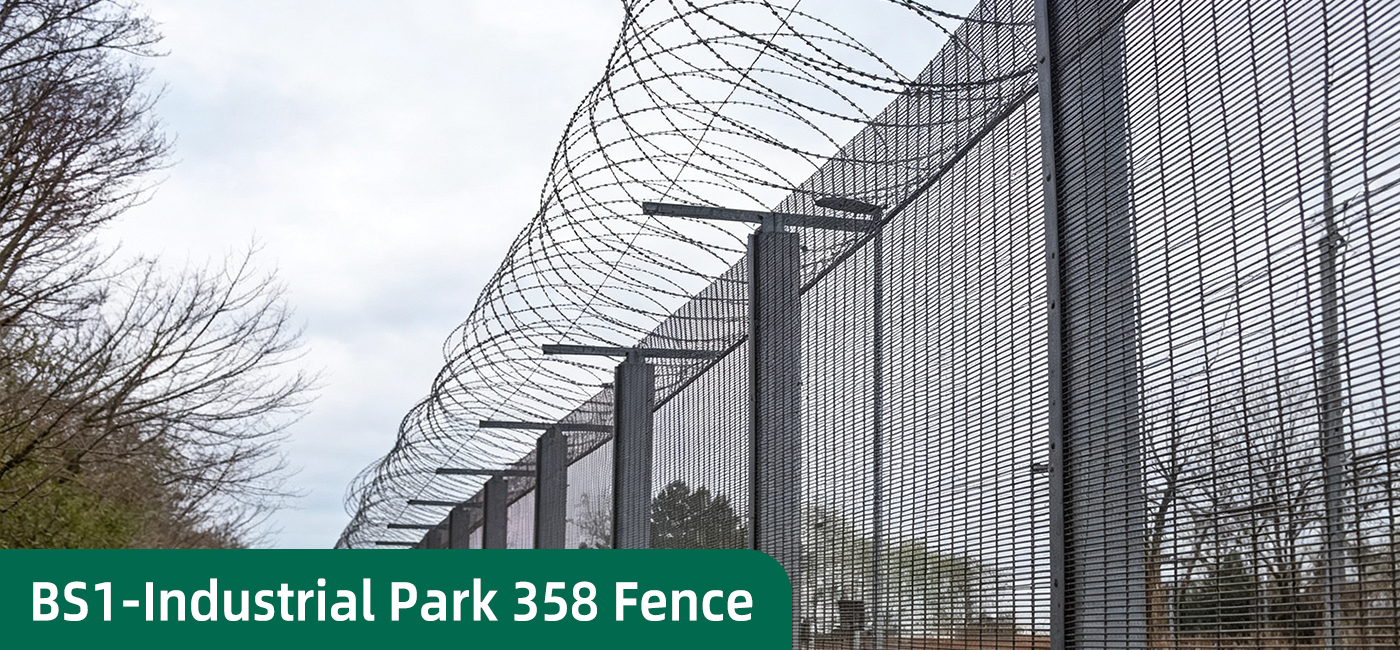
The 358 fence is a widely recognized high-security mesh configuration.
The name refers to the traditional imperial dimensions of approximately 3 inches × 0.5 inches with 8-gauge wire.
A commonly specified 358 mesh opening is approximately 76.2 × 12.7 mm, although the exact wire diameter and tolerances should be confirmed against the product specification.
Narrow Mesh Openings
The narrow openings make it difficult to gain a foothold or obtain a useful grip through the mesh.
Resistance to Cutting Attempts
The dense arrangement of wires limits access for many conventional cutting tools.
Actual cut resistance depends on wire diameter, steel properties, weld quality and the tools used.
Visibility Through the Fence
The open mesh allows security personnel and surveillance cameras to observe areas beyond the perimeter.
Visibility depends on the viewing angle, lighting, camera placement and surrounding conditions.
Modular Installation
Panels can be installed with compatible posts and fixing accessories to create a continuous perimeter.
The final configuration should be coordinated with the site layout, corners, gates and ground conditions.
3. Typical Anti-Climb Fence Specifications
Bendin can discuss customized configurations according to product drawings and project requirements.
| Parameter | Typical Options |
|---|---|
| Product Type | Anti-Climb Fence / 358 Security Fence |
| Material | Welded Steel Wire Mesh |
| Mesh Opening | 76.2 × 12.7 mm for a common 358 configuration |
| Wire Diameter | Common 358 specifications use approximately 4 mm wire; confirm the exact product |
| Panel Height | Customized according to the security design |
| Panel Width | Customized |
| Post Types | Square / Rectangular / I-Post / Other Compatible Profiles |
| Surface Treatment | Galvanized / Powder Coated / Duplex Coating |
| Fixing Method | Compatible Clips / Brackets / Specified Security Fixings |
| Color | Galvanized Finish / RAL Colors, subject to availability |
| Gates | Compatible Pedestrian and Vehicle Gates |
| Customization | Height / Panel Width / Wire / Post / Coating / Accessories |
These are indicative options rather than a fixed specification for every product. Actual wire diameter, mesh opening, panel dimensions, coating requirements and post sections should be confirmed before ordering.
4. Anti-Climb Fence vs. Standard Welded Mesh Fence
Although both systems use welded steel mesh, their design priorities can differ.
| Feature | Anti-Climb Fence | Standard Welded Mesh Fence |
|---|---|---|
| Primary Purpose | Increase resistance to unauthorized climbing | General boundary separation |
| Mesh Opening | Often narrow and dense | Varies by application |
| Tool Access | Restricted by the mesh geometry | Depends on the mesh design |
| Typical Applications | Restricted-access and high-security sites | Residential, commercial and industrial boundaries |
| Post and Fixing Design | May include security-specific components | Depends on the selected system |
| Overall Security | Depends on the complete design and installation | Depends on the product and application |
A standard welded mesh fence should not automatically be considered equivalent to a high-security anti-climb system.
5. Choosing the Right Post System
Post selection affects panel compatibility, installation and the performance of the complete fence.
Square Posts
Square posts provide regular geometric mounting faces and may be suitable for compatible mesh panels using clips or brackets.
They are commonly considered for industrial, commercial and high-security perimeter projects.
Rectangular Posts
Rectangular posts may be selected where the post dimensions and orientation need to be coordinated with the panel arrangement.
Their performance depends on section dimensions, wall thickness, steel properties, loading direction and foundation conditions.
I-Posts
I-posts use an I-shaped cross-section and may be suitable for selected engineered fence systems.
Their compatibility with anti-climb panels depends on the actual profile and fixing arrangement.
Other Compatible Posts
Other post types may be available for specific panel systems.
The exact post section, fixing method and compatible panel models should be confirmed using technical drawings rather than relying on the post name alone.
6. Security Fixings and Connection Design
The connection between the panel and post is an important part of an anti-climb fence system.
Depending on the product design, fixing arrangements may include:
- Dedicated panel clips
- Bolted brackets
- Security fasteners
- Specified anti-tamper connections
- Compatible post caps and accessories
The connection system should match the post profile, panel dimensions and security requirements.
For restricted-access sites, fixing details should be selected as part of the complete security design. The presence of security fasteners alone does not establish a particular security rating.
7. Surface Treatment and Corrosion Protection
High-security fencing is often installed outdoors and may be exposed to rain, humidity, pollution and coastal conditions.
The appropriate surface treatment depends on the base steel, manufacturing process and expected environmental exposure.
Galvanized Steel
Galvanizing provides a zinc coating that helps protect steel against corrosion.
The required coating specification should be confirmed for the selected product and manufacturing process.
Powder Coating
Powder coating provides a decorative finish and an additional protective layer when applied over an appropriately prepared substrate.
It also allows the fence to be coordinated with surrounding buildings and security infrastructure.
Galvanizing Plus Powder Coating
A compatible galvanized substrate combined with powder coating may be selected when both corrosion protection and appearance are important.
The coating system should be specified according to the environment, installation conditions and maintenance requirements.
Coastal and Industrial Environments
Coastal areas and industrial facilities may require particular attention to corrosion exposure.
The coating specification should consider humidity, airborne salt, pollutants, cleaning procedures and the expected maintenance schedule.
A fixed service-life claim should only be published when supported by product data and clearly defined environmental conditions.
8. Anti-Climb Fence for Airports and Seaports
Airports and seaports may require perimeter fencing to restrict unauthorized access to controlled areas.
Potential applications include:
- External perimeter boundaries
- Cargo and logistics compounds
- Restricted maintenance areas
- Equipment enclosures
- Selected service and operational zones
The fence specification should reflect the site’s security assessment, operational layout and applicable aviation or port requirements.
Gates, access control and surveillance systems may form part of the wider perimeter-security arrangement.
A fence panel alone should not be described as providing complete airport or port security.
9. Anti-Climb Fence for Data Centers and Power Facilities
Data centers and electrical infrastructure may require clearly defined restricted-access boundaries.
Anti-climb mesh fencing can be considered where the project calls for a dense mesh structure, controlled access and good visibility through the perimeter.
Important considerations include:
- Fence height and mesh configuration
- Post and foundation design
- Gate access arrangements
- Compatibility with surveillance equipment
- Environmental exposure
- Inspection and maintenance access
- Applicable site security requirements
For electrical facilities, the overall installation must also consider electrical clearances, grounding requirements where applicable, and the site’s operating procedures.
The fence should be designed for its intended function and coordinated with the facility’s engineering and security teams.
10. Anti-Climb Fence for Industrial Parks and Restricted Areas
Industrial sites may use anti-climb fencing to separate storage areas, equipment compounds and restricted-access zones.
Potential applications include:
- Industrial park perimeters
- Warehouse compounds
- Utility facilities
- Manufacturing sites
- Equipment storage areas
- Restricted service zones
The required security level depends on the site’s risk assessment.
Where additional security features are needed, the design may incorporate compatible gates, access-control equipment, surveillance and other perimeter-security components.
11. Selecting Fence Height and Panel Dimensions
Fence height and panel dimensions should be determined according to the site’s security requirements and physical layout.
Fence Height
The required height depends on the threat assessment, applicable regulations, site geometry and any additional security measures.
A single height should not be described as suitable for every high-security facility.
Panel Width
Panel width affects post spacing, installation planning and the number of connections required.
The layout should account for corners, changes in direction, gate openings and ground-level variations.
Ground-Level Details
Gaps beneath the fence can affect the effectiveness of the perimeter.
The lower edge, ground clearance, foundations and any required ground-level protection should be specified according to the project design.
12. Illustrative Project Example: Data Center Perimeter
A data center requires a perimeter fence around a restricted-access compound.
The project team considers a dense welded mesh fence with compatible steel posts, security fixings and a corrosion-resistant finish.
Preliminary Configuration
| Item | Example Requirement |
|---|---|
| Application | Data Center Perimeter |
| Fence Type | Anti-Climb Welded Mesh Fence |
| Mesh Opening | 76.2 × 12.7 mm for a common 358 configuration |
| Wire Diameter | Confirmed according to the selected product |
| Fence Height | Determined by the security assessment |
| Post Type | Compatible Square or Rectangular Posts |
| Surface Treatment | Galvanized or Galvanized Plus Powder Coated |
| Fixings | Compatible Security Fixings |
| Gates | Controlled-Access Gates, where required |
| Inspection | Panel, |