



A warehouse security fence is only as good as the items being stored within it. Also important is how people and vehicles come and go from the warehouse and what kind of damage could be expected when someone accidentally or intentionally enters the fenced area of a warehouse. Basic storage areas have simple perimeter solutions that are cost-effective and visible. Expensive equipment, controlled materials and sensitive goods require anti-climb mesh, strong posts and restricted access through specially designed gates. They also require a fence configuration which supports the use of CCTV and other access control systems.
Chain link and 3D welded mesh fences are typically used for low to medium risk boundaries and can be reinforced with stronger 2D panels, steel tubular fencing and 358 anti-climb fencing for higher risk areas. Warehouse partitions are used to create separate areas within a warehouse for stock, for machinery, forklift routes and restricted areas. They do not form part of the external perimeter of a building or site.
The comparison should begin with risk, not with the cheapest panel on a quotation. BENDIN’s perimeter protection systems include several fence structures that can be matched to warehouse location, site traffic, security level, and installation conditions.
How Should You Assess Warehouse Security Risk?
A warehouse does not have one uniform risk level. The front entrance, loading dock, rear boundary, utility area, and indoor storage zones may all need different forms of protection. Dividing the site into zones often produces a more practical result than using the same fence everywhere.
Evaluate Assets, Access, and Surrounding Conditions
Start with the value and sensitivity of the stored goods. General packaging materials create a different risk from electronics, industrial equipment, controlled chemicals, spare parts, or high-value imported products. Warehouses that operate overnight or remain unattended for long periods may also need stronger perimeter protection.
Consider also the immediate surrounding environment. Is the site adjacent to a public road, open land, other industrial properties or even within a busy logistics area? The lack of adequate lighting, insufficiently covered areas, exposed rear boundaries and easy vehicle access all can increase risk of theft even of non-abnormally high value stocks.
Separate External Perimeter Risk from Internal Operational Risk
An external security fence is intended to mark and control the boundary of a property, to deter intruders and to delay an intruder for some time. The design of a security fence can comprise a number of factors including the mesh opening, height, post design, gate design, anti-climb features and corrosion protection.
An internal warehouse partition has another job. It may separate finished goods from receiving areas, keep pedestrians away from forklift routes, protect machinery, or restrict entry to selected inventory zones. Internal machine guarding and warehouse zoning systems should therefore be assessed separately from outdoor perimeter fencing.
| Risk Level | Typical Warehouse Conditions | Suitable Fence Direction | Main Priority |
| Low | General stock, staffed site, controlled neighborhood | Chain link or 3D fence | Boundary definition and cost control |
| Medium | Valuable goods, regular vehicle access, exposed loading areas | 3D, 2D, or steel tubular fence | Stronger structure and controlled access |
| High | Sensitive inventory, isolated location, repeated intrusion risk | 358 anti-climb fence with reinforced gates | Delay, anti-climb performance, and monitoring |
| Internal | Machinery, high-value cages, pedestrian and forklift routes | Warehouse partition or machine guard fence | Separation and workplace control |
These levels are practical planning categories, not substitutes for local building, fire, workplace safety, or security regulations.
Which Fences Work for Low-Risk Warehouses?
Low risk does not mean no risk. It usually means the warehouse has ordinary stock, regular staff presence, established access procedures, and no history of serious perimeter intrusion. The fence still needs to remain stable outdoors and arrive with compatible posts, rails, gates, and fittings.
Chain Link Fence for Long and Cost-Sensitive Boundaries
A chain link fence is useful when a warehouse needs to enclose a long rear or side boundary without blocking visibility. Its woven mesh can follow changes in terrain more easily than rigid panels, while different wire diameters, mesh sizes, roll heights, posts, and rails allow the system to be adjusted to the project.
Chain link fencing is economical, but the lowest specification should not be used automatically. Smaller mesh, thicker wire, stronger posts, top rails, and suitable tension fittings improve stability. Barbed-wire arms or other security additions may be considered where they are legal and appropriate, but they should be included in the original post and foundation design.
3D Fence for Visible Commercial Boundaries
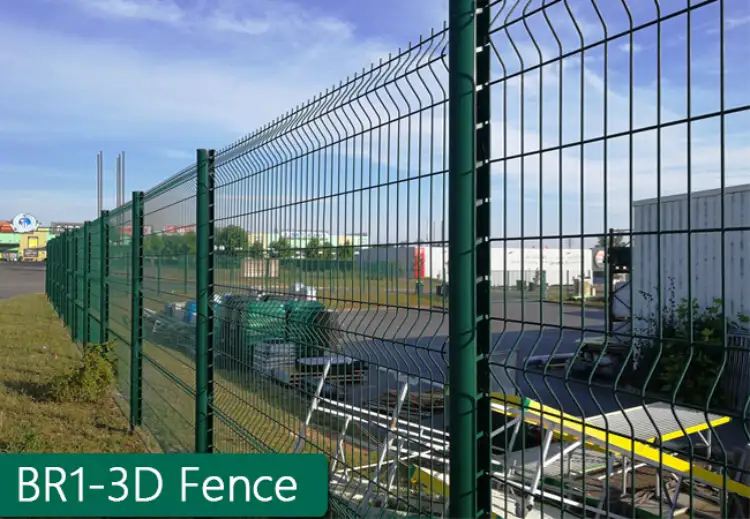
A 3D fence uses welded wire panels with V-shaped bends that increase rigidity. It provides a cleaner, more structured appearance than rolled chain link mesh, making it suitable for front boundaries, staff parking areas, office-facing sections, and warehouse sites visible from public roads.
The open mesh maintains sightlines for guards and cameras. Panel height, wire diameter, mesh opening, post type, and connection method should still be chosen around the site. A light panel may suit a controlled commercial boundary, while an exposed industrial location may require heavier wire, stronger posts, or closer attention to foundation design.
Which Fences Fit Medium-Risk Warehouse Sites?
Medium-risk warehouses often contain more valuable goods, receive frequent vehicle traffic, or have loading areas that are difficult to monitor continuously. At this level, fence strength alone is not enough. Gates, corners, end posts, hardware, and access procedures become part of the security system.
2D Fence for a More Rigid Mesh Barrier
A 2D welded mesh fence normally uses vertical wires combined with double horizontal wires. This structure creates a flatter and more rigid panel than many lighter mesh systems. It can suit warehouse boundaries where panel stability and a solid visual line matter, but full high-security anti-climb performance is not required.
Buyers should compare wire configuration, mesh opening, panel height, post thickness, clips, and surface treatment together. A rigid panel attached to weak posts or exposed fasteners can create an uneven system. Corners and gate openings may also need stronger support than ordinary straight runs.
Steel Tubular Fence for Entrances and Public-Facing Areas
A steel tubular fence can work well around warehouse entrances, office sections, parking areas, and road-facing boundaries. Its post, rail, and picket construction provides a formal appearance and can be coordinated with pedestrian, double-swing, or sliding gates.
Flat-top designs are suitable where a cleaner and less aggressive appearance is preferred. Spear-top or other security-oriented designs may add deterrence where permitted. Tube size, wall thickness, rail quantity, picket spacing, gate width, hinge load, and surface treatment all affect performance, so the visible design should not be the only selection factor.
What Should High-Risk Warehouses Use?
High-risk sites may store expensive electronics, controlled goods, specialist equipment, energy components, or inventory that would cause major business disruption if stolen or damaged. An isolated location, limited night staffing, or previous intrusion attempts can also move an otherwise ordinary warehouse into a higher-risk category.
358 Fence for Anti-Climb Perimeter Protection
A 358 anti-climb fence uses a narrow mesh opening that leaves little space for fingers or feet to gain a hold. A common 358 specification uses a 3 × 0.5-inch mesh opening, equivalent to 76.2 × 12.7 mm, with 8-gauge wire of approximately 4 mm. The welded panel remains open enough to support visual inspection and camera monitoring.
The panel should be treated as part of a complete system. Fence height, square or I-section posts, post thickness, panel connections, foundations, gate frames, hinges, locks, and top security accessories must work together. A dense anti-climb panel will not protect a site effectively if the vehicle gate, rear service entrance, or panel-to-post connection is significantly weaker.
Layered Security for Sensitive Warehouse Zones
A high-security fence delays access, but it does not replace lighting, cameras, alarms, guard procedures, and controlled gates. Camera positions should be checked against posts, vegetation, parked trailers, loading equipment, and other objects that could create blind spots.
Barbed wire, razor wire, security spikes, or electric fence components may be added to compatible metal fence systems only where local regulations, site conditions, and safety procedures allow them. These additions should be designed from the beginning because they change post loads, installation details, warning requirements, and maintenance responsibilities.
Which System Components Affect Security Most?
Choosing the panel is only one part of warehouse fence planning. Many failures occur at gates, corners, poorly supported end sections, damaged coatings, or areas where the fence meets a wall or building.
Match Gates to People and Vehicle Movement
A pedestrian gate should not be treated like a reduced-width vehicle gate. Each opening needs suitable posts, hinges, locks, stops, and clearances. Double-swing gates can provide wide vehicle access, while sliding gates may be more practical where there is not enough turning space for gate leaves.
Loading schedules also influence gate selection. A gate used by dozens of trucks each day faces different loads from an emergency access gate that remains closed most of the time. Confirm the opening width, vehicle type, operating frequency, ground condition, locking method, and access-control equipment before production.
Check Posts, Connections, and Surface Protection
Posts and connections transfer the loads created by mesh tension, wind, gates, and security accessories. End posts, corner posts, and gate posts often require different specifications from ordinary line posts. The installation method—buried or base-mounted—also affects post length and foundation planning.
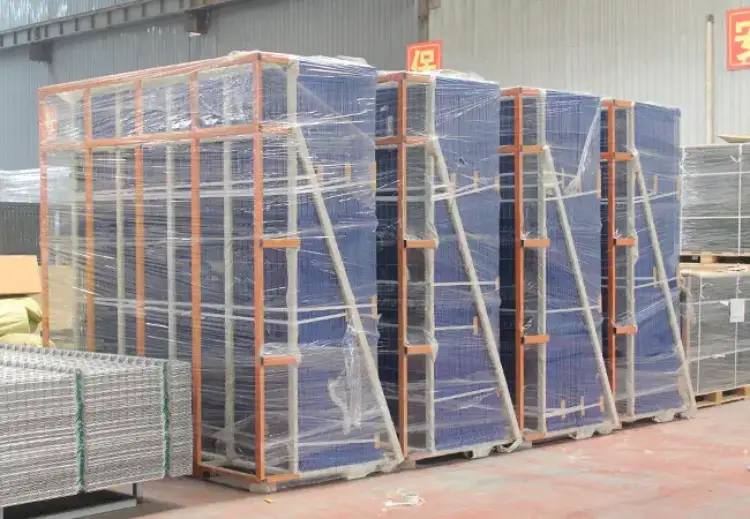
Outdoor warehouse fencing must withstand rain, humidity, sunlight, industrial dust, and possible contact damage. Galvanizing, powder coating, or combined surface treatments should be selected for the site environment. Packing also matters on export orders because unprotected panels and posts can suffer coating damage before installation begins.
Before requesting a quotation, prepare the perimeter length, required height, gate schedule, ground conditions, risk zones, preferred coating, installation method, and drawings if available. BENDIN can match panels, posts, gates, fittings, and packaging around the same project specification. For layout review or customized requirements, you can contact BENDIN before confirming the final system.
Conclusion
Warehouse security fencing should follow the site’s actual risk instead of one standard specification. Chain link fencing can provide economical coverage for low-risk and long boundaries, while 3D panels offer a cleaner and more rigid option for visible commercial areas. Medium-risk sites may benefit from 2D welded mesh or steel tubular fencing combined with stronger posts and controlled gates.
For high-risk warehouse perimeters, 358 fencing provides a tighter anti-climb structure, but the panel must be supported by suitable posts, connections, gates, foundations, lighting, and monitoring. Internal warehouse partitions should be planned separately to protect equipment, organize storage zones, and separate pedestrian and vehicle routes.
The best result may use several fence types across one property. Matching each section to its risk, traffic, visibility, and maintenance needs can provide stronger protection without overspecifying every part of the warehouse.
FAQ
Q1: What Is the Best Security Fence for a Warehouse?
A1: The best fence depends on the warehouse risk level. Chain link and 3D fences suit many low- to medium-risk boundaries, while 2D, tubular, or 358 anti-climb systems may be more suitable when stronger protection is required.
Q2: Is Chain Link Fence Secure Enough for a Warehouse?
A2: Chain link fence can be suitable for low-risk warehouse perimeters, especially along long side or rear boundaries. Security can be improved with smaller mesh, thicker wire, stronger posts, top rails, suitable fittings, and approved top security accessories.
Q3: When Should a Warehouse Use 358 Fencing?
A3: A warehouse should consider 358 fencing when it stores high-value or sensitive goods, operates in an isolated area, has experienced intrusion attempts, or requires stronger anti-climb protection around restricted zones.