



How Industrial Safety Systems Reduce Factory Operational Costs
Industrial safety systems are often considered a necessary investment for protecting workers and meeting workplace safety requirements. However, effective safety measures can also play an important role in reducing factory operational costs.
For manufacturing facilities, unplanned downtime, equipment damage, production interruptions and inefficient maintenance procedures can create significant financial losses.
Well-designed industrial safety systems help factories manage these risks while supporting more stable and efficient operations.
BenDin manufactures customizable machine guard fencing, workshop isolation fencing and industrial partition systems for manufacturing facilities, automated production lines and warehouse operations.
This guide explains how industrial safety systems can contribute to cost control and how manufacturers can evaluate their potential return on investment.
1. Reducing Unplanned Production Downtime
Unexpected production interruptions can be expensive for industrial facilities.
When workers enter hazardous machinery areas without appropriate protection, an incident may result in equipment shutdown, investigation, repairs and production delays.
Machine guarding systems help establish controlled boundaries around hazardous equipment.
Common applications include:
- Robotic welding cells
- Automated assembly lines
- CNC machinery
- Conveyor systems
- Packaging equipment
- Industrial production cells
Physical barriers, controlled access doors and properly integrated safety devices can reduce exposure to machinery hazards.
Although safety systems cannot eliminate every interruption, they can help reduce the likelihood of certain preventable incidents.

2. Protecting Expensive Industrial Equipment
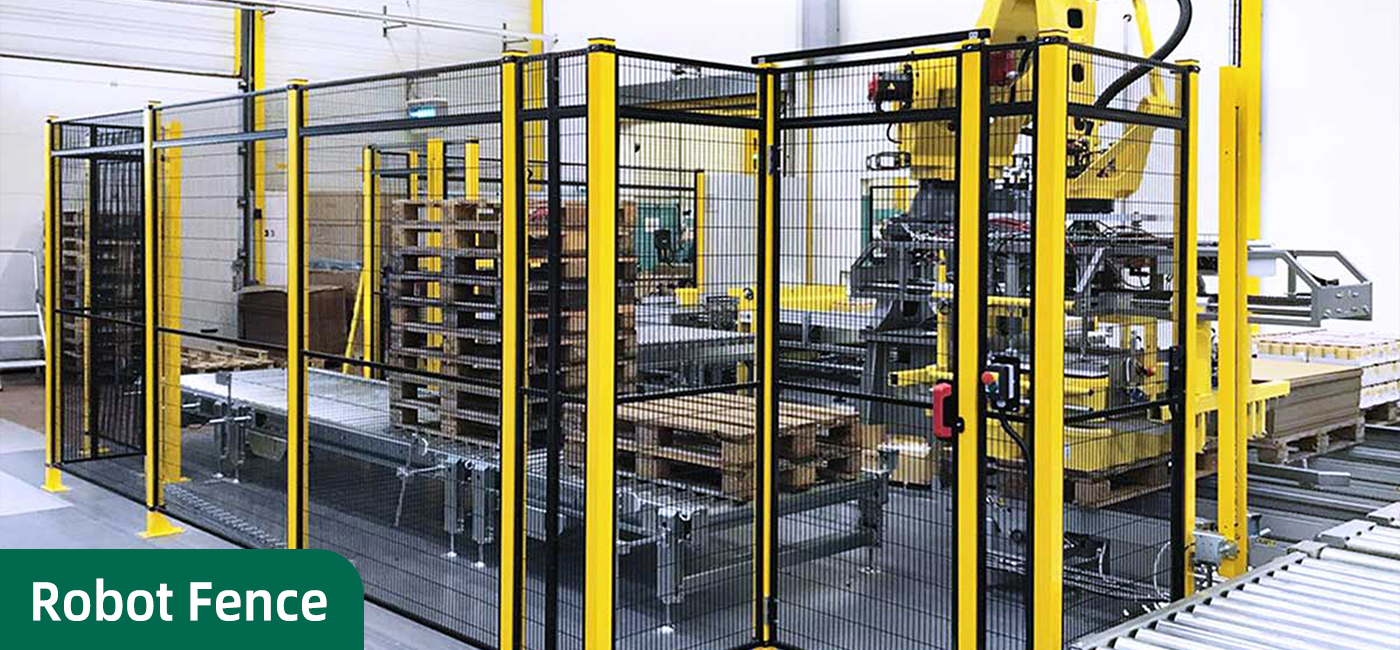
Industrial machinery often represents a significant capital investment.
Accidental contact between vehicles, materials, personnel and equipment may lead to damage and repair costs.
Industrial partition fencing can help separate equipment from surrounding operations.
For example, factories may install protective barriers around:
- Automated robotic equipment
- Electrical control areas
- Conveyor machinery
- Sensitive production equipment
- Restricted maintenance zones
Where forklift or vehicle impact is a credible hazard, appropriately engineered impact barriers may be required rather than ordinary welded mesh fencing.
The correct protective system should be selected according to the site’s risk assessment.
3. Improving Maintenance Efficiency
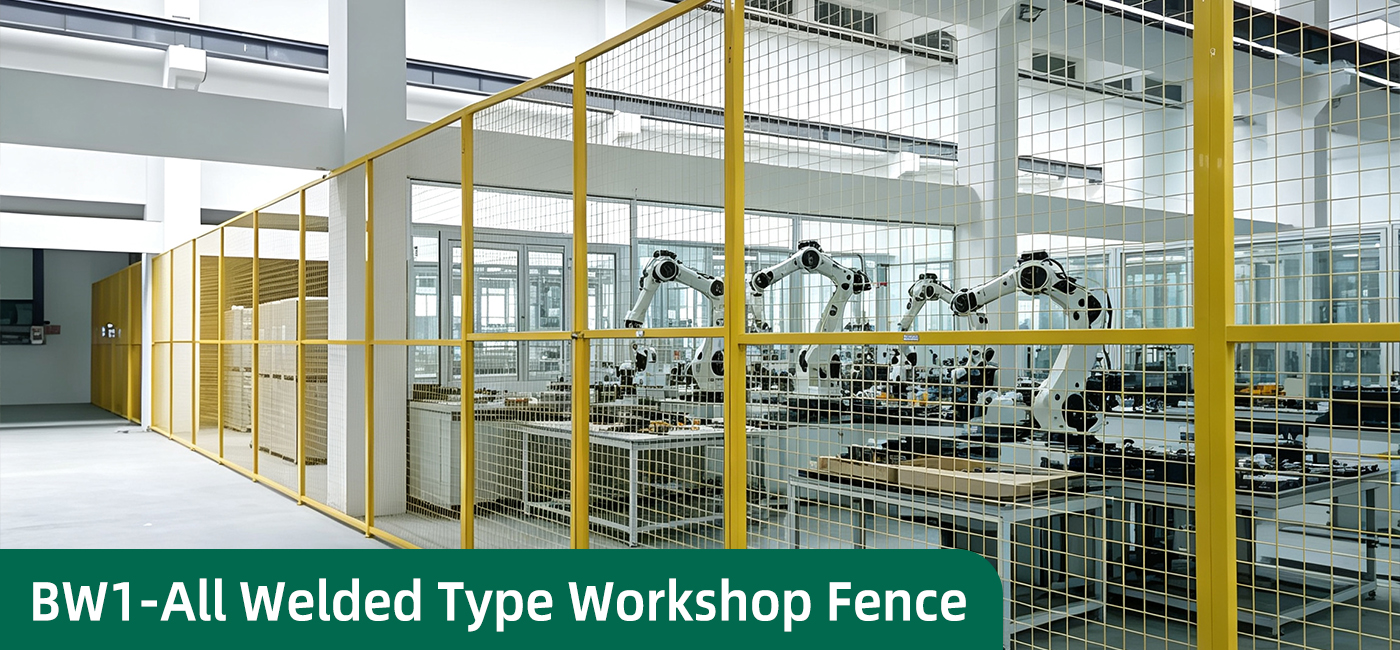
Maintenance work often requires technicians to access machinery for inspection, adjustment and repairs.
Poorly designed barriers may make these operations unnecessarily difficult.
Modular machine guard fencing can incorporate:
- Hinged access doors
- Sliding doors
- Removable panels
- Designated maintenance openings
- Safety interlock provisions
A well-planned layout helps maintenance teams reach authorized service areas without unnecessarily dismantling the entire protective structure.
For hazardous machinery, access arrangements must also be coordinated with appropriate isolation, lockout/tagout and machine safety procedures.
4. Supporting Efficient Workshop Layouts
Industrial safety fencing can also improve factory organization.
By separating machinery, production areas and pedestrian routes, factories can create clearer operational boundaries.
Typical applications include:
Production Zone Separation: Distinguishing automated machinery from general working areas.
Warehouse Partitioning: Separating restricted storage and equipment zones.
Pedestrian Route Management: Helping define walking routes around industrial operations.
Robotic Cell Protection: Establishing controlled access around automated equipment.
Effective layout planning can reduce unnecessary interference between different workshop activities.
5. Reducing Maintenance and Replacement Costs
The durability and modularity of a safety fencing system can influence long-term ownership costs.
A modular fence allows individual panels, posts or doors to be replaced when necessary, rather than automatically replacing the entire installation.
For industrial applications, buyers should consider:
- Steel material
- Panel construction
- Welding quality
- Surface treatment
- Connection components
- Replacement-part availability
- Installation accessibility
Powder-coated or galvanized steel components may be appropriate depending on the workshop environment.
The lowest initial purchase price does not always represent the lowest total cost of ownership.
6. Comparing Industrial Safety Fence Systems
Different protective systems serve different purposes.
| Safety System | Main Function | Potential Operational Benefit |
|---|---|---|
| Machine Guard Fence | Restrict access to machinery hazards | Reduce exposure to hazardous equipment |
| Robot Safety Fence | Separate automated robotic cells | Support controlled access and safer operations |
| Workshop Isolation Fence | Divide production and working areas | Improve workshop organization |
| Warehouse Partition Fence | Separate storage and restricted zones | Support access control and inventory organization |
| Solid Protective Panels | Provide physical containment where specified | Help contain selected debris or process hazards |
| Engineered Impact Barriers | Protect against specified vehicle impacts | Reduce collision-related equipment damage |
These systems are not interchangeable. Their suitability depends on the specific hazards and required performance.
7. Typical Industrial Safety Fence Specifications
BenDin can manufacture industrial safety fencing according to confirmed project drawings and technical requirements.
| Item | Typical Options |
|---|---|
| Panel Height | 1,000–2,500 mm |
| Panel Width | 200–1,500 mm |
| Mesh Opening | 20×50, 20×100, 50×50 mm |
| Wire Diameter | 3.0–5.0 mm |
| Frame Material | Carbon Steel |
| Post Size | 40×40, 50×50, 60×60 mm |
| Panel Type | Welded Mesh / Perforated / Solid |
| Surface Treatment | Powder Coated / Galvanized |
| Colors | Yellow, Black, Gray or Custom RAL |
| Installation | Floor-Mounted Base Plates |
| Access | Hinged / Sliding Doors |
| Customization | According to Project Drawings |
These are indicative manufacturing options, not universal machine safety specifications. Guard dimensions, mesh openings and safety distances must be determined through the machinery risk assessment.
8. Example: Calculating the Cost of Factory Downtime
Consider a manufacturing facility operating an automated production line.
Assume the following hypothetical conditions:
| Cost Factor | Example Value |
|---|---|
| Estimated Cost per Hour of Downtime | $1,200 |
| Annual Avoidable Downtime | 12 hours |
| Initial Safety System Investment | $8,000 |
| Annual Safety System Maintenance | $300 |
If an appropriately designed safety improvement prevents 12 hours of downtime annually, the estimated avoided downtime cost would be:
12 hours × $1,200 = $14,400 per year
After deducting $300 in annual maintenance costs:
Estimated annual net benefit = $14,100
The simplified first-year net benefit after the initial investment would be:
$14,100 − $8,000 = $6,100
This calculation illustrates how avoided downtime may contribute to the financial value of a safety investment.
Important: This is a hypothetical financial example, not an actual BenDin customer result. The assumed downtime reduction must be supported by a site-specific assessment before using the calculation for a purchasing decision.
9. How to Calculate Industrial Safety System ROI
Factories can evaluate safety investments by considering several potential cost categories.
A simplified approach is:
Annual Net Benefit = Avoided Downtime Costs + Avoided Repair Costs + Other Measurable Savings − Annual Operating Costs
A simplified return-on-investment calculation is:
First-Year ROI = (Annual Net Benefit − Initial Investment) ÷ Initial Investment × 100%
For the illustrative example above:
ROI = ($14,100 − $8,000) ÷ $8,000 × 100% = 76.25%
Actual ROI varies depending on the factory, equipment, hazard profile and effectiveness of the installed system.
Safety controls should first be selected to manage risks appropriately. Financial benefits are an additional consideration, not a substitute for safety requirements.
10. Industrial Safety Requirements in International Markets
Industrial machine guarding requirements vary between countries.
For US manufacturing facilities, applicable OSHA requirements may include 29 CFR 1910.212, depending on the machinery and hazards involved.
For European machinery applications, relevant technical standards may include:
- EN ISO 14120: General requirements for fixed and movable guards
- EN ISO 13857: Safety distances for preventing access to hazardous zones
- EN ISO 14119: Interlocking devices associated with guards
The complete machinery installation must be evaluated against the applicable requirements.
A fencing panel alone should not be described as making an entire production line OSHA-compliant or CE-compliant.
11. Choosing a Cost-Effective Industrial Safety System
Before purchasing industrial safety fencing, factory managers and project buyers should confirm:
Risk Assessment: Identify machinery hazards and required protection.
Factory Layout: Determine fence length, height, doors and access routes.
Panel Design: Select mesh, perforated or solid panels according to the hazard.
Maintenance Access: Include suitable doors and removable sections.
Surface Treatment: Choose a finish appropriate for the operating environment.
Installation: Confirm post bases, anchors and supporting floor conditions.
Future Expansion: Consider modular configurations where production layouts may change.
A properly specified system helps avoid unnecessary redesign and replacement expenses.
12. Custom Industrial Safety Fencing from BenDin
BenDin manufactures customizable industrial fencing systems for factories, warehouses and automated production facilities.
Available product configurations include:
- Machine guard fence panels
- Robot safety fence systems
- Workshop isolation fencing
- Warehouse partition fencing
- Welded mesh panels
- Perforated panels
- Solid steel panels
- Customized posts and base plates
- Hinged and sliding access doors
- Interlock mounting provisions
Manufacturing specifications can be confirmed according to customer drawings and project requirements.
Frequently Asked Questions
How can industrial safety systems reduce operating costs?
They can help reduce preventable production interruptions, equipment damage and operational inefficiencies when appropriately designed and integrated into factory operations.
Can machine guarding reduce production downtime?
Machine guarding can help prevent access to hazardous machinery and reduce certain incident risks. Actual downtime savings depend on the factory and the effectiveness of the complete safety system.
Is modular safety fencing more cost-effective?
Modular fencing may reduce modification and replacement costs because individual components can be adjusted or replaced. Actual savings depend on the installation.
What is the difference between machine guarding and warehouse partition fencing?
Machine guarding is designed to protect against specific machinery hazards. Warehouse partition fencing is generally used for area separation and access control.
Can BenDin customize industrial safety fencing?
Yes. BenDin can manufacture panels, posts, doors and accessories according to confirmed project drawings and specifications.
Conclusion: Safety and Cost Efficiency Can Work Together
Industrial safety systems are important for protecting workers, equipment and production processes.
When correctly selected and integrated, machine guarding and industrial partition fencing can also contribute to reduced downtime, more efficient maintenance and better workshop organization.
For factory managers and industrial buyers, the goal should be to select a safety system that meets operational requirements while delivering sustainable long-term value.
Request an Industrial Safety Fence Quote
BenDin supplies customizable machine guard fencing, robot safety fencing and workshop isolation systems for industrial facilities worldwide.
For an accurate quotation, please provide:
Factory layout + equipment type + required fence dimensions + panel type + access doors + surface treatment + project quantity + destination.
BenDin can manufacture industrial safety fencing components according to confirmed project specifications.