



Workshop Isolation Fence: Industrial Safety, Specifications and Applications
Workshop isolation fencing is used to separate production areas, machinery, pedestrian routes and restricted-access zones in manufacturing facilities. A properly designed system helps establish clear boundaries, organize workshop layouts and reduce the risk of accidental entry into hazardous areas.
Unlike general perimeter fencing, industrial workshop fencing must be selected according to the equipment being protected, the hazards present, the required access arrangements and the conditions of the production environment.
Bendin (Hebei Bendin Industrial Technology Co., Ltd.) supplies customizable industrial fencing systems for factories, warehouses and manufacturing facilities. Depending on the application, configurations can include welded mesh panels, steel posts, mounting accessories, access gates and compatible safety-interlocking components.
This guide explains workshop isolation fence construction, typical specifications, safety considerations, surface treatments, installation and practical selection criteria for industrial projects.
1. What Is a Workshop Isolation Fence?
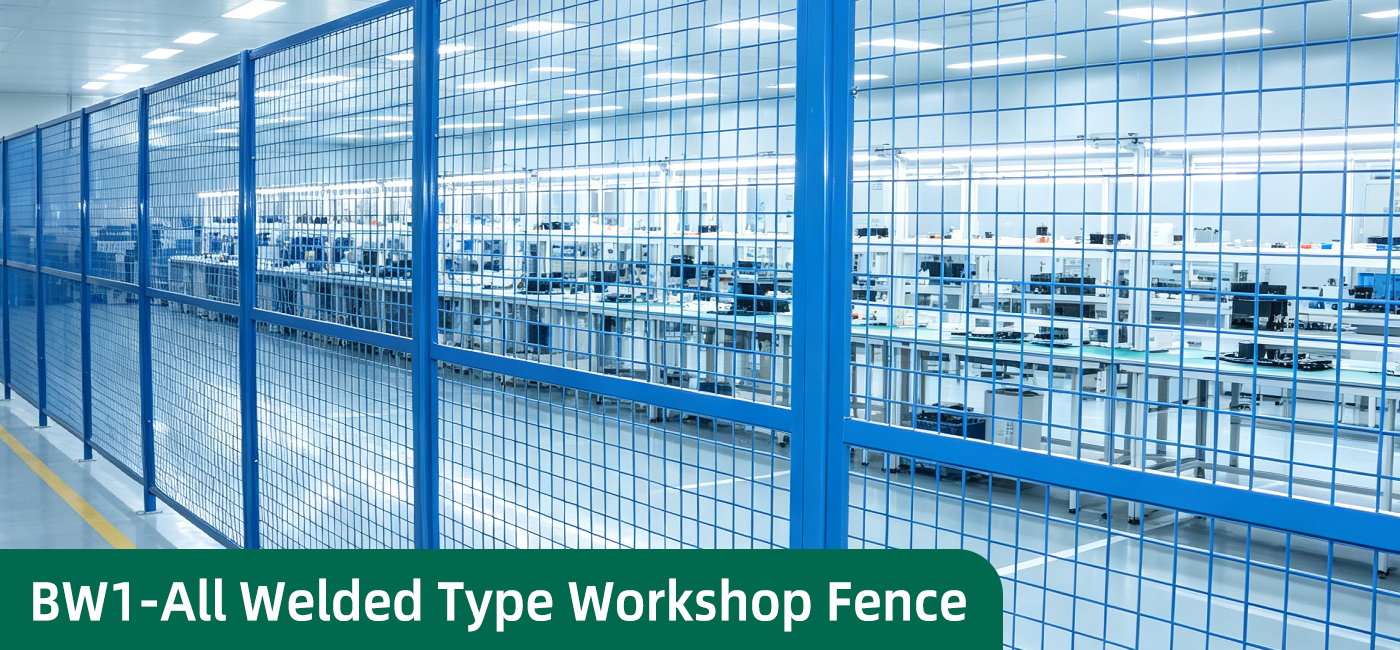
A workshop isolation fence is a physical barrier used to divide an industrial workspace into designated areas.
It may separate automated equipment, production lines, maintenance zones, material-handling areas and pedestrian routes.
A typical system may include:
- Welded steel mesh panels
- Supporting steel posts
- Panel clips and mounting brackets
- Pedestrian access gates
- Maintenance or equipment-access gates
- Locking and latching components
- Compatible safety interlocks where required
- Galvanized or powder-coated finishes
The exact configuration depends on the machinery, risk assessment, workshop layout and access requirements.
A workshop fence is not automatically a complete machine-guarding system. Where hazardous moving parts are present, the fence, gates, interlocks and equipment controls must be designed as part of the overall safety solution.
2. Main Applications of Workshop Isolation Fencing
Robot Workstations
Industrial robots may move rapidly within defined operating envelopes. A suitable perimeter guard can help prevent unauthorized entry into the robot’s working area.
Gate locations and access-control arrangements should be coordinated with the robot’s risk assessment and control system.
Welding Areas
Welding workstations may require separation from pedestrian routes and adjacent production activities.
The appropriate enclosure depends on the equipment, process hazards, visibility requirements and any additional protection needed for welding-related hazards.
A standard mesh fence alone does not provide protection from every welding hazard.
Automated Production Lines
Workshop isolation fencing can divide automated production equipment from surrounding work areas.
Modular panels may help accommodate changes to production layouts, provided the revised arrangement maintains the required safety clearances and guarding functions.
Assembly and Packaging Areas
Fencing can help define equipment zones, separate selected work areas and organize access around production machinery.
The mesh opening, panel height and gate arrangement should be selected according to the intended function.
Warehouse and Material-Handling Areas
Industrial fencing can separate storage areas, conveyor equipment and restricted-access zones.
Where forklifts or other vehicles operate nearby, the fence design should consider the potential for impact and whether additional vehicle barriers are required.
3. Typical Workshop Isolation Fence Specifications
Bendin can discuss customized configurations according to project drawings and manufacturing capabilities.
| Parameter | Typical Options |
|---|---|
| Product Type | Workshop Isolation Fence / Industrial Safety Fence |
| Main Material | Low-Carbon Steel Wire and Steel Profiles |
| Mesh Opening | Common options include 20 × 20 mm, 25 × 25 mm and 50 × 50 mm, subject to design |
| Wire Diameter | Project-specific |
| Panel Height | Approximately 1.0–2.5 m, subject to application |
| Panel Width | Customized according to layout |
| Post Type | Square / Rectangular / Other Compatible Profiles |
| Surface Treatment | Galvanized / Powder Coated / Duplex Coating |
| Gate Options | Pedestrian / Maintenance / Equipment Access |
| Safety Accessories | Compatible Interlocks, Latches and Fixings where specified |
| Mounting | Floor-Mounted Posts / Base Plates / Other Approved Arrangements |
| Customization | Height / Width / Mesh / Post / Gate / Color |
These are indicative options rather than a fixed specification for every product. Actual wire diameter, mesh opening, panel dimensions, post section and connection details should be confirmed before ordering.
The appropriate fence height and mesh opening should be determined by the equipment risk assessment, required separation and applicable safety requirements.
4. Key Design Considerations for Industrial Safety
Physical Separation
The fence should establish a clear boundary between the hazardous area and surrounding workspaces.
The design should account for the machinery’s movement, potential access points and the required distance between the barrier and the hazard.
Mesh Opening
Mesh openings should be selected according to the risk assessment and the distance between the fence and hazardous moving parts.
A smaller opening does not automatically make a system compliant. The complete guarding design must meet the relevant requirements.
Fence Height
The appropriate height depends on the equipment, potential hazards, access requirements and applicable standards.
A universal fence height should not be specified for every robot cell or production line.
Structural Stability
Posts, panels, connections and foundations should be suitable for the expected operating environment.
Where foreseeable impacts from equipment or vehicles are possible, the required resistance should be assessed and specified separately.
Access and Maintenance
Gates should provide suitable access for authorized personnel, maintenance tasks and equipment servicing.
The layout should minimize unnecessary openings while preserving safe access and emergency procedures.
5. Safety Gates and Interlocking Systems
Some industrial applications require safety-related access control in addition to a physical fence.
Access Gates
Gates provide access for operation, inspection, cleaning and maintenance.
Their dimensions, hinges, latches and opening direction should be selected according to the equipment and workspace.
Safety Interlocks
Where required by the risk assessment, a gate may be equipped with a compatible safety interlock connected to the machine’s safety control system.
The interlock can be designed to initiate a defined safety response when the gate is opened or when an unsafe access condition is detected.
The actual response depends on the machine design, safety-control architecture and validated safety function.
Important Safety Distinction
A safety interlock is not simply a mechanical latch. The complete arrangement may require a suitable safety-rated device, compatible control hardware, appropriate installation and validation.
Bendin can discuss fence and gate configurations for projects requiring interlocks, but the machine integrator or responsible safety engineer should confirm the safety function and system compliance.
6. Materials and Surface Treatment
Industrial fencing may be exposed to dust, humidity, cleaning agents, oil residues and other workshop conditions.
The appropriate material and coating should be selected according to the environment.
Q235 Low-Carbon Steel
Q235 steel may be used for compatible mesh and structural components, subject to the product design and required mechanical properties.
The material grade should be confirmed in the product specification where it is important to the project.
Hot-Dip Galvanizing
Hot-dip galvanizing provides a zinc coating that helps protect steel against corrosion.
It may be considered for industrial environments where corrosion protection is required.
Powder Coating
Powder coating provides a decorative finish and an additional protective layer when applied over an appropriately prepared substrate.
Different colors can be used to coordinate with workshop layouts or site-identification systems.
Galvanizing Plus Powder Coating
A compatible galvanized substrate combined with powder coating may be selected when both corrosion protection and appearance are important.
The required coating specification depends on environmental exposure, maintenance requirements and the manufacturing process.
A claim of 15 years or more of service life should only be published when supported by product data and clearly defined environmental conditions.
7. Modular Design and Installation
Modular workshop fencing uses coordinated panels, posts and connection accessories to simplify assembly and future adjustments.
Benefits of Modular Construction
- Standardized panel dimensions
- Consistent alignment
- Convenient transportation
- Replacement of individual panels
- Flexible layout planning
- Easier expansion where the system permits
Installation Considerations
The installation method depends on the fence design and the workshop floor.
Before installation, confirm:
- Floor condition and anchoring requirements
- Post positions
- Panel dimensions
- Gate locations
- Equipment clearance
- Cable and service routes
- Safety-interlock requirements
- Maintenance access
After any layout change, the fence and associated safety functions should be reviewed before the equipment returns to operation.
Modular construction can simplify installation, but actual installation time depends on the design, site conditions and installation team.
8. Workshop Isolation Fence vs. General Industrial Fence
| Feature | Workshop Isolation Fence | General Industrial Perimeter Fence |
|---|---|---|
| Main Purpose | Separate machinery and workshop zones | Define external property boundaries |
| Typical Location | Inside factories and production facilities | Around industrial sites |
| Mesh Selection | Based on equipment and access risks | Based on perimeter and security requirements |
| Gates | May require controlled maintenance access | Often used for pedestrian and vehicle entry |
| Interlocks | May be required for selected machine-access gates | Not typically a standard feature |
| Layout Changes | May need to follow production-line changes | Usually follows the site boundary |
| Main Design Priority | Machine safety and workflow separation | Boundary control and perimeter protection |
The correct system depends on whether the primary purpose is internal machine guarding or external perimeter security.
9. Illustrative Project Example: Automated Production Line
A manufacturing facility needs to separate an automated production line from adjacent pedestrian routes.
The project team considers modular welded mesh panels, steel posts and a designated maintenance gate.
Preliminary Configuration
| Item | Example Requirement |
|---|---|
| Application | Automated Production Line |
| Fence Type | Modular Workshop Isolation Fence |
| Panel Height | Selected according to the risk assessment |
| Mesh Opening | Selected according to equipment clearance and access risks |
| Post Type | Compatible Steel Posts |
| Surface Treatment | Galvanized or Galvanized Plus Powder Coated |
| Access | Designated Maintenance Gate |
| Interlock | Where required by the validated safety design |
| Installation | Floor-Mounted Posts and Specified Fixings |
| Inspection | Panel Stability, Gate Operation and Safety Functions |
The final fence dimensions, gate arrangement, anchoring details and interlock requirements should be confirmed against the machinery layout and applicable safety requirements.
This is an illustrative project scenario, not a completed Bendin customer installation.
10. Quality Control for Workshop Isolation Fencing
Quality inspection should cover the mesh panels, posts, connections, coating and gate components.
Inspection may include:
- Wire diameter and mesh opening
- Panel dimensions and flatness
- Weld appearance and integrity
- Post section dimensions
- Fixing compatibility
- Coating condition
- Gate alignment and latching
- Accessory completeness
- Packaging and labeling
For projects requiring specified impact resistance or other performance ratings, the test method and acceptance criteria should be agreed before production.
Where safety interlocks are included, their safety functions must be validated as part of the complete machine-guarding system.
11. Bendin Custom Workshop Isolation Fence Solutions
Bendin supplies customizable industrial fencing systems for factories, automated production lines, warehouses and selected manufacturing applications.
Customization may include:
- Mesh opening
- Wire diameter
- Panel height and width
- Post profiles
- Surface treatment
- Powder-coating color
- Gate dimensions
- Mounting method
- Compatible interlock provisions
- Accessories and OEM requirements
Customers can provide machinery layouts, site dimensions, reference photographs and technical specifications for review before ordering.
For automated equipment, supplying the machine layout and identifying maintenance-access points at the quotation stage can help establish a suitable fence configuration.
12. Frequently Asked Questions
What is a workshop isolation fence used for?
It is used to separate production areas, machinery, restricted-access zones and selected pedestrian routes within industrial facilities.
Can workshop fencing be customized for robot workstations?
Yes. Panel dimensions, mesh openings, post positions and access gates can be discussed according to the equipment layout and project requirements.
Can safety interlocks be installed on the gates?
Compatible interlock provisions can be discussed. The complete safety function must be designed and validated by the responsible machine integrator or safety engineer.
Is Q235 steel suitable for workshop fencing?
Q235 steel may be suitable for compatible fence components, depending on the design, required mechanical properties and operating environment.
Can galvanized and powder-coated fencing be used in factories?
It can be suitable for many industrial environments, but the appropriate coating depends on the actual exposure and maintenance conditions.
Does a 1,200-hour salt-spray test guarantee a 15-year service life?
No. Salt-spray testing and expected outdoor service life are different measures. Any specific claim should be supported by the product specification and relevant evidence.
13. Request a Workshop Isolation Fence Quotation
A suitable workshop isolation fence combines compatible mesh panels, posts, connections, access gates and any required safety-related components.
The correct configuration depends on the equipment being protected, the required access arrangements, the workshop environment and the applicable safety requirements.
Bendin supplies customizable industrial fencing systems for international distributors, contractors and manufacturing facilities.
For a quotation, provide:
- Intended application
- Workshop or machine layout
- Required fence height
- Mesh opening and wire diameter
- Panel dimensions
- Post type
- Surface treatment and color
- Gate dimensions and locations
- Interlock requirements, if applicable
- Quantity
- Project location and destination
Bendin can review your requirements and discuss a suitable workshop isolation fence configuration for your project.