


Industrial Partition Fencing: Warehouse Dividers, Factory Safety Barriers and Workshop Partitions
Industrial partition fencing helps manufacturers organize production areas, separate storage zones and control access around equipment. From warehouse divider mesh to factory safety barriers and workshop partition fences, the right configuration can improve site organization while maintaining visibility and convenient access.
Different industrial environments require different fencing designs. Warehouse partitions often prioritize flexible space division, while machine guarding systems must address specific machinery hazards. Production-line partitions may need to accommodate frequent layout changes, maintenance access and material movement.
Bendin (Hebei Bendin Industrial Technology Co., Ltd.) supplies customizable metal fencing solutions for warehouses, factories, workshops and industrial facilities. Depending on the selected design, systems may include welded mesh panels, steel tube frames, modular posts, access gates and galvanized or powder-coated finishes.
This guide compares three major industrial partition products, explains their technical specifications and helps project buyers identify a suitable solution for their facility.
1. Warehouse Partition Mesh and Warehouse Divider Mesh
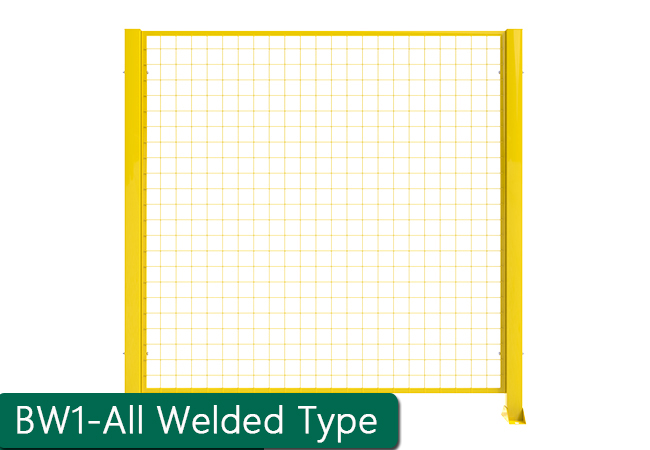
Warehouse partition mesh is used to divide storage and operational areas while maintaining visibility across the facility.
It can separate picking zones, inventory areas, packing stations, equipment spaces and designated storage sections without requiring permanent solid walls throughout the warehouse.
Key Features
Modular construction
Prefabricated panels and compatible posts allow the partition layout to be planned around storage racks, pedestrian routes and material-handling equipment.
Visibility through the mesh
Open welded mesh allows workers to observe adjacent areas and makes it easier to identify stored goods and activities beyond the partition.
Flexible layout changes
Where the selected system supports disassembly, compatible panels can be relocated or replaced when warehouse operations change.
Corrosion-resistant finishes
Galvanized or compatible powder-coated finishes may be selected according to the warehouse environment, cleaning requirements and expected maintenance conditions.
Typical Applications
- Warehouse storage sections
- Inventory and picking areas
- Packing and dispatch zones
- Equipment and maintenance areas
- Restricted storage locations
- Separation between pedestrian and operational areas
Warehouse Partition Specifications
| Parameter | Specification |
|---|---|
| Panel Type | Welded Wire Mesh Partition |
| Frame | Specified Steel Tube |
| Mesh Opening | Product-specific |
| Wire Diameter | Product-specific |
| Panel Height | Customized according to the layout |
| Panel Width | Customized according to the layout |
| Post Type | Compatible Steel Posts |
| Surface Treatment | Galvanized / Powder Coated / Other Available Finishes |
| Access | Compatible Gates, where available |
| Customization | Dimensions, Mesh, Frames, Colors and Accessories |
The actual panel dimensions, mesh opening, wire diameter and post specifications should be confirmed in the approved product drawing.
For warehouses using forklifts or other powered industrial trucks, the partition’s structural requirements and placement should be assessed according to the anticipated hazards. A general mesh divider should not automatically be treated as a vehicle-impact barrier.
2. Factory Safety Barriers and Industrial Safety Barriers
Factory safety barriers define operational boundaries around machinery, production equipment and selected restricted areas.
Their primary function depends on the intended application. Some barriers provide general area separation, while machine guarding systems are specifically designed to prevent access to identified machinery hazards.
Key Features
Rigid panel construction
Welded mesh panels and compatible steel frames provide a physical boundary around designated work areas.
Visibility for operational monitoring
Open mesh can help supervisors and operators observe selected areas while maintaining physical separation.
Modular assembly
Compatible panels, posts and connectors may simplify installation, replacement and layout adjustments.
Access gate options
Gates can provide designated entry points for authorized personnel and maintenance activities. Where the barrier functions as a machine guard, gate arrangements must meet the applicable safety design requirements.
Typical Applications
- Robotic work cells
- Automated production equipment
- Conveyor systems
- Machinery maintenance zones
- Manufacturing workstations
- Selected equipment and storage areas
Factory Safety Barrier Specifications
| Parameter | Specification |
|---|---|
| Panel Type | Welded Mesh / Other Specified Guarding Design |
| Frame Material | Specified Steel Tube |
| Mesh Opening | According to the application |
| Frame Dimensions | Product-specific |
| Panel Height | According to the risk assessment and layout |
| Mounting | Approved Floor-Fixed or Other Specified Arrangement |
| Surface Treatment | Suitable for the operating environment |
| Access Gates | According to the safety design |
| Safety Interlocks | Where required by the machine safeguarding design |
For machine guarding, the required mesh opening, guard position, safety distance and access arrangements must be determined through the machinery risk assessment and applicable requirements.
Where interlocking gates are required, the complete arrangement—including the guard, gate, interlock and control system—must be designed and validated for the intended machinery.
3. Workshop Partition Fence and Workshop Divider Fence
Workshop partition fences separate production lines, assembly stations, pedestrian routes and material-handling areas.
Compared with a fixed building wall, a modular partition can offer more flexibility where production layouts change or equipment requires periodic access.
Common Configuration Options
Full-mesh partition
An open welded mesh design for general workshop separation where visibility and access to surrounding areas are important.
Mesh with selected solid panels
A combination of mesh and solid sections may be considered where the project requires a different balance of visibility and physical separation.
Special-purpose machine guarding
Some industrial applications require guarding designed around specific machinery, operating conditions and safety requirements. These systems must be specified according to their intended function rather than selected solely by appearance.
Typical Applications
- Production-line separation
- Assembly and inspection areas
- Material-handling zones
- Workshop storage sections
- Equipment maintenance areas
- Selected automated manufacturing cells
Workshop Partition Specifications
| Parameter | Specification |
|---|---|
| Panel Structure | Modular Mesh / Specified Hybrid Design |
| Frame | Steel Tube Frame |
| Mesh Opening | Product-specific |
| Wire Diameter | Product-specific |
| Panel Height and Width | Customized according to the layout |
| Post Configuration | Compatible Steel Posts |
| Surface Treatment | Galvanized / Powder Coated / Other Available Finishes |
| Mounting | According to the approved design |
| Gates | Compatible Access Gates, where available |
| Reconfiguration | Subject to the selected modular system |
The actual dimensions and available configurations should be confirmed against the selected product range.
4. Comparing the Three Industrial Partition Systems
Although warehouse partitions, factory safety barriers and workshop partition fences may use similar mesh panels and steel frames, their intended functions differ.
| Feature | Warehouse Partition Mesh | Factory Safety Barrier | Workshop Partition Fence |
|---|---|---|---|
| Primary Purpose | Divide storage and warehouse areas | Separate designated equipment or operational zones | Organize production and workshop areas |
| Typical Location | Warehouses and logistics facilities | Factories and selected machinery areas | Manufacturing workshops |
| Main Design Focus | Visibility, layout and storage separation | Hazard assessment and barrier function | Flexible production layout |
| Modular Design | Often useful | Depends on the safety design | Often useful |
| Access Gates | According to storage layout | According to the intended safety function | According to workflow and maintenance needs |
| Special Safety Requirements | Depends on the stored goods and site risks | May require machinery safeguarding provisions | Depends on whether it functions as a machine guard |
The best product depends on the actual purpose of the barrier. A warehouse divider should not automatically be used as a machine guard, and a general workshop partition should not be described as a certified safety barrier without supporting evidence.
5. Materials and Surface Treatment
Industrial partition fencing commonly uses steel mesh panels, steel tube frames, posts and compatible connectors.
The material and finish should be selected according to the intended application and operating environment.
Galvanized Steel
Galvanized steel has a zinc coating that helps protect the underlying steel against corrosion.
Confirm the actual coating specification and manufacturing sequence for the selected product.
Powder-Coated Finish
Powder coating provides a decorative finish and an additional protective layer when applied over an appropriately prepared substrate.
It also allows different functional areas to use coordinated or contrasting colors, subject to product availability.
Galvanizing Plus Powder Coating
A compatible galvanized substrate combined with powder coating may be suitable where both corrosion protection and appearance are important.
The manufacturing sequence should be confirmed because cutting, welding and other processing operations can affect protective coatings.
Environmental Selection
| Environment | Main Considerations |
|---|---|
| Dry Warehouse | Panel dimensions, visibility and layout |
| Humid Workshop | Corrosion protection and maintenance |
| Dusty Production Area | Cleaning access and coating condition |
| Oil-Exposed Area | Compatibility with the actual oil or cleaning agents |
| Chemical Processing Area | Specific chemical compatibility and maintenance requirements |
Do not assume that every powder coating is resistant to all oils, solvents or industrial chemicals. Where chemical exposure is relevant, confirm the coating specification and supporting compatibility data.
6. Customization for Industrial Projects
Bendin can discuss customized industrial partition configurations according to product design, manufacturing capabilities and project requirements.
Customization may include:
- Panel height and width
- Mesh opening and wire diameter
- Frame profile and dimensions
- Post configuration
- Surface treatment and color
- Gate dimensions and locations
- Mounting brackets and fixing accessories
- Packaging and OEM requirements
For large projects, buyers should provide a workshop or warehouse layout drawing showing equipment positions, storage areas, pedestrian routes, access gates and mounting conditions.
This information helps coordinate the panel schedule, accessory quantities and installation plan before manufacturing begins.
7. Installation Planning and Site Safety
Correct installation helps maintain panel alignment, stability and the intended separation function.
Step 1: Review the Layout
Identify the locations of machinery, storage racks, pedestrian routes, vehicle paths, access gates and maintenance areas.
Step 2: Confirm the Product Specification
Verify panel dimensions, mesh opening, wire diameter, frame dimensions, post type and surface treatment against the approved drawings.
Step 3: Determine the Mounting Method
Floor fixing, base plates or other mounting arrangements should be selected according to the product design, floor structure and expected loads.
Check the floor and identify embedded utilities before drilling.
Step 4: Install Panels and Posts
Position the posts and assemble the panels using compatible brackets and fasteners.
Check alignment and ensure that connections are installed according to the manufacturer’s instructions.
Step 5: Install Access Gates
Confirm gate dimensions, opening direction, latches and any required safety equipment.
For machine guarding applications, verify that the completed gate and any interlock arrangement meet the approved safety design.
Step 6: Complete the Inspection
Check panel stability, fasteners, exposed edges, coating condition, gate operation and access clearances before the area is returned to use.
8. Illustrative Project Example: Warehouse and Production-Zone Separation
A manufacturing facility requires a partition system to separate a warehouse picking area from an adjacent production zone.
The project team considers modular welded mesh panels, steel tube frames and compatible access gates.
Preliminary Configuration
| Item | Example Requirement |
|---|---|
| Application | Warehouse and Production-Zone Separation |
| Fence Type | Modular Industrial Partition Fence |
| Panel Height | Confirmed according to the site layout |
| Panel Width | Selected according to the approved drawing |
| Mesh Opening | Confirmed according to the intended separation function |
| Frame | Specified Steel Tube |
| Surface Treatment | Suitable for the facility environment |
| Mounting | Approved Floor-Fixed Arrangement |
| Gates | Positioned for authorized access and material movement |
| Inspection | Dimensions, Connections, Stability, Coating and Gate Operation |
The final configuration should be confirmed against the site layout, operational requirements, mounting conditions and applicable safety specifications.
If the partition is also intended to protect workers from machinery hazards or vehicle impact, those functions require a specific risk assessment and appropriate supporting design.
This is an illustrative project scenario, not a completed Bendin customer installation.
9. Quality Control and Documentation
A suitable inspection plan should cover panels, frames, posts, connectors and surface treatment.
Dimensional Inspection
Check panel height and width, mesh opening, frame dimensions and relevant tolerances.
Weld Inspection
Inspect welded joints according to the agreed method and acceptance criteria.
Visual appearance alone does not establish a particular load capacity or safety rating.
Surface Inspection
Check coating consistency and visible defects. Where specified, verify coating measurements or other relevant test results.
Component Compatibility
Confirm that panels, posts, connectors and gates match the approved drawings.
Documentation
Depending on the project, buyers may request:
- Product drawings
- Material specifications
- Surface-treatment details
- Inspection records
- Relevant test reports
- Installation instructions
- Applicable certificates and conformity documents
Any certification or performance claim should identify the applicable product, scope and supporting documentation.
10. How to Choose an Industrial Partition Fence Supplier
When comparing suppliers, evaluate the actual product specification rather than relying only on general marketing claims.
Product Range
Confirm available panel dimensions, mesh openings, wire diameters, frame profiles and surface finishes.
Technical Drawings
Request drawings showing panel dimensions, gate locations, mounting details and connection arrangements.
Modular Compatibility
Verify that panels, posts, connectors and gates are designed to work together.
Safety Requirements
Identify whether the product is a general partition or a machine guard. Where machinery hazards are involved, determine the applicable requirements before finalizing the design.
Quality Documentation
Confirm which material records, inspection reports, certificates and test documents are available for the selected product.
Delivery and After-Sales Support
Agree on packaging, delivery arrangements, installation information, replacement components and warranty terms before ordering.
For customized projects, approve the final technical drawings and bill of materials before production begins.
11. Bendin Industrial Partition Fencing Solutions
Bendin supplies customizable metal fencing products for warehouse, factory and workshop applications.
Depending on product design and manufacturing capabilities, configurations may include:
- Warehouse partition mesh
- Modular factory safety barriers
- Workshop partition fences
- Welded mesh panels and steel tube frames
- Compatible posts and mounting brackets
- Galvanized or powder-coated finishes
- Access gates and compatible accessories
- Customized dimensions and packaging
Customers can provide layout drawings, equipment dimensions, storage requirements, access routes and technical specifications for review before ordering.
For projects involving machinery or vehicle hazards, provide the intended safety function at the quotation stage so that the proposed configuration can be evaluated appropriately.
12. Frequently Asked Questions
What is the difference between warehouse partition mesh and a factory safety barrier?
Warehouse partition mesh primarily divides storage and operational areas. A factory safety barrier may serve a more specific protective function, depending on its design and the hazards involved.
Can industrial partition fences be customized?
Customization can be discussed according to product design and manufacturing capabilities. Confirm panel dimensions, mesh opening, frame specifications, finish and access requirements before ordering.
Can modular partitions be moved when the factory layout changes?
Some systems allow compatible panels and connectors to be disassembled and reconfigured. Inspect the components and confirm compatibility before reuse.
Is a warehouse partition suitable for protecting robotic equipment?
Not automatically. A machine guard must be designed according to the machinery risk assessment and applicable safety requirements.
Which surface treatment is suitable for industrial environments?
The appropriate finish depends on moisture, pollutants, cleaning methods and possible chemical exposure. Confirm the actual coating specification before ordering.
What information is needed for a quotation?
Provide the site layout, intended application, required panel dimensions, mesh opening, frame specifications, surface treatment, gate requirements, mounting method, quantity and delivery destination.
13. Request an Industrial Partition Fence Quotation
Industrial partition fencing helps organize warehouse storage, separate production areas and define designated operational zones.
The appropriate configuration depends on the intended function, panel dimensions, mesh opening, frame structure, mounting method, environmental conditions and any applicable safety requirements.
Bendin (Hebei Bendin Industrial Technology Co., Ltd.) supplies customizable industrial fencing products for international distributors, contractors and project owners.
For a quotation, provide:
- Project location and application
- Warehouse or workshop layout
- Required panel height and width
- Mesh opening and wire diameter
- Frame and post specifications
- Surface treatment and color
- Mounting method
- Gate and access requirements
- Applicable project specifications
- Quantity and delivery destination
Bendin can review your requirements and discuss a suitable industrial partition fencing configuration for your project.