



Robot Safety Fence: Machine Guarding, Interlocks and Specifications
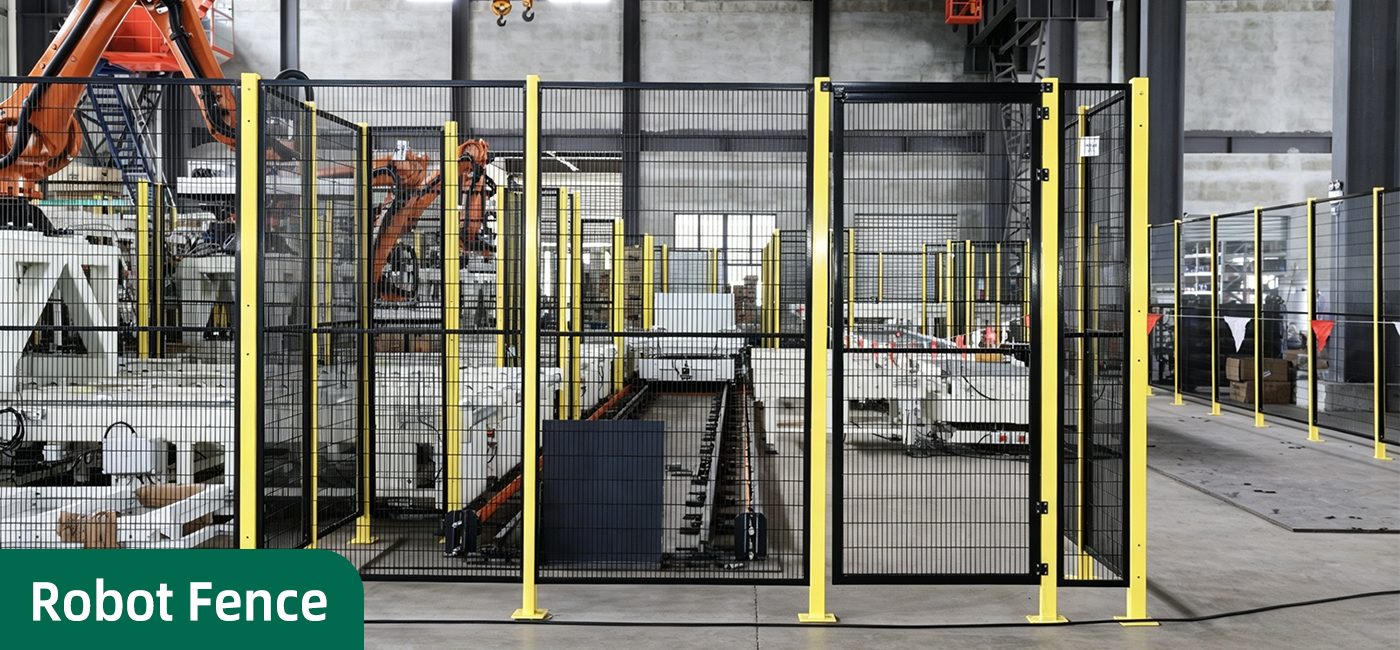
Robot safety fencing is an important component of industrial automation safety. It establishes a physical boundary around robotic workstations, automated production lines and selected machinery, helping prevent unauthorized access to hazardous operating areas.
Modern robot guarding systems may combine welded mesh panels, steel posts, access gates and safety-related control devices. The correct configuration depends on the robot’s operating envelope, the hazards identified during risk assessment, maintenance access requirements and the safety functions needed for the complete machine.
Bendin (Hebei Bendin Industrial Technology Co., Ltd.) supplies customizable industrial machine guarding fences for automation facilities, manufacturing plants and industrial equipment enclosures. Available configurations can include full-mesh panels, mesh-and-solid-panel combinations, punched panels, compatible access gates and provisions for suitable safety interlocks.
This guide explains robot safety fence types, technical specifications, safety gate considerations, installation requirements and practical selection criteria for industrial automation projects.
1. What Is a Robot Safety Fence?
A robot safety fence is a physical guarding system installed around an industrial robot or automated process.
Its purpose is to restrict access to hazardous areas during operation and provide a defined boundary between machinery and surrounding workspaces.
A typical system may include:
- Welded steel mesh panels
- Supporting steel posts
- Panel clips and mounting brackets
- Pedestrian access gates
- Maintenance and equipment-access gates
- Mechanical latches
- Compatible safety interlocks where required
- Galvanized or powder-coated finishes
- Additional guarding components specified by the risk assessment
The fence is one part of the overall machine safety solution. Its effectiveness depends on the panel design, openings, mounting, distance from hazards, gate arrangements and any associated safety-control functions.
A standard industrial fence should not automatically be considered compliant with every robot application.
2. Applicable Standards for Robot Safety Fencing
Industrial robot guarding should be selected according to the intended application and applicable safety requirements.
EN ISO 14120
EN ISO 14120 addresses general requirements for the design and construction of fixed and movable guards.
It is relevant when specifying the construction and installation of machine guards, subject to the applicable edition and project requirements.
EN ISO 14119
EN ISO 14119 addresses the design and selection of interlocking devices associated with guards.
It is relevant when an access gate requires an interlocking arrangement to control access to hazardous machinery.
Robot-Specific Safety Requirements
Industrial robot applications may also require assessment against applicable robot safety standards, such as ISO 10218, depending on the equipment, application and jurisdiction.
The appropriate requirements should be determined for the complete robotic system rather than inferred from the fence product alone.
Important Compliance Consideration
Compliance depends on the actual product design, installation, risk assessment and relevant safety functions.
A supplier should not claim that a fence is universally compliant simply because its mesh panels or posts follow a particular standard.
3. Typical Robot Safety Fence Specifications
Bendin can discuss customized configurations according to product drawings, machine layouts and manufacturing capabilities.
| Parameter | Typical Options |
|---|---|
| Product Type | Robot Safety Fence / Machine Guard Fence |
| Main Material | Steel Wire Mesh and Steel Profiles |
| Mesh Opening | Common options may include 10 × 10 mm to 100 × 100 mm, subject to design |
| Wire Diameter | Project-specific |
| Panel Height | Approximately 1.2–3.5 m, subject to application |
| Panel Width | Customized according to the layout |
| Post Type | Square / Rectangular / Other Compatible Profiles |
| Panel Types | Full Mesh / Mesh with Solid Lower Panel / Punched Panel |
| Surface Treatment | Galvanized / Powder Coated / Duplex Coating |
| Gate Options | Pedestrian / Maintenance / Equipment Access |
| Interlock Provisions | Compatible devices where required |
| Mounting | Floor-Mounted Posts / Base Plates / Specified Fixings |
| Customization | Panel / Post / Gate / Color / Accessories |
These are indicative configuration options rather than a fixed specification for every product. Actual wire diameters, mesh openings, panel dimensions, post sections and fixing details should be confirmed before ordering.
The final guard height, opening size, positioning and mounting arrangement should be determined by the machinery risk assessment and applicable requirements.
4. Main Types of Robot Safety Fence
Different automation applications may require different panel constructions.
Full-Mesh Robot Safety Fence
Full-mesh panels use welded wire mesh to create a physical boundary while allowing visibility through the enclosure.
Potential applications include:
- General robot workstations
- Automated assembly lines
- Material-handling robots
- Industrial equipment enclosures
Mesh opening and panel position should be selected according to the hazards, reach-through risks and required separation distance.
Mesh with Solid Lower Panel
This configuration combines an open mesh section with a solid lower panel.
Depending on the design, it may help contain certain materials or separate lower-level areas while retaining visibility through the upper mesh.
It may be considered for selected welding, handling or production applications.
The lower panel should not be assumed to provide protection against every type of flying debris without appropriate testing and design verification.
Punched Metal Panel Guarding
Punched metal panels may be considered where a more enclosed appearance or a particular opening pattern is required.
Their suitability depends on the material, opening geometry, panel strength, visibility requirements and access risks.
A punched panel should not automatically be described as compliant with cleanroom or GMP requirements without evaluating the complete material and installation specification.
Application-Specific Robot Guarding
Some robot cells require specialized panel arrangements, access points or additional guarding components.
These configurations should be developed around the machine layout and the risk assessment.
Collaborative robot applications also require an application-specific safety assessment. A fence is not automatically necessary or unnecessary merely because a robot is described as collaborative.
5. Safety Gates and Interlocking Devices
Access gates are important components of robot guarding systems because operators and maintenance personnel may need to enter the guarded area.
Pedestrian Access Gates
Pedestrian gates provide access for inspection, cleaning and maintenance.
Their dimensions, hinges, latches and opening direction should suit the workspace and intended use.
Equipment-Access Gates
Larger gates or removable sections may be required when equipment, tooling or components need to pass through the enclosure.
The gate arrangement should preserve the required guarding function when closed.
Safety Interlocks
Where required by the risk assessment, a gate may be equipped with a compatible safety interlock connected to the machine’s safety-control system.
Opening the gate can initiate a defined safety response, depending on the validated system design.
The actual response may involve stopping hazardous motion, preventing restart or implementing another required safety function.
Safety-Control Validation
A mechanical latch alone is not necessarily a safety interlock.
The interlocking device, control system, wiring, logic and stopping behavior must be suitable for the application and validated according to the relevant requirements.
The required stopping time depends on the machine and its hazards. A universal 0.1-second stopping claim should not be made without documented measurements and system-specific evidence.
6. Selecting Mesh Openings and Safety Distances
Mesh opening and fence placement must be considered together.
A smaller opening does not automatically make a guard compliant, and a suitable mesh cannot compensate for an inadequate safety distance.
Important considerations include:
- Robot movement and operating envelope
- Potential access to hazardous areas
- Mesh opening dimensions
- Distance between the fence and moving parts
- Gate locations
- Openings near floors and adjacent structures
- Maintenance access
- Additional hazards such as flying materials or hot surfaces
The final layout should be checked against the applicable safety requirements and machine risk assessment.
Where necessary, the machine integrator or responsible safety engineer should confirm the required guarding distances and access restrictions.
7. Materials and Corrosion Protection
Robot safety fences are often installed in factories where they may be exposed to dust, humidity, oil residues, cleaning agents and other environmental conditions.
The appropriate material and coating should be selected according to the environment.
Steel Wire Mesh
Welded steel mesh provides a defined grid pattern and can be configured into panels of different dimensions.
Wire diameter, mesh opening and weld quality should be specified according to the intended application.
Steel Posts and Frames
Posts and frames support the panels and transfer loads to the floor or other supporting structure.
Their dimensions and mounting method should be suitable for the panel arrangement and operating environment.
Hot-Dip Galvanizing
Hot-dip galvanizing provides a zinc coating that helps protect steel against corrosion.
The required coating specification should be confirmed for the actual product and manufacturing process.
Powder Coating
Powder coating provides a decorative finish and an additional protective layer when applied over an appropriately prepared substrate.
Colors can be selected to coordinate with the factory layout or site identification system.
Galvanizing Plus Powder Coating
A compatible galvanized substrate combined with powder coating may be suitable where both corrosion protection and appearance are important.
A claim of 15 years or more of service life should only be published when supported by product data and clearly defined environmental conditions.
8. Modular Design and Installation
Modular robot fencing uses coordinated panels, posts and accessories to simplify assembly and future adjustments.
Benefits of Modular Construction
- Standardized panel dimensions
- Consistent panel alignment
- Convenient transportation
- Replacement of individual panels
- Flexible layout planning
- Easier expansion where the system permits
Installation Considerations
Before installation, confirm:
- Machine layout and guarding boundary
- Floor condition and anchoring requirements
- Post positions
- Panel dimensions
- Gate locations
- Equipment clearance
- Cable and service routes
- Interlock requirements
- Maintenance access
Any modification to the fence layout should be reviewed before the equipment returns to operation.
Modular construction can simplify installation, but actual installation time depends on the product design, site conditions and installation team.
9. Robot Safety Fence for Different Industries
Automotive Manufacturing
Robot guarding is commonly used around welding robots, handling systems, assembly cells and automated production equipment.
The fence layout should reflect the robot’s operating envelope, material flow and maintenance requirements.
Metalworking and Machinery
Machine guarding may be used around automated machining equipment and robotic handling systems.
The design should account for moving components, workpiece movement and any foreseeable ejection or impact hazards.
Electronics Manufacturing
Robot safety fencing may be used to separate automated assembly equipment from adjacent workspaces.
Panel openings, gate arrangements and the surrounding production environment should be considered when selecting the system.
Packaging and Logistics
Robot guarding can define the operating area around palletizing robots, packaging equipment and automated handling systems.
The layout should consider conveyor interfaces, material access and t