



Woven Gabion Mesh for Riverbank Protection and Ecological Engineering
Woven gabion mesh is widely used in civil engineering projects where flexible stone-filled structures are required for riverbank protection, slope stabilization, erosion control and landscape construction.
Manufactured by weaving steel wire into a double-twist hexagonal pattern, woven gabion mesh can accommodate a degree of local deformation while maintaining the integrity of the mesh enclosure. When assembled into baskets or mattresses and filled with suitable stone, it forms a permeable structure that combines the mass of the filling material with the flexibility of the woven mesh.
Bendin (Hebei Bendin Industrial Technology Co., Ltd.) supplies customizable woven gabion mesh for river engineering, road construction, slope protection and landscape projects. Available configurations can be discussed according to mesh opening, wire diameter, coating system, basket dimensions and project requirements.
This guide explains how woven gabion mesh works, how to select suitable specifications and how gabion systems can be incorporated into ecological engineering projects.
1. What Is Woven Gabion Mesh?
Woven gabion mesh is a steel wire mesh product manufactured using a mechanical weaving process.
In a common double-twist configuration, adjacent wire pairs are twisted together to form a continuous hexagonal mesh pattern. The mesh can then be assembled into baskets or mattresses and filled with appropriately graded stones.
A complete gabion system may include:
- Double-twist hexagonal wire mesh
- Edge or selvedge wires
- Binding wire
- Internal diaphragms
- Connection spirals or approved fasteners
- Stone filling
- Foundation and drainage components where specified
The mesh retains the stone while allowing water to pass through the spaces between the filling material.
The performance of the completed structure depends on the mesh specification, connections, stone grading, foundation, drainage and surrounding ground conditions.
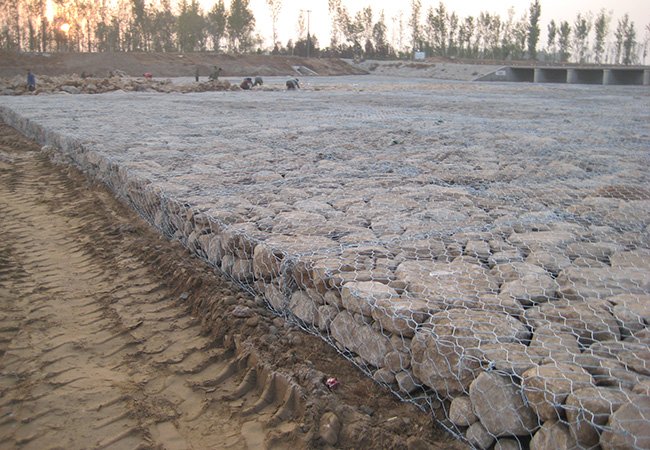
2. How Double-Twist Weaving Works
Double-twist weaving creates a continuous mesh structure in which adjacent wire pairs are twisted together.
This construction allows a degree of local movement within the mesh, which may be beneficial where the ground experiences limited settlement or irregular movement.
Compared with rigid welded mesh panels, woven gabion mesh is generally more flexible.
However, flexibility does not mean that the structure can withstand unlimited deformation. The basket geometry, mesh specification, stone filling and foundation must all be suitable for the expected loads.
This is one reason double-twist gabion mesh is commonly considered for riverbank protection, erosion control and selected slope-engineering applications.
3. Woven Gabion Mesh Specifications
Bendin can discuss customized configurations according to project drawings and technical requirements.
| Parameter | Typical Options |
|---|---|
| Product Type | Woven Gabion Mesh |
| Mesh Structure | Double-Twist Hexagonal |
| Material | Low-Carbon Steel Wire |
| Mesh Opening | Commonly 60 × 80 mm / 80 × 100 mm / 100 × 120 mm, subject to specification |
| Wire Diameter | Project-specific |
| Edge Wire | Reinforced edge wire as specified |
| Surface Treatment | Galvanized / Zinc-Aluminum Alloy / PVC-Coated Options |
| Basket Length | Customized |
| Basket Width | Customized |
| Basket Height | Customized |
| Diaphragms | Optional according to basket design |
| Connection | Binding Wire / Spirals / Approved Fasteners |
| Filling Material | Suitable Natural Stone or Approved Aggregate |
| Packaging | Folded Mesh / Bundled Rolls / Project-Specific |
These are indicative configuration options rather than a fixed product specification. Final mesh openings, wire diameters, coating characteristics and basket dimensions should be confirmed against the applicable product standard and project drawings.
4. Woven Gabion Mesh for Riverbank Protection
Riverbanks are exposed to changing water levels, current forces, surface erosion and localized scour.
Gabion structures can be considered where a permeable stone-filled system is appropriate for protecting exposed soil and stabilizing the riverbank surface.
Surface Erosion Control
The stone-filled structure helps protect exposed soil from direct water action.
Permeable Construction
Water can pass through the spaces between the stones, depending on the filling arrangement and site conditions.
Adaptability to Ground Conditions
The woven mesh can accommodate a degree of localized movement when the structure is correctly designed.
Modular Construction
Gabion baskets can be assembled into a continuous protective arrangement along the required riverbank section.
Engineering Considerations
For river projects, the design team should evaluate:
- Water velocity
- Flood levels
- Scour depth
- Foundation conditions
- Stone grading
- Basket dimensions
- Toe protection
- Filter or geotextile requirements
- Connections between adjacent units
Gabion mesh alone does not guarantee riverbank stability. The complete structure must be designed for the hydraulic and geotechnical conditions of the site.
5. Woven Gabion Mesh for Slope Stabilization
Slope-protection projects often need to manage surface runoff, soil erosion and localized ground movement.
Woven gabion structures may be incorporated into slope-protection or retaining systems when the site conditions are suitable.
Typical applications include:
- Roadside slopes
- Highway embankments
- Drainage channels
- Hillside developments
- Retaining structures
- Erosion-prone areas
Depending on the project, gabions can be combined with geotextiles, drainage layers, vegetation and engineered foundations.
The final design should account for soil properties, slope geometry, groundwater conditions, foundation stability and drainage.
6. Choosing the Right Mesh Opening
Mesh opening affects stone retention, material consumption and the behavior of the finished basket.
Smaller openings may be appropriate when smaller filling stones must be retained. Larger openings may be suitable when larger, well-graded stones are used.
The selected opening should be compatible with:
- Stone size and grading
- Expected hydraulic conditions
- Wire diameter
- Basket dimensions
- Required structural performance
- Applicable product standards
The mesh opening should not be selected independently of the filling material and project design.
7. Corrosion Protection for Woven Gabion Mesh
Gabion mesh may be exposed to moisture, soil, freshwater, coastal conditions and other environmental factors.
Bendin can discuss different coating options according to project requirements.
Galvanized Wire
Galvanized steel wire uses a zinc coating to help protect the steel substrate against corrosion.
The required coating specification should be selected according to the product design and environmental exposure.
Zinc-Aluminum Alloy Coating
Zinc-aluminum alloy coatings, including Galfan-type systems, may provide improved corrosion performance compared with conventional zinc coatings in suitable environments.
They can be considered for projects requiring additional corrosion protection.
PVC-Coated Wire
PVC coating adds a polymer layer over the underlying metallic coating.
It may be suitable for selected projects where additional surface protection or a particular appearance is required.
Selecting a Coating System
Coating selection should consider:
- Freshwater or coastal exposure
- Soil chemistry
- Expected service period
- Wire specification
- Applicable product standard
- Maintenance requirements
A service-life claim such as 50 years should only be published when supported by relevant coating specifications, environmental assumptions and appropriate technical evidence.
8. Ecological Benefits and Vegetation
Gabion structures can be incorporated into ecological engineering projects where a stone-filled, permeable structure is appropriate.
The spaces between stones may provide opportunities for sediment accumulation and vegetation establishment under suitable conditions.
Potential considerations include:
- Local plant species
- Soil and sediment characteristics
- Water availability
- Seasonal water levels
- Stone type and grading
- Erosion risk
- Maintenance requirements
Vegetation growth is not guaranteed by the mesh itself. Successful ecological restoration depends on the overall site design, environmental conditions and appropriate management.
Where habitat restoration is a project objective, the gabion design should be coordinated with the ecological and engineering requirements.
9. Natural Stone and Recycled Aggregate
The filling material is an essential part of a gabion structure.
Suitable natural stone is commonly used because of its mass, durability and ability to remain stable within the basket.
Recycled aggregates may be considered for selected applications where the material properties, grading, durability and environmental suitability meet the project requirements.
Before selecting a filling material, confirm:
- Particle-size distribution
- Material strength and durability
- Resistance to the expected environment
- Compatibility with the mesh opening
- Availability and transport costs
- Project-specific environmental requirements
For hydraulic structures, the stone grading and basket configuration must be compatible with the expected water flow and potential scour conditions.
10. Woven Gabion Mesh vs. Welded Gabion Mesh
Woven and welded gabion mesh serve related purposes but have different construction characteristics.
| Feature | Woven Gabion Mesh | Welded Gabion Mesh |
|---|---|---|
| Manufacturing | Double-twist wire weaving | Resistance-welded panels |
| Mesh Pattern | Hexagonal | Usually square or rectangular |
| Structural Behavior | Flexible woven structure | More rigid panel structure |
| Deformation | Can accommodate some local movement | Less flexible at welded intersections |
| Assembly | Woven mesh folded and connected | Rigid panels assembled into baskets |
| Appearance | Traditional gabion texture | Regular geometric appearance |
| Typical Applications | Riverbanks, erosion control, irregular terrain | Retaining structures, landscaping, architectural gabions |
Neither product is automatically better for every project.
Woven gabion mesh may be preferred where flexibility is important, while welded gabion mesh may be selected where dimensional consistency and a rigid panel shape are priorities.
11. Installation Process for Woven Gabion Baskets
A typical installation sequence includes the following stages.
Step 1: Prepare the Foundation
Prepare the foundation according to the engineering design. Install any specified filter layer or geotextile before placing the gabion.
Step 2: Assemble the Mesh Basket
Unfold the mesh basket and connect the side panels, end panels and diaphragms using the specified binding wire, spirals or approved fasteners.
Step 3: Position the Basket
Place the assembled basket at the designed location and align it with adjacent units.
Step 4: Fill with Stone
Fill the basket using suitable stone. The filling method should minimize excessive voids and avoid distorting the mesh.
Step 5: Secure the Lid
After filling and checking the basket dimensions, close and secure the top panel.
Step 6: Connect Adjacent Units
Connect neighboring gabions where required to create a continuous structure.
Step 7: Inspect the Installation
Check basket alignment, connections, stone containment and conformity with the approved drawings.
The actual installation procedure may vary according to basket dimensions, site access and engineering requirements.
12. Illustrative Project Example: Ecological Riverbank Restoration
A riverbank restoration project requires a permeable protective structure along an exposed section of bank.
The project team considers woven gabion mesh because a stone-filled structure may be appropriate for the site’s erosion-control requirements.
A preliminary configuration could include:
| Item | Example Requirement |
|---|---|
| Application | Riverbank Restoration |
| Mesh Type | Double-Twist Woven Gabion Mesh |
| Mesh Opening | Selected according to stone grading |
| Wire Coating | Galvanized or Zinc-Aluminum Alloy |
| Basket Dimensions | Determined by engineering design |
| Filling | Suitable Local Stone |
| Foundation | Prepared according to site conditions |
| Additional Components | Filter Layer / Geotextile / Connection Accessories where specified |
| Ecological Measures | Locally Appropriate Vegetation, where suitable |
The project engineer should evaluate water velocity, scour depth, foundation conditions, stone grading and the required coating system before finalizing the configuration.
This is an illustrative project scenario, not a completed Bendin customer installation.
13. Quality Control
Quality control should focus on the mesh structure, wire dimensions, coating and connection integrity.
Inspection may include:
- Wire diameter measurement
- Mesh opening inspection
- Double-twist configuration
- Edge wire inspection
- Coating inspection
- Basket dimensions
- Connection accessory verification
- Packaging inspection
For engineering projects, the applicable product standard, inspection methods and acceptance criteria should be agreed before production.
14. Bendin Custom Woven Gabion Mesh Solutions
Bendin supports customized woven gabion mesh production according to project requirements.
Customization may include:
- Mesh opening
- Wire diameter
- Edge wire specification
- Coating type
- Basket length, width and height
- Diaphragm arrangement
- Connection accessories
- Packaging
- OEM requirements
Customers can provide drawings, quantities, material requirements and destination details for review before ordering.
For large projects, a detailed bill of materials can help coordinate basket dimensions, connection accessories and packaging.
15. Frequently Asked Questions
What is woven gabion mesh used for?
Woven gabion mesh is commonly used for riverbank protection, slope stabilization, erosion control, retaining structures, drainage projects and landscaping.
What is the difference between woven and welded gabion mesh?
Woven gabion mesh uses twisted wire to create a flexible hexagonal structure. Welded gabion mesh uses welded intersections and provides a more rigid panel structure.
Which coating is suitable for riverbank projects?
Galvanized and zinc-aluminum alloy-coated wires are commonly considered. The appropriate choice depends on water chemistry, soil conditions, environmental exposure and the required service period.
Can woven gabion mesh support ecological restoration?
It can be incorporated into ecological engineering where the design, stone filling, drainage and local environmental conditions are suitable. Vegetation establishment depends on the overall project design and site conditions.
Can Bendin customize mesh and basket dimensions?
Yes. Mesh opening, wire diameter, coating, basket dimensions and connection accessories can be discussed according to project specifications.
Does Bendin supply stone filling?
Stone supply depends on the project location and transport economics. For international projects, locally sourced stone is often more practical than shipping heavy filling materials over long distances.
16. Request a Woven Gabion Mesh Quotation
Woven gabion mesh combines a double-twist hexagonal structure with stone filling to provide a practical option for erosion control, river engineering, slope stabilization and ecological landscaping.
The most suitable system depends on the mesh specification, coating, basket dimensions, stone grading, foundation and drainage design.
Bendin supplies customizable woven gabion mesh for international distributors, contractors and civil engineering projects.
For a quotation, provide:
- Project application
- Mesh opening
- Wire diameter
- Coating requirement
- Basket dimensions
- Stone size
- Quantity
- Project location and destination
Bendin can review your requirements and discuss a suitable woven gabion mesh configuration for your project.