


Custom Double Wire Fence: Specifications, Colors and Project Solutions
Double wire fencing is a welded steel mesh system designed to provide reinforced panel rigidity while maintaining an open, regular appearance. By combining paired horizontal wires with vertical wires, the system can offer greater panel stiffness than comparable single-wire mesh configurations.
For projects with specific architectural, environmental or installation requirements, customization may involve wire diameter, mesh opening, panel dimensions, post profiles, surface treatment and color.
Bendin (Hebei Bendin Industrial Technology Co., Ltd.) supplies customizable double wire mesh fencing systems for residential communities, sports facilities, municipal projects, commercial properties and selected industrial applications.
This guide explains the main customization options, typical specifications, post compatibility and practical considerations for specifying a double wire fence.
1. What Is a Double Wire Fence?
A double wire fence is a welded mesh fencing system that uses two horizontal wires at specified horizontal positions, combined with vertical wires.
The paired horizontal wires increase the amount of steel at the reinforced sections and can improve panel rigidity compared with a comparable single-horizontal-wire design.
A typical system includes:
- Double horizontal wire mesh panels
- Vertical welded wires
- Supporting steel posts
- Panel clips or brackets
- Bolts and fixing accessories
- Optional pedestrian gates
- Optional vehicle gates
- Galvanized or coated finishes
The actual panel strength depends on wire dimensions, mesh opening, weld quality, panel width, post spacing, connections and installation conditions.
Customization should therefore be based on the complete fence specification rather than wire diameter alone.

2. Custom Wire Diameter Options
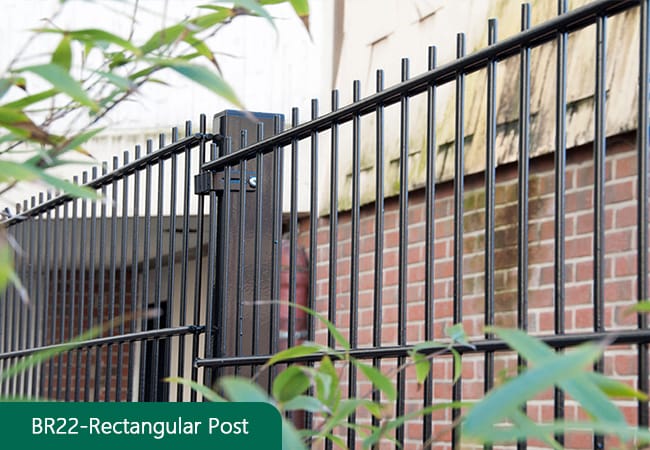
Wire diameter affects material consumption, panel stiffness, product weight and overall cost.
Double wire fencing is commonly specified using the diameters of the two horizontal wires and the vertical wire.
For example, a designation such as 6/5/6 mm commonly indicates two 6 mm horizontal wires with a 5 mm vertical wire. An 8/6/8 mm configuration commonly uses 8 mm horizontal wires and 6 mm vertical wires.
The exact notation should be confirmed with the supplier.
Lighter Configurations
Smaller wire diameters may be considered for projects where cost, handling and general perimeter separation are priorities.
Heavier Configurations
Larger wire diameters may be considered where greater panel rigidity is required.
The final design should account for the mesh opening, panel dimensions, post spacing, foundation conditions and expected loading.
The wire diameter should not be changed independently of the weld design and supporting structure.
3. Typical Custom Double Wire Fence Specifications
Bendin can discuss customized configurations according to project drawings and manufacturing capabilities.
| Parameter | Typical Options |
|---|---|
| Product Type | Custom Double Wire Mesh Fence |
| Material | Low-Carbon Steel Wire |
| Horizontal Wires | Double-Wire Reinforced Configuration |
| Wire Configuration | Commonly 6/5/6 mm or 8/6/8 mm, subject to specification |
| Mesh Opening | Commonly 50 × 200 mm, with other configurations subject to design |
| Panel Height | Approximately 0.8–2.4 m, customized |
| Panel Width | Approximately 2.0–2.5 m, customized |
| Post Type | Square / Rectangular / Other Compatible Profiles |
| Surface Treatment | Galvanized / Powder Coated / Duplex Coating |
| Color | RAL Colors / Project-Specific Colors |
| Connection | Clips / Brackets / Bolted Fixings |
| Gate Options | Single Swing / Double Swing |
| Customization | Wire / Mesh / Panel / Post / Color / Gate |
These are indicative configuration options rather than a fixed product specification. Final dimensions, wire diameters, coating requirements and connection details should be confirmed before production.
4. Custom Mesh Openings and Panel Dimensions
Mesh opening affects visibility, containment, material use and the appearance of the finished fence.
A smaller opening may be required for a particular containment or safety function. A larger opening may provide a more open appearance and reduce material consumption.
When specifying mesh dimensions, confirm:
- Horizontal wire spacing
- Vertical wire spacing
- Wire diameter
- Panel height
- Panel width
- Number and arrangement of horizontal wires
- Connection positions
- Compatibility with the selected post
The mesh opening should be selected according to the intended application and applicable requirements.
5. RAL Color Customization
Color is an important consideration for residential, landscape, sports and municipal projects.
Bendin can discuss powder-coating colors according to the available production process and the project’s color specification.
Common choices for fencing include:
- RAL 6005 green
- RAL 7016 anthracite grey
- RAL 9005 black
- Other specified RAL colors
Custom colors may be possible depending on the coating system, production quantity and material availability.
Before ordering, confirm the color reference, coating type, surface preparation and any required sample approval.
A color reference alone does not define the coating’s corrosion resistance or durability. These characteristics depend on the coating specification and application process.
6. Surface Treatment and Corrosion Protection
Outdoor double wire fencing may be exposed to rain, humidity, sunlight, pollution and coastal salt.
The appropriate surface treatment depends on the environment and required maintenance conditions.
Hot-Dip Galvanizing
Hot-dip galvanizing provides a zinc coating that helps protect the steel substrate against corrosion.
The required coating specification should be confirmed for the product design.
Powder Coating
Powder coating provides a decorative finish and an additional protective layer when applied over an appropriately prepared substrate.
It also allows the fence to be supplied in different colors.
Galvanizing Plus Powder Coating
A duplex coating combines zinc protection with a powder-coated finish.
It may be considered where the project requires both corrosion protection and a specified appearance.
The expected service life depends on the coating system, environmental exposure, installation and maintenance. A fixed lifespan should not be promised without supporting product data.
7. Can Double Wire Fence Bend to Follow the Terrain?
The phrase “bendable double wire fence” can refer to different product designs.
A conventional double wire mesh panel is a rigid welded panel. It should not automatically be assumed that the entire panel can be bent to any angle without affecting the mesh, welds or coating.
For uneven terrain or changes in direction, several design approaches may be considered:
Stepped Installation
Panels can be installed at different elevations to follow changes in ground level.
Angled Panel Connections
Where the post and fixing system permits, adjacent panels may be connected at an appropriate angle.
Special Panel Design
Customized panels may be considered where the project requires a particular geometry.
The actual permitted angle and installation method must be confirmed using the product drawing and engineering requirements. A claim such as “bends up to 30 degrees while maintaining full strength” should only be used when supported by product testing or an approved design.
8. Post and Connection Compatibility
The post system is an important part of a customized double wire fence.
Bendin can discuss compatible post profiles according to the panel design.
Square Posts
Square posts provide a straightforward configuration for modular welded mesh fencing.
Rectangular Posts
Rectangular posts allow different section dimensions to be selected according to structural and installation requirements.
Other Compatible Posts
Alternative post profiles may be considered where suitable fixing details are available.
Panel Fixings
The panel can be attached using suitable clips, brackets or bolted connections.
Before ordering, confirm that the selected panel, post and fixing system are designed to work together.
Gate posts may require a different structural specification from intermediate posts because they support hinges, latches and operating loads.
9. Custom Double Wire Fence for Sports Facilities
Sports facilities often require a fence that provides a clear boundary while maintaining visibility for players, spectators and operators.
Double wire mesh fencing may be considered for:
- Sports complex boundaries
- Training facilities
- Selected outdoor courts
- Recreational areas
- Equipment compounds
The required fence height, mesh opening and post arrangement depend on the sport and facility design.
For ball-containment applications, the system may need a different height or mesh configuration from a general perimeter fence.
The fence should not be assumed suitable for every sports application without checking the relevant safety and operational requirements.
10. Custom Double Wire Fence for Municipal and Residential Projects
Residential Communities
Different post profiles and powder-coating colors can be selected to coordinate with buildings and landscaped areas.
Parks and Municipal Boundaries
Standardized panel dimensions can simplify layout planning and procurement for public-space projects.
Commercial Properties
Double wire fencing can provide a consistent boundary around offices, warehouses, parking areas and business parks.
Industrial Parks
Heavier configurations may be considered where greater panel rigidity is required.
For high-security applications, a dedicated anti-climb system may be more appropriate than a standard double wire fence.
11. Illustrative Project Example: Municipal Park Boundary
A municipal park requires a 600-meter perimeter fence with a consistent appearance and coordinated gate design.
The project team requests a reinforced mesh panel, a dark grey finish and compatible steel posts.
Preliminary Configuration
| Item | Example Requirement |
|---|---|
| Application | Municipal Park |
| Total Perimeter | 600 m |
| Fence Height | 1.8 m |
| Panel Width | 2.5 m |
| Mesh Type | Double Wire Welded Mesh |
| Wire Configuration | Confirmed According to Specification |
| Post Type | Square or Rectangular |
| Surface Treatment | Galvanized + Powder Coated |
| Color | RAL 7016 Grey |
| Gates | Matching Pedestrian Gates |
Preliminary Panel Quantity
Using a nominal panel width of 2.5 meters:
600 ÷ 2.5 = 240 nominal panel positions
The final quantity should account for gate openings, corners, changes in direction and installation allowances.
The wire configuration, post spacing, foundation arrangement and coating specification should be confirmed before manufacturing.
This is an illustrative project scenario, not a completed Bendin customer installation.
12. Installation and Quality Control
A typical installation process includes:
- Measure the fence line and identify corners and gates.
- Confirm the panel dimensions and post spacing.
- Prepare the foundations or mounting locations.
- Install the selected posts.
- Attach panels using the specified connection system.
- Install gates and accessories.
- Inspect panel alignment, connections and surface coating.
Quality inspection may include:
- Wire diameter
- Mesh opening
- Panel dimensions
- Horizontal wire arrangement
- Weld quality
- Post dimensions
- Fixing compatibility
- Coating condition
- Packaging and labeling
For projects requiring specific structural performance or third-party inspection, the test methods and acceptance criteria should be agreed before production.
13. Bendin Custom Double Wire Fence Solutions
Bendin supports customized double wire mesh fencing for distributors, contractors and project owners.
Customization can include:
- Wire diameter
- Mesh opening
- Panel height and width
- Horizontal and vertical wire configuration
- Post type and dimensions
- Connection accessories
- Surface treatment
- Powder-coating color
- Pedestrian and vehicle gates
- Packaging and OEM requirements
Customers can provide drawings, site dimensions, reference photographs and technical specifications for review before ordering.
For large projects, coordinating panels, posts, gates and accessories under one specification can simplify procurement and installation planning.
14. Frequently Asked Questions
Can double wire fence be customized?
Yes. Wire diameter, mesh opening, panel dimensions, post profiles, coating and color can be discussed according to manufacturing capabilities and project requirements.
What does 6/5/6 mm mean?
It commonly indicates two 6 mm horizontal wires and 5 mm vertical wires. The notation should be confirmed with the supplier.
Can the fence be supplied in custom RAL colors?
Custom colors can be discussed according to the available coating process, production quantity and project requirements.
Can a double wire fence bend around corners?
The permitted arrangement depends on the panel design and post connection system. Conventional rigid panels should not be bent beyond their designed limits.
Does a heavier wire diameter always mean a stronger fence?
Not necessarily. Overall performance also depends on mesh geometry, weld quality, post spacing, connections, foundations and loading conditions.
Can Bendin supply matching gates?
Compatible pedestrian and vehicle gates can be discussed as part of the complete fencing system.
15. Request a Custom Double Wire Fence Quotation
A customized double wire fence should be specified according to its intended application, wire dimensions, mesh opening, post system, surface treatment and installation conditions.
Bendin supplies customizable double wire mesh fencing systems for residential, municipal, sports, commercial and selected industrial projects.
For a quotation, provide:
- Required fence height
- Panel width
- Wire configuration
- Mesh opening
- Post type
- Surface treatment and color
- Gate requirements
- Quantity
- Project location and destination
Bendin can review your requirements and discuss a suitable double wire fence configuration for your project.