


Barbed Wire: Types, Specifications and Fence Applications
Barbed wire is a widely used perimeter security material designed to discourage unauthorized access along property boundaries, agricultural land, industrial compounds and selected restricted areas.
Its simple construction, relatively low material cost and compatibility with different fence systems make it a practical option for projects requiring additional boundary protection.
Bendin (Hebei Bendin Industrial Technology Co., Ltd.) supplies customizable barbed wire products for international fencing projects, with options for galvanized steel wire, PVC-coated wire, strand configurations, barb spacing, wire diameter and packaging.
This guide explains the main types of barbed wire, common specifications, surface treatments, installation considerations and how to select a suitable product for your application.
1. What Is Barbed Wire?
Barbed wire is manufactured from steel wire incorporating regularly spaced sharp projections, commonly called barbs.
Depending on the product design, the barbs are formed from additional wire wrapped or twisted around the main line wire.
A typical barbed wire product consists of:
- Main line wire
- Barb wire
- Twisted or secured connections
- Protective surface coating
- Coils or rolls for transportation
Barbed wire is commonly installed along existing fences or property boundaries to discourage climbing and unauthorized entry.
It is not a substitute for a complete perimeter security system. Its effectiveness depends on the fence structure, installation, site conditions and other security measures.

2. Types of Barbed Wire
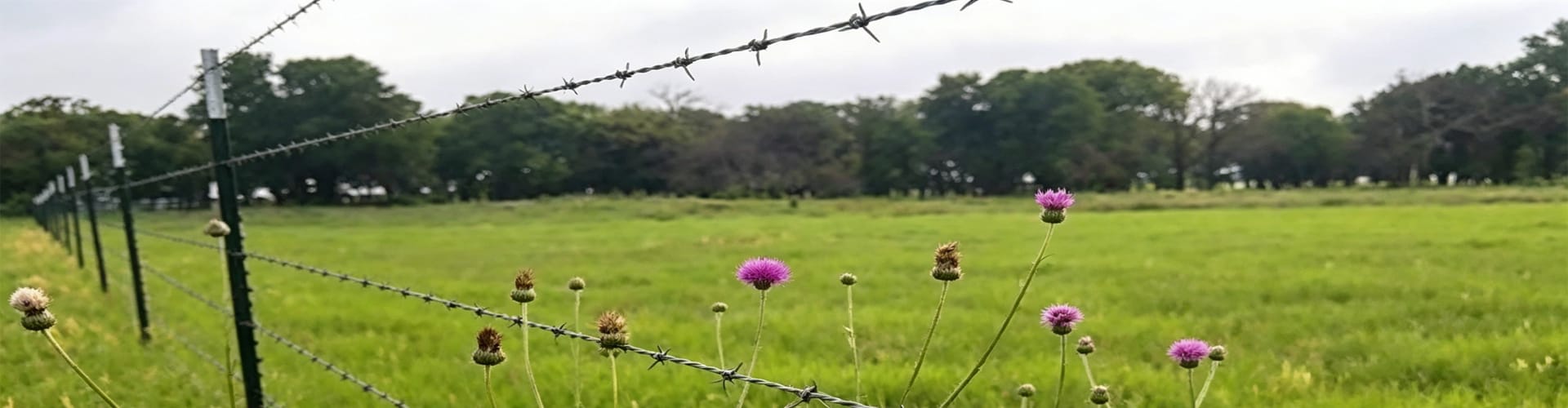
Bendin can discuss different barbed wire configurations according to project requirements.
Single-Strand Barbed Wire
Single-strand barbed wire uses one main line wire with regularly spaced barbs.
It may be suitable for selected agricultural boundaries, property demarcation and general fencing applications.
Typical considerations include:
- Main wire diameter
- Barb wire diameter
- Barb spacing
- Coating specification
- Required roll length
Double-Strand Barbed Wire
Double-strand barbed wire uses two line wires twisted together, with barbs secured around the combined strands.
This configuration provides a different structural arrangement from single-strand products and is commonly selected for general perimeter protection.
Its performance depends on wire dimensions, twisting quality, barb configuration and installation tension.
Reverse-Twist or Customized Configurations
Some manufacturers offer different twisting or barb arrangements for specific applications.
Before ordering, buyers should confirm the exact construction using a technical drawing or sample rather than relying on product names alone.
3. Typical Barbed Wire Specifications
Bendin provides configurable options according to the intended application and manufacturing requirements.
| Parameter | Typical Options |
|---|---|
| Product | Barbed Wire |
| Main Material | Low-Carbon Steel Wire |
| Line Wire Diameter | Approx. 1.6–2.8 mm |
| Barb Wire Diameter | Approx. 1.4–2.5 mm |
| Strand Configuration | Single-Strand / Double-Strand |
| Barb Spacing | Commonly 75–150 mm, customized |
| Surface Treatment | Galvanized / PVC-Coated |
| Color | Metallic / Green / Black / Customized |
| Packaging | Coil / Roll / Project-Specific |
| Roll Weight | Customized |
| Roll Length | Customized |
| Applications | Agricultural / Industrial / Perimeter Fencing |
These are indicative options rather than a universal product specification. Exact wire diameters, coating requirements, barb spacing and roll dimensions should be confirmed before production.
For products sold by gauge, buyers should specify the required diameter in millimeters as well, because gauge conventions can vary between markets and suppliers.
4. Galvanized Barbed Wire
Galvanized barbed wire uses a zinc coating to help protect the steel substrate from corrosion.
It is commonly selected for outdoor fencing where moisture and weather exposure are important considerations.
Typical applications include:
- Agricultural boundaries
- Farm fencing
- Industrial compounds
- General perimeter protection
- Selected infrastructure boundaries
The corrosion performance depends on the coating specification, wire dimensions and environmental exposure.
For projects in coastal or highly corrosive environments, the buyer should specify the required coating characteristics and applicable inspection criteria.
5. PVC-Coated Barbed Wire
PVC-coated barbed wire combines a steel wire core with an external polymer coating.
Depending on the product design, the coating may provide additional surface protection and a more visually integrated appearance.
Common applications include selected residential, agricultural and landscape-related fencing projects.
Before ordering, confirm whether the specified wire diameter refers to the steel core or the finished coated wire.
The suitability of PVC-coated products for a particular environment depends on the coating formulation, thickness, adhesion and exposure conditions.
6. How Barbed Wire Is Used with Other Fencing Systems
Barbed wire is often installed as a supplementary component rather than as a stand-alone barrier.
Chain Link Fence
Barbed wire may be used with suitable chain link fencing in selected agricultural or industrial applications.
The supporting posts and attachments must be capable of carrying the additional loads.
Welded Mesh Security Fence
For some industrial or restricted-access projects, barbed wire may be considered as an additional perimeter component.
The final arrangement should comply with applicable safety requirements and avoid creating unnecessary hazards for authorized personnel.
Agricultural Fence
Barbed wire is commonly used for selected livestock boundaries and property demarcation.
The number of strands, spacing and installation height should reflect the animals, terrain and containment requirements.
Existing Perimeter Fence
Barbed wire may be added to an existing fence where the supporting structure, local regulations and safety requirements permit it.
Before retrofitting, inspect the condition of the posts, brackets, foundations and fence line.
7. How to Select Barbed Wire for Different Applications
Agricultural and Farm Boundaries
For farms and agricultural properties, buyers should consider:
- Required boundary length
- Terrain
- Livestock type
- Main wire diameter
- Barb spacing
- Post arrangement
- Corrosion protection
The appropriate configuration depends on whether the objective is property demarcation, livestock management or additional perimeter deterrence.
Industrial Facilities
Industrial sites may require a more durable wire specification and a compatible support structure.
Selection should consider the existing fence, access points, maintenance requirements and the site’s safety procedures.
Coastal Environments
Coastal locations expose steel wire to salt-laden air and moisture.
Galvanized products with a suitable coating specification may be considered, but actual corrosion performance depends on the coating and local exposure.
Periodic inspection is important for identifying coating damage and corrosion at connection points.
General Perimeter Protection
For ordinary perimeter applications, the main considerations are total length, wire specification, installation method, post spacing and maintenance requirements.
8. Barb Spacing and Wire Diameter
Two important parameters are barb spacing and wire diameter.
Barb Spacing
Barb spacing determines the distance between successive barbs along the wire.
Different spacing configurations may be available depending on the product design.
Buyers should specify the required spacing in millimeters rather than relying on an informal product description.
Wire Diameter
Wire diameter affects the material strength, handling characteristics and overall product weight.
The appropriate wire dimensions depend on the application, expected loads, coating and installation arrangement.
For a consistent quotation, specify the line wire diameter and barb wire diameter separately.
9. Manufacturing and Quality Inspection
A typical barbed wire manufacturing process includes:
- Steel wire preparation
- Wire feeding
- Barb forming
- Twisting or connection
- Surface treatment where required
- Coil winding
- Dimensional inspection
- Packaging
Quality inspection may include:
- Line wire diameter
- Barb wire diameter
- Barb spacing
- Twist consistency
- Surface coating
- Coil dimensions
- Packaging condition
For projects requiring particular mechanical properties or coating performance, the acceptance criteria and test methods should be agreed upon before production.
10. Illustrative Project Example: Agricultural Boundary
A farm requires barbed wire for a 1,000-meter property boundary.
The buyer selects a galvanized double-strand configuration for use with suitable supporting posts.
Preliminary Configuration
| Item | Example Requirement |
|---|---|
| Application | Agricultural Boundary |
| Total Boundary Length | 1,000 m |
| Product Type | Double-Strand Barbed Wire |
| Line Wire | Galvanized Steel |
| Barb Spacing | Project-Specific |
| Surface Treatment | Galvanized |
| Support | Suitable Fence Posts |
| Accessories | Tensioning and Fixing Components |
The final quantity depends on the required number of wire runs, roll length, corners, gates, overlap and installation allowances.
For example, a 1,000-meter boundary with three separate horizontal wire runs requires approximately 3,000 meters of line installation before allowances for connections and waste.
This is a basic material estimate only; the final layout and number of runs must be determined by the project requirements.
This is an illustrative project scenario, not a completed Bendin customer project.
11. Installation and Maintenance Considerations
Barbed wire must be installed with appropriate safety procedures because the sharp projections can cause serious injuries.
Important considerations include:
- Correct post spacing
- Suitable attachment brackets
- Appropriate wire tension
- Secure end and corner connections
- Safe handling equipment
- Clearly controlled installation areas
- Compliance with local safety and access requirements
After installation, periodic inspection should check for:
- Broken or loose wires
- Corrosion
- Damaged posts
- Loose brackets
- Changes in wire tension
- Vegetation interference
Maintenance requirements depend on the environment and the frequency of exposure to mechanical damage.
12. Barbed Wire vs. Razor Wire
Barbed wire and razor wire are different products.
| Feature | Barbed Wire | Razor Wire |
|---|---|---|
| Main Construction | Wire with attached barbs | Steel strip with sharp blades |
| Typical Use | Agricultural and general perimeter applications | Selected higher-security perimeter applications |
| Handling | Requires protective equipment | Requires particularly careful handling |
| Installation | Suitable posts and attachments | Specialized supports and installation methods |
| Selection | Based on boundary and deterrence needs | Based on security assessment and applicable requirements |
Neither product should be selected solely on the basis of appearance or price. The installation must be appropriate for the site, intended use and local safety requirements.
13. Bendin Custom Barbed Wire Supply
Bendin supports customized barbed wire configurations according to project requirements.
Customization can include:
- Line wire diameter
- Barb wire diameter
- Barb spacing
- Strand configuration
- Surface treatment
- Color
- Coil length
- Coil weight
- Packaging
- OEM requirements
Customers can provide drawings, technical specifications, application details and estimated quantities for review before production.
14. Frequently Asked Questions
What is barbed wire commonly used for?
Barbed wire is used for agricultural boundaries, selected industrial perimeters, property demarcation and supplementary fencing applications.
What is the difference between single-strand and double-strand barbed wire?
Single-strand barbed wire uses one main line wire, while double-strand products use two line wires twisted together. The appropriate option depends on the intended application and product specification.
Is galvanized barbed wire suitable for outdoor use?
Galvanized barbed wire is commonly used outdoors. Actual corrosion resistance depends on the coating specification and environmental exposure.
Can Bendin customize barb spacing?
Yes. Barb spacing, wire diameter, strand configuration and packaging can be discussed according to the project requirements and manufacturing capabilities.
Can barbed wire be installed on existing fences?
It may be possible when the existing posts, attachments and foundations are suitable and the installation complies with applicable local requirements.
What information is required for a quotation?
Provide the product type, line wire diameter, barb wire diameter, barb spacing, coating, roll length, quantity, application and destination country.
15. Request a Barbed Wire Quotation
Barbed wire provides a practical perimeter component for selected agricultural, industrial and general boundary applications.
The right product depends on wire construction, barb spacing, coating, support structure, installation method and local requirements.
Bendin supplies customizable barbed wire products for international distributors, contractors and project buyers.
For a quotation, provide:
- Application
- Strand configuration
- Line wire diameter
- Barb wire diameter
- Barb spacing
- Surface treatment
- Roll length and quantity
- Delivery destination
Bendin can review your requirements and discuss a suitable barbed wire configuration for your project.