



358 Security Fence for North America: Quality, Specifications and Customization
For industrial facilities, utility sites, logistics centers and other restricted-access properties, perimeter fencing is an important part of a coordinated security system. In the United States and Canada, project buyers must consider not only fence dimensions and materials but also site conditions, installation requirements, applicable regulations and product documentation.
The 358 security fence, also known as 358 anti-climb mesh fencing, uses dense welded mesh openings designed to make climbing and access with conventional cutting tools more difficult while maintaining visibility through the perimeter.
Bendin (Hebei Bendin Industrial Technology Co., Ltd.) supplies customizable 358 security fencing for international distributors, contractors and infrastructure project buyers. Depending on the selected configuration, options may include welded mesh panels, compatible steel posts, specified fixing systems, galvanized or powder-coated finishes, and matching gates.
This guide explains the key specifications, material choices, corrosion protection, customization options and procurement considerations for North American fencing projects.
1. What Is a 358 Security Fence?
The name 358 refers to a traditional combination of imperial mesh specifications:
- 3 inches of horizontal wire spacing
- 0.5 inches of vertical wire spacing
- 8-gauge wire, commonly specified at approximately 4.0 mm in diameter
These dimensions correspond to approximately 76.2 × 12.7 mm mesh openings, with the 76.2 mm dimension referring to the wider opening.
The exact orientation, wire diameter and dimensional tolerances should be confirmed in the manufacturer’s technical drawing.
Unlike conventional chain-link fencing, 358 mesh uses welded wire intersections to form a rigid panel. Its narrow openings limit available handholds and footholds and restrict access for many conventional cutting tools.
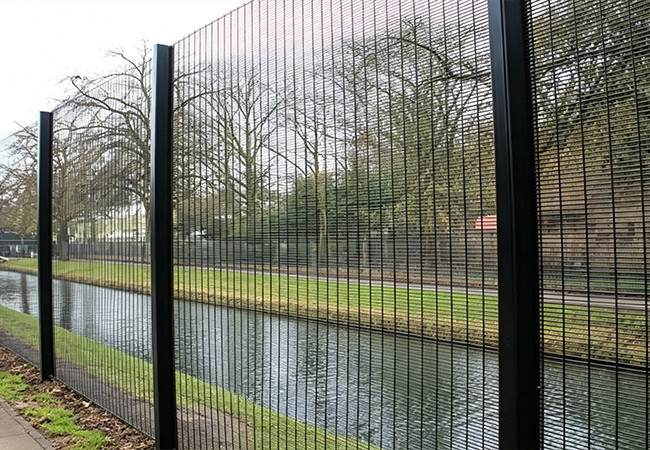
Main Components
A typical 358 fence system may include:
- Dense welded mesh panels
- Supporting steel posts
- Specified security clips, brackets or fasteners
- Post caps and mounting accessories
- Compatible pedestrian and vehicle gates
- Galvanized or other specified protective finishes
- Optional supplementary security equipment, where required and permitted
The performance of the complete system depends on the panels, posts, connections, foundations, gates and installation quality. The mesh pattern alone does not establish a particular security rating.
2. Key Specifications for North American Projects
Bendin can discuss customized configurations according to product design, manufacturing capabilities and project requirements.
| Parameter | Typical Specification |
|---|---|
| Product Type | 358 Anti-Climb Welded Mesh Fence |
| Horizontal Wire Spacing | Approximately 76.2 mm |
| Vertical Wire Spacing | Approximately 12.7 mm |
| Common Wire Diameter | Approximately 4.0 mm |
| Other Wire Options | Product-specific |
| Panel Height | Customized according to project requirements |
| Panel Width | Customized according to the approved layout |
| Mesh Structure | Dense rectangular welded mesh |
| Post Type | Square / Rectangular / Other Compatible Profiles |
| Fixing System | Compatible Clips / Brackets / Specified Fasteners |
| Surface Treatment | Galvanized / Galvanized Plus Powder Coated / Other Available Finishes |
| Color | Selected RAL reference, where available |
| Gates | Compatible Pedestrian and Vehicle Gates |
| Customization | Panel Dimensions / Wire Diameter / Posts / Finish / Accessories |
These are indicative specifications, not a guarantee that every combination is available. Actual wire diameter, panel height, panel width, post dimensions, coating requirements and tolerances should be confirmed before ordering.
Mesh Opening and Wire Diameter
The narrow rectangular mesh is a defining feature of 358 fencing. It makes climbing more difficult while preserving visibility through the fence.
Wire diameter influences panel weight, rigidity and mechanical performance. It should be evaluated together with steel properties, weld quality, panel dimensions and supporting components.
Panel Dimensions and Post Configuration
Panel dimensions should be selected according to the site layout, required security function, post spacing, ground conditions and installation method.
Higher panels may require different post sections, fixing arrangements and foundations. The correct configuration should be confirmed in the approved project drawings.
3. Steel Materials and Manufacturing Quality
Material consistency and manufacturing quality are important when selecting a security fence for a commercial or infrastructure project.
Steel Material Options
Depending on the selected product, the fence may use specified low-carbon steel wire and compatible structural steel posts.
For projects requiring a particular steel grade, material documentation should be confirmed before production.
Stainless steel, including selected 304-grade applications, should not be assumed to be part of every standard 358 product. Its suitability and availability must be confirmed for the actual design.
Welded Mesh Quality
The mesh should be inspected against the agreed product specification.
Relevant checks may include:
- Wire diameter
- Horizontal and vertical wire spacing
- Panel dimensions
- Weld appearance and integrity
- Panel alignment
- Post and fixing compatibility
A visually consistent weld does not by itself establish a specific impact rating or security certification.
Fabrication and Finishing
Cutting, welding and other fabrication operations should be coordinated with the selected corrosion-protection process.
Where the coating is applied before fabrication, the treatment of affected areas should be confirmed. Where galvanizing is performed after fabrication, the applicable coating specification should be identified.
4. Corrosion Protection for Different North American Climates
North American projects may be exposed to coastal salt, humidity, winter precipitation, road salts, industrial pollutants or significant temperature changes.
The correct surface treatment depends on the product design and actual operating environment.
Galvanized Steel
Galvanizing provides a zinc coating that helps protect steel against corrosion.
When evaluating galvanized fencing, confirm the specified coating requirements and whether galvanizing is performed before or after fabrication.
Galvanizing Plus Powder Coating
A compatible galvanized substrate combined with powder coating may be suitable where both corrosion protection and appearance are important.
The actual coating system, surface preparation and manufacturing sequence should be confirmed for the selected product.
Climate-Based Selection Considerations
| Project Environment | Main Considerations |
|---|---|
| Coastal Facilities | Airborne salt and increased corrosion risk |
| Northern US and Canadian Locations | Moisture, freezing conditions, de-icing salts and maintenance access |
| Industrial Sites | Humidity, pollutants and possible chemical exposure |
| Dry Inland Locations | UV exposure, temperature variation and routine maintenance |
| Commercial Properties | Coating appearance, color consistency and repair requirements |
No surface treatment should be assumed suitable for every climate. Where corrosion performance is critical, request the relevant coating specification and supporting test documentation.
Salt-spray test hours should not be directly converted into a guaranteed number of outdoor service years.
5. Customization for North American Projects
Different sites require different panel dimensions, mounting arrangements and access solutions.
Depending on the selected product and manufacturing capabilities, Bendin can discuss customization of the following elements.
Panel Height and Width
Panel dimensions should match the boundary layout, required fence height, ground conditions and transportation requirements.
Customized panel dimensions may be needed around corners, gates or irregular site boundaries.
Post Profiles and Mounting
Post profiles and dimensions should be selected according to the fence design, expected loads and installation conditions.
Possible mounting arrangements depend on the approved design and may include suitable embedded posts or base-plate systems.
For projects involving existing concrete slabs or elevated structures, the supporting structure and anchoring arrangement must be checked before installation.
Surface Finish and Color
Color selection can be coordinated with site requirements and surrounding structures.
If a specific RAL reference is required, confirm its availability and finish before production.
Gates and Accessories
A complete order may include compatible pedestrian gates, vehicle gates, hinges, latches, fixing hardware and other specified accessories.
Gate openings, post locations and access-control requirements should be included in the layout before the panel schedule is finalized.
6. Applications of 358 Security Fencing
Industrial and Logistics Facilities
358 fencing may be considered for selected warehouses, logistics centers, storage yards and industrial compounds requiring enhanced resistance to climbing.
The complete system should be specified according to the facility’s security assessment and operational requirements.
Power and Utility Sites
Utility facilities may require perimeter fencing that defines restricted-access areas and supports site security procedures.
The selected fence, posts, gates and supplementary equipment should match the project’s technical requirements.
Airports and Transport Facilities
Some airport and transport projects specify dense anti-climb mesh fencing.
The actual configuration must meet the requirements established for the particular facility. A standard 358 product should not automatically be described as compliant with every aviation or transport security standard.
Commercial and Institutional Properties
Some commercial campuses, public institutions and other restricted-access properties may use 358 fencing where dense mesh and visibility are important.
The design should reflect the intended security function, appearance requirements and applicable local rules.
7. Compliance and Documentation for US and Canadian Buyers
Compliance requirements depend on the project, product function and applicable jurisdiction.
Before placing an order, buyers should identify the actual standards, specifications and documents required for the installation.
Product Documentation
Depending on the project, the procurement package may include:
- Approved product drawings
- Material specifications
- Wire diameter and mesh dimension records
- Surface-treatment information
- Inspection records
- Relevant test reports
- Installation instructions
- Applicable conformity documents
- Warranty terms
Standards and Certification
A general statement that a product meets all North American standards is insufficient without identifying the specific requirements and supporting evidence.
If a project specifies an ASTM standard, building requirement or security performance test, confirm that it applies to the selected product and intended use.
ISO 9001 relates to quality management systems; it does not automatically certify every product manufactured by a company.
Likewise, CE marking relates to applicable European legislation and should not be presented as a general North American product certification.
Project-Specific Requirements
US and Canadian projects may have different requirements depending on the facility, state or province, building conditions and intended use.
The buyer and project team should confirm the applicable requirements before the final specification is approved.
8. Installation Planning for 358 Fence Systems
Proper installation helps maintain panel alignment and the intended performance of the fence.
Step 1: Review the Site Layout
Identify boundary dimensions, corners, gate locations, terrain changes, existing structures and underground utilities.
Step 2: Confirm the Product Specification
Verify mesh dimensions, wire diameter, panel height, post sections, fixing components and surface treatment against the approved drawings.
Step 3: Prepare Foundations
Foundation dimensions and post installation methods should be determined according to the approved design, soil conditions, fence height and expected loads.
Do not use a universal post embedment depth or footing dimension for every project.
Step 4: Install and Align Posts
Position posts according to the layout and verify spacing and vertical alignment.
For concrete foundations, follow the specified curing requirements before installing panels or applying loads.
Step 5: Attach Panels
Install the panels using the specified clips, brackets or fasteners.
Check alignment and avoid damaging the protective coating during assembly.
Step 6: Install Gates and Accessories
Fit compatible gates, locks, hinges and other specified accessories.
Step 7: Complete the Final Inspection
Check panel alignment, post stability, connection security, coating condition, ground-level gaps and gate operation.
The installation should follow the manufacturer’s instructions and applicable project requirements.
9. Illustrative Project Example: North American Industrial Compound
A restricted-access industrial compound in North America requires a dense mesh perimeter fence, compatible steel posts and controlled pedestrian and vehicle entrances.
The project team evaluates a 358 mesh configuration with a specified corrosion-protection system.
Preliminary Configuration
| Item | Example Requirement |
|---|---|
| Application | Restricted-Access Industrial Compound |
| Fence Type | 358 Anti-Climb Mesh |
| Mesh Opening | Approximately 76.2 × 12.7 mm |
| Wire Diameter | Approximately 4.0 mm, subject to confirmation |
| Panel Height | Determined by the approved project design |
| Panel Width | According to the site layout |
| Posts | Compatible Steel Posts |
| Surface Treatment | Specified Galvanized or Coated Finish |
| Fixing System | Compatible Specified Fasteners |
| Gates | Controlled Pedestrian and Vehicle Access |
| Inspection | Dimensions, Welds, Posts, Fixings, Coating and Gate Operation |
| Documentation | Project-Specified Drawings, Inspection Records and Applicable Reports |
The final panel dimensions, post sections, foundations, gate arrangement, coating requirements and documentation should be confirmed against the approved project specification.
This is an illustrative project scenario, not a completed Bendin customer installation.
10. How to Evaluate a 358 Fence Manufacturer
When comparing suppliers, evaluate the actual product specification and supporting documentation rather than relying only on marketing claims.
Material and Dimensions
Confirm the mesh opening, wire diameter, panel dimensions, post profiles and fixing arrangement.
Manufacturing Capability
Verify that the supplier can produce the required panel dimensions, surface finishes and compatible accessories.
Quality Documentation
Agree on the inspection scope and acceptance criteria. Request relevant test reports where the project requires specific performance evidence.
Corrosion Protection
Confirm the coating specification and its suitability for the intended environment.
Customization
Check whether the supplier can provide the required posts, gates, colors, mounting arrangements and packaging.
Export and Delivery
Confirm product identification, packaging, shipment quantities, delivery terms and required export documentation.
Warranty Terms
Request the actual warranty document and clarify the products covered, exclusions and maintenance conditions.
For customized projects, approve the final technical drawings and bill of materials before production begins.
11. Bendin 358 Security Fence Solutions
Bendin supplies customizable 358 security fencing and compatible metal fencing components for international distributors, contractors and infrastructure project buyers.
Depending on product design and manufacturing capabilities, customization may include:
- Mesh opening and wire diameter
- Panel height and width
- Compatible post profiles
- Fixing clips and brackets
- Galvanized and powder-coated finishes
- Color selection
- Gate dimensions and accessories
- Packaging and OEM requirements
Customers can provide site drawings, boundary measurements, reference photographs and technical specifications for review before ordering.
For US and Canadian projects, identify the applicable product requirements, environmental conditions and required documents at the quotation stage. This helps align the proposed configuration with the intended installation.
12. Frequently Asked Questions
What is the standard mesh size of a 358 fence?
The traditional 358 configuration uses approximately 76.2 × 12.7 mm mesh openings. The actual orientation and tolerances should be confirmed in the product drawing.
Is 358 fencing suitable for US and Canadian projects?
It may be suitable for selected industrial, commercial and restricted-access applications. The final configuration must meet the project’s requirements and applicable local rules.
Does Bendin provide customized 358 fence panels?
Customization can be discussed according to product design and manufacturing capabilities. Confirm panel dimensions, wire diameter, posts, surface treatment and accessories before ordering.
Which surface treatment is suitable for cold or coastal regions?
The appropriate finish depends on the actual environment, base material, coating specification and maintenance requirements. Coastal salt and de-icing salts may require particular attention.
Does ISO 9001 certify the 358 fence itself?
No. ISO 9001 relates to a quality management system. Product performance and compliance require the relevant product specifications, tests or other applicable documentation.
Can 358 fencing include gates and additional security equipment?
Compatible gates and selected supplementary equipment can be discussed according to the product design and project requirements. Their suitability must be assessed for the intended installation.
13. Request a 358 Security Fence Quotation
358 security fencing combines dense welded mesh openings with compatible posts and fixing systems to make unauthorized climbing and cutting more difficult.
The correct configuration depends on mesh dimensions, wire diameter, panel size, post arrangement, surface treatment, gates and installation conditions.
Bendin (Hebei Bendin Industrial Technology Co., Ltd.) welcomes inquiries from US and Canadian distributors, contractors and infrastructure project buyers.
For a quotation, provide:
- Project location and application
- Required fence height and total boundary length
- Mesh opening and wire diameter
- Panel width and post type
- Surface treatment and color
- Gate requirements
- Applicable project specifications
- Required documentation
- Quantity and delivery destination
Bendin can review your requirements and discuss a suitable 358 security fence configuration for your North American project.